Setting Up Your First Liquidity Position: Complete Uniswap V3 Guide 2025
Learn how to provide liquidity on Uniswap V3 and earn trading fees. Complete beginner's guide covering pool selection, price ranges, impermanent loss, and position management.
Setting Up Your First Liquidity Position: Complete Uniswap V3 Guide 2025
Want to earn fees by providing liquidity on Uniswap? You're about to learn everything you need to know.
Liquidity providing (LP) can earn you 20-100%+ APR on your crypto—but it comes with risks like impermanent loss that can wipe out your profits if you don't understand them.
This guide will walk you through setting up your first liquidity position safely, choosing the right pool, setting optimal price ranges, and managing your position for maximum returns.
By the end, you'll be confidently earning fees as a liquidity provider.
What You'll Learn
✅ What liquidity providing is and how you earn fees
✅ Uniswap V2 vs V3 (which to choose)
✅ How to select profitable pools
✅ Setting optimal price ranges
✅ Understanding impermanent loss
✅ Managing and rebalancing your position
✅ Tax implications and record keeping
Time needed: 1 hour for first position
Recommended capital: $500-5,000 (start smaller)
Difficulty: Intermediate (requires understanding IL)
Prerequisites
Before providing liquidity, make sure you have:
1. Understand DeFi Basics
Must know:
- How DEXs work
- How to use MetaMask
- How to make swaps
- Gas fees and networks
Don't know these yet? Read our Getting Started with DeFi guide first.
2. Understand Impermanent Loss
CRITICAL: Read about Impermanent Loss before providing liquidity.
Quick summary:
- IL = Loss compared to just holding tokens
- Happens when price ratios change
- Can negate all trading fee earnings
- More volatile pairs = higher IL risk
Use our IL Calculator to understand potential losses.
3. Have the Required Crypto
You need:
- Both tokens in the trading pair (50/50 split by value)
- Gas fees for transactions ($10-50 on Ethereum, $2-5 on L2s)
- Buffer capital (keep 10-20% extra for rebalancing)
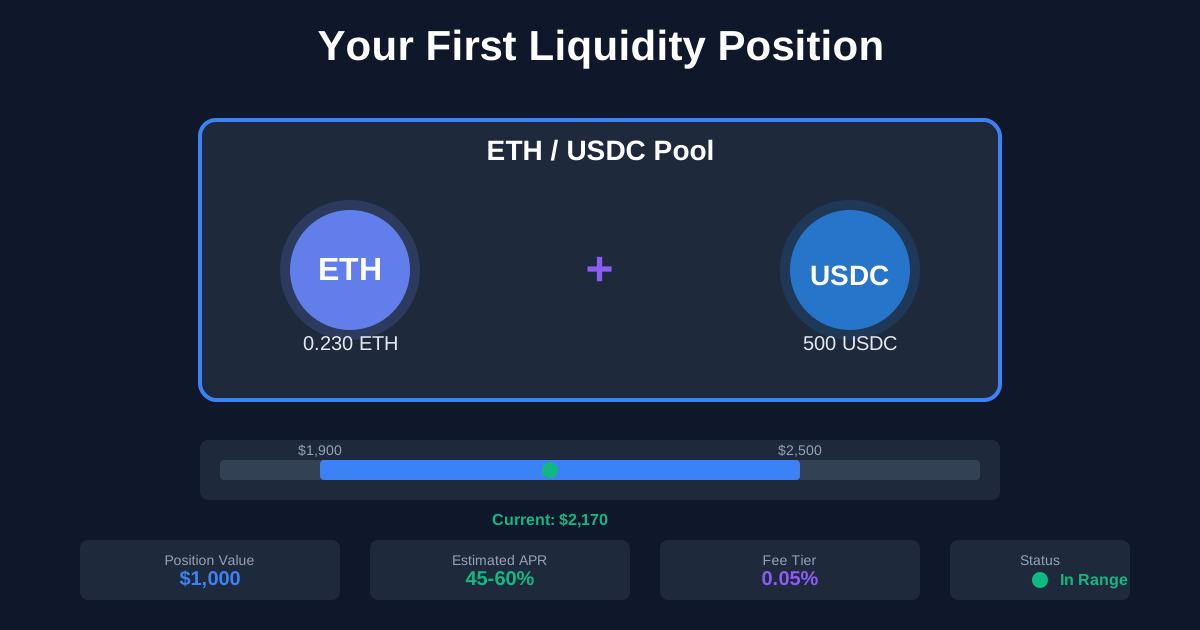
Example for ETH/USDC pool:
- $500 USDC
- $500 worth of ETH (~0.23 ETH)
- $20 for gas
- Total needed: ~$1,020
Step 1: Understanding Liquidity Providing (5-Min Primer)
How Liquidity Pools Work
Traditional Exchange (Coinbase):
- Order book with buyers and sellers
- You place order, wait for match
- Market makers provide liquidity
Uniswap (AMM - Automated Market Maker):
- Liquidity pools replace order books
- Anyone can become the "market maker"
- Smart contracts automatically make trades
- You earn fees from every trade
How You Earn Money
As a liquidity provider, you earn:
1. Trading Fees
- Users pay 0.05-1% per swap (varies by pool)
- Fees distributed to all LPs proportionally
- You earn even while sleeping
2. Potential Token Rewards
- Some pools offer extra incentives
- Protocol tokens, governance rewards
- Not available on all pools
Example Earnings
ETH/USDC 0.05% Pool:
- Your position: $10,000 (0.5% of pool)
- Daily volume: $50M
- Daily fees: $50M × 0.05% = $25,000
- Your share: $25,000 × 0.5% = $125/day
- Annual: ~$45,625 (456% APR) 😱
Too good to be true? Actually no—but impermanent loss will reduce this significantly. More on that later.
Step 2: Uniswap V2 vs V3 (Which to Choose?)
Uniswap has two versions. Here's the difference:
Uniswap V2 (Original)
How it works:
- Your liquidity covers ALL price ranges
- Simpler to understand
- "Set and forget" approach
- Lower capital efficiency
Pros:
- ✅ Easier for beginners
- ✅ No active management needed
- ✅ Liquidity never "out of range"
Cons:
- ❌ Lower fee earnings
- ❌ Capital spread thin
- ❌ Less efficient
Best for:
- Complete beginners
- Long-term passive positions
- Volatile, unpredictable pairs
Uniswap V3 (Current)
How it works:
- You choose specific price range
- Liquidity concentrated = higher fees
- Requires active management
- Can go "out of range"
Pros:
- ✅ 10-100x higher fees than V2
- ✅ Capital efficient
- ✅ Flexible strategies
Cons:
- ❌ More complex
- ❌ Need to manage actively
- ❌ Can miss fees if out of range
- ❌ Higher IL risk
Best for:
- Experienced LPs
- Active management
- Stablecoin pairs
- Correlated assets
Our Recommendation:
Start with V3 (but on a stable pair like USDC/USDT or ETH/WETH).
Why? Higher returns justify learning curve. Plus, this guide focuses on V3.
Step 3: Choosing Your First Pool
Not all pools are created equal. Here's how to pick.
Best Pools for Beginners
Tier 1: Lowest Risk (Start Here)
1. Stablecoin Pairs
- USDC/USDT
- USDC/DAI
- USDT/DAI
Characteristics:
- Minimal impermanent loss (prices stay close)
- Lower APRs (10-30%)
- Great for learning
- Easy to manage
2. Correlated Asset Pairs
- ETH/WETH
- stETH/ETH
- wBTC/BTC
Characteristics:
- Low IL (prices move together)
- Medium APRs (20-50%)
- Relatively stable
Tier 2: Medium Risk
3. Major Token Pairs
- ETH/USDC
- ETH/USDT
- BTC/USDC
Characteristics:
- Moderate IL risk
- Higher APRs (30-100%)
- Need active monitoring
- Most volume
Tier 3: High Risk (Avoid as Beginner)
4. Volatile Altcoin Pairs
- SHIB/ETH
- DOGE/USDC
- New token launches
Characteristics:
- High IL risk (can lose 50%+)
- Very high APRs (100-1000%+)
- Need constant monitoring
- Often lose money despite high APRs
Pool Selection Checklist
Use this when evaluating pools:
Volume & Liquidity:
□ 24h volume > $1M (good liquidity)
□ TVL (Total Value Locked) > $10M (established)
□ Volume/TVL ratio > 0.1 (active trading)
Fee Tier:
□ 0.01% - Stablecoin pairs only
□ 0.05% - Low volatility (ETH/WETH, ETH/USDC)
□ 0.3% - Medium volatility (most pairs)
□ 1% - High volatility (risky alts)
Risk Assessment:
□ Both tokens you understand
□ IL calculator shows acceptable loss
□ Can afford to lose 20-30%
□ Have time to manage position
Where to Research Pools
Best Analytics Tools:
1. Uniswap Info
- URL: info.uniswap.org
- See all pools, volumes, fees
- Filter by network
2. APY Vision
- Tracks LP performance
- Shows impermanent loss history
- Compares actual returns
3. DeFi Llama
- Cross-DEX comparison
- Pool rankings
- Historical data
4. Our Token Price Calculator
- Compare token prices
- Check price stability
- Assess volatility
Step 4: Calculating Your Position Size
Before adding liquidity, calculate your investment.
Position Size Formula
50/50 Split by Value:
If you want $1,000 position in ETH/USDC:
- Token A (ETH): $500 worth
- Token B (USDC): $500
- Gas fees: $10-20
- Total needed: $510-520
Example Calculation:
ETH price: $2,170
- ETH needed: $500 ÷ $2,170 = 0.230 ETH
- USDC needed: $500
- Total: 0.230 ETH + 500 USDC
Recommended Position Sizes
First time:
- Minimum: $200-500
- Recommended: $500-1,000
- Maximum: $2,000
Why start small?
- Learn without big risk
- Test the process
- Understand IL in practice
- Scale up after success
After 3+ months experience:
- Can increase to $5K-50K+
- Diversify across multiple pools
- Try different strategies
Capital Allocation Strategy
Conservative (Recommended for beginners):
- 50% stablecoin pairs (USDC/USDT)
- 30% correlated pairs (ETH/stETH)
- 20% major pairs (ETH/USDC)
- 0% volatile alts
Balanced:
- 30% stablecoin pairs
- 30% correlated pairs
- 30% major pairs
- 10% selective alts
Aggressive (Experienced only):
- 20% stablecoin pairs
- 20% major pairs
- 40% volatile pairs
- 20% new opportunities
Step 5: Setting Up Position on Uniswap V3
Now the hands-on part. Let's add liquidity.
Complete Step-by-Step Tutorial
Example: Adding liquidity to ETH/USDC 0.05% pool on Arbitrum
Step 1: Go to Uniswap
- Visit app.uniswap.org
- Connect MetaMask
- Switch to desired network (Arbitrum for this example)
Step 2: Navigate to Pools
- Click "Pool" in top menu
- You'll see "Positions" page
- Click "New Position"
Step 3: Select Token Pair
- Click first token selector
- Search "ETH" → Select
- Click second token selector
- Search "USDC" → Select
Order doesn't matter (ETH/USDC = USDC/ETH)
Step 4: Choose Fee Tier
You'll see options:
- 0.01% (best for stable pairs)
- 0.05% (select this for ETH/USDC)
- 0.30% (general pairs)
- 1.00% (exotic pairs)
Each shows:
- Select based on pair volatility
- TVL: Total liquidity
- 24h volume
Click 0.05% for ETH/USDC.
Step 5: Set Price Range (Most Important!)
You'll see chart with current price and range selectors.
Current Price: ~$2,170 (ETH/USDC)
Setting Range (Conservative):
- Min Price: $1,900 (13% below)
- Max Price: $2,500 (15% above)
- Range: $600 (~28% total range)
Setting Range (Aggressive):
- Min Price: $2,000 (8% below)
- Max Price: $2,350 (8% above)
- Range: $350 (~16% total range)
How to decide?
Wider Range (Conservative):
- ✅ Stays in range longer
- ✅ Less management needed
- ❌ Lower fee earnings
- ❌ More capital needed
Narrower Range (Aggressive):
- ✅ Higher fee earnings (2-10x)
- ✅ More capital efficient
- ❌ Goes out of range faster
- ❌ Needs constant monitoring
For first position: Use conservative range (20-30% total).
Use range selectors:
- Drag blue bars on chart
- Or type exact prices
- Green area = your range
- Current price shown as vertical line
Step 6: Enter Deposit Amounts
Two ways to enter amounts:
Option A: Enter one token amount
- Type "500" in USDC field
- ETH amount auto-calculates (~0.23 ETH)
- Interface shows you need both
Option B: Enter both token amounts
- Type "0.23" ETH
- Type "500" USDC
- Interface validates ratio
Important: Ratio must match current price. Uniswap calculates this automatically.
You'll see summary:
Deposit Amounts:
━━━━━━━━━━━━━━━━━━━━━
ETH: 0.230 (~$500)
USDC: 500.00
Total: ~$1,000

Selected Range:
━━━━━━━━━━━━━━━━━━━━━
Min: $1,900
Max: $2,500
Current: $2,170

Estimated APR: 45%
Step 7: Approve Tokens
First time only: Need to approve each token.
- Click "Approve ETH"
- MetaMask opens
- Review gas fee (~$1-2 on Arbitrum)
- Click "Confirm"
- Wait for confirmation (~30 seconds)
- Repeat for USDC
Subsequent times: Skip this (approval persists).
Step 8: Preview & Add Liquidity
-
Click "Preview"
-
Review all details:
- Token amounts
- Price range
- Current price
- Estimated fees
- Gas cost
-
Click "Add"
-
MetaMask opens with transaction:
Uniswap V3: Add Liquidity

ETH: 0.230
USDC: 500.00

Gas fee: $1.87
Total cost: $1.87
-
Click "Confirm"
-
Wait for transaction (30-60 seconds)
Transaction confirmed! 🎉
Step 9: Verify Position
- Returns to "Positions" page
- See your new position listed:
ETH/USDC 0.05%
━━━━━━━━━━━━━━━━━━━━━━━━
Liquidity: $1,000.00
Range: $1,900 - $2,500
In Range: ✅ Yes
Unclaimed Fees: $0.00
- Click position to see details:
- Current value
- Fees earned
- Price range status
- Token amounts
✅ You're now a liquidity provider!
Step 6: Understanding Your Position
After adding liquidity, here's what to monitor.
Your Position Dashboard
Key Metrics:
1. Liquidity Value
- Current USD value of position
- Changes with token prices
- Compare to initial investment
2. In Range Status
- ✅ Green: Earning fees
- ⚠️ Yellow: Near edge of range
- ❌ Red: Out of range (not earning)
3. Unclaimed Fees
- Fees earned but not collected
- Accumulate over time
- Claim whenever you want
4. Current Price vs Range
- See where price is in your range
- Closer to edge = higher IL
- Middle of range = balanced
5. Token Ratio
- How much ETH vs USDC you have now
- Changes as price moves
- Differs from 50/50 as price shifts
What Each Status Means
In Range (Green ✅):
- You're earning fees on trades
- Everything working as planned
- Monitor but don't panic
Near Edge (Yellow ⚠️):
- Price approaching your range limit
- Consider rebalancing soon
- Watch more closely
- Still earning fees
Out of Range (Red ❌):
- Price outside your range
- NOT earning any fees
- Position is 100% in one token
- Must rebalance to earn again
Position Value Breakdown
Example position after 1 week:
Initial Investment:
━━━━━━━━━━━━━━━━━━━━━━━
0.230 ETH ($500)
500 USDC ($500)
Total: $1,000

Current Value (ETH up 5%):
━━━━━━━━━━━━━━━━━━━━━━━
0.225 ETH ($512.25)
492 USDC ($492)
Total: $1,004.25

Fees Earned:
━━━━━━━━━━━━━━━━━━━━━━━
ETH: 0.003 ($6.83)
USDC: $6.50
Total Fees: $13.33

Performance:
━━━━━━━━━━━━━━━━━━━━━━━
LP Position: $1,004.25 + $13.33 = $1,017.58
If Just Held: $525 + $500 = $1,025
Impermanent Loss: $7.42 (0.74%)
Net Gain: $13.33 - $7.42 = $5.91
ROI: 0.59% in 1 week (~30% APR)
Key takeaway: Fees $13.33, but IL reduced gains by $7.42. Still profitable!
Step 7: Managing Your Position
LP positions need active management. Here's how.
Daily Monitoring (5 Minutes)
Every day, check:
1. In Range Status
- Still earning fees?
- How close to edge?
2. Unclaimed Fees
- How much earned today?
- Enough to claim? (>$20 worth to justify gas)
3. Price Movement
- Where's price in your range?
- Trending toward edge?
4. IL Status
- Use our IL Calculator
- Enter current vs initial prices
- Calculate IL percentage
5. APR Performance
- Calculate current APR: (Daily Fees × 365) / Position Size
- Compare to initial estimates
- Adjust strategy if underperforming
Weekly Actions (30 Minutes)
Every week:
1. Collect Fees (if > $20)
Steps:
- Go to your position
- Click "Collect fees"
- Choose: Keep as is OR Convert to one token
- Approve transaction
- Fees added to wallet
Gas costs $1-5, so only collect when worthwhile.
2. Rebalance Decision
Ask yourself:
- Is position still in range?
- Are fees meeting expectations?
- Has IL exceeded 5%?
- Should I adjust range?
3. Record Keeping
Track in spreadsheet:
- Date
- Position value
- Fees collected
- IL percentage
- Current APR
- Actions taken
When to Rebalance
Rebalance if:
✅ Out of range (not earning)
✅ Near edge and trending further
✅ IL > 10% (eating too much profit)
✅ Better opportunity in different pool
✅ APR dropped significantly
How to rebalance:
Option 1: Remove & Re-add (Simple)
- Remove liquidity entirely
- You receive both tokens back
- Add liquidity with new range
- Costs: 2 transactions worth of gas
Option 2: Partial Rebalance
- Remove portion (e.g., 50%)
- Rebalance that portion
- Keep other portion active
- More complex but flexible
Option 3: Add New Position
- Keep existing position
- Add second position with different range
- Diversify ranges
- More capital required
Emergency Actions
When to exit immediately:
🚨 Token is crashing (>30% drop incoming)
🚨 Pool exploit/hack news
🚨 Smart contract vulnerability announced
🚨 Rug pull suspected
🚨 IL exceeds 50% with no recovery
How to exit fast:
- Go to position
- Click "Remove Liquidity"
- Select 100%
- Important: Check "Collect as WETH/USDC" or choose which token
- Click "Remove"
- Approve transaction
- Tokens returned to wallet
You'll receive:
- Your tokens (adjusted for IL)
- All unclaimed fees
- In wallet in 30-60 seconds
Step 8: Claiming and Compounding Fees
Maximize returns by managing fees effectively.
When to Claim Fees
Factors to consider:
Gas Costs:
- Ethereum mainnet: $10-30 per claim
- Arbitrum/Optimism: $1-3
- Polygon: $0.10-0.50
Fee Amount:
- Claim only if fees > 10x gas cost
- Ethereum: Claim when > $100-300
- L2s: Claim when > $10-30
Compounding Strategy:
- Claim weekly/monthly
- Re-add to position to compound
- Increases position size → more fees
How to Compound
Manual Compounding (Best Returns):
-
Claim fees:
- Go to position
- Click "Collect fees"
- Receive to wallet
-
Rebalance if needed:
- Check if still in range
- Adjust range if necessary
-
Add fees back to position:
- Click "Increase Liquidity"
- Add claimed fees
- Same position, larger size
Automatic Compounding (Advanced):
Use protocols that auto-compound:
- Gamma Strategies
- Arrakis Finance
- Visor Finance
They:
- Auto-collect fees
- Auto-rebalance
- Auto-compound
- Charge 10-20% performance fee
Worth it? For large positions ($10K+) or passive investors.
Fee Claiming Strategy
Aggressive (Active Manager):
- Claim daily/weekly
- Compound immediately
- Maximize APR
- Higher gas costs
- Best for: Large positions, L2 networks
Conservative (Passive):
- Claim monthly
- Let fees accumulate
- Minimize gas costs
- Best for: Ethereum mainnet, smaller positions
Our Recommendation:
- L2 networks: Weekly claims + compound
- Ethereum mainnet: Monthly claims
- Position size < $1K: Monthly
- Position size > $10K: Weekly
Step 9: Understanding Your Returns
Calculate true performance including all factors.
Complete ROI Formula
True ROI = (Fees Earned - Gas Costs - Impermanent Loss) / Initial Investment

APR = (True ROI / Days Active) × 365
Real Example (30 Days)
Starting Position:
- 0.230 ETH @ $2,170 = $500
- 500 USDC = $500
- Total: $1,000
After 30 Days:
Fees Earned:
- ETH: 0.015 ($32.55)
- USDC: $31.00
- Total Fees: $63.55
Gas Costs:
- Initial deposit: $2
- Fee collection (3x): $6
- Total Gas: $8
Impermanent Loss:
- ETH now $2,280 (up 5%)
- Current position value: $1,014
- If just held: $1,025
- IL: $11 (1.1%)
Final Calculation:
True ROI = ($63.55 - $8 - $11) / $1,000
        = $44.55 / $1,000
        = 4.455%

APR = (4.455% / 30) × 365
    = 54.24% APR
Conclusion: Made $44.55 in 30 days (54% APR)—good returns!
Tracking Performance
Use spreadsheet with these columns:
| Date | Position Value | Fees Earned | IL % | Gas Costs | Net Gain | APR | |------|---------------|-------------|------|-----------|----------|-----| | Day 1 | $1,000 | $0 | 0% | $2 | -$2 | - | | Day 7 | $1,004 | $13 | 0.7% | $2 | $3.50 | 18% | | Day 30 | $1,014 | $64 | 1.1% | $8 | $44.55 | 54% |
Tools to help:
- APY Vision - Auto-tracks LP positions
- DeFi Llama - Portfolio tracking
- Our IL Calculator - Calculate IL manually
- DeBank - Overall portfolio view
Common Mistakes & How to Avoid Them
Mistake 1: Ignoring Impermanent Loss
The Error: "I'm earning 100% APR in fees! Amazing!"
→ Price moves 30%
→ IL is 50%
→ Actually lost money despite high APR
The Fix:
- Always calculate IL alongside fees
- Use our IL Calculator
- Only provide liquidity if: Fees > IL
- Accept that IL is part of LP life
Mistake 2: Setting Range Too Narrow
The Error: Sets $2,150-$2,200 range (2.3% total) on ETH/USDC.
→ ETH moves to $2,210 next day
→ Out of range, earning nothing
→ Constant rebalancing needed
→ Gas costs eat all profits
The Fix:
- Start with wider ranges (20-30%)
- Narrow down as you gain experience
- Factor in asset volatility
- Conservative > aggressive when learning
Mistake 3: Not Monitoring Position
The Error: Adds liquidity, forgets about it for 2 months.
→ Price moved out of range after 1 week
→ Earned fees for only 7 days
→ Missed 7 weeks of potential earnings
The Fix:
- Check position daily (5 minutes)
- Set price alerts
- Rebalance when needed
- LPs require active management
Mistake 4: Gas Fee Negligence
The Error: On Ethereum mainnet:
- Adds liquidity: $30 gas
- Collects fees weekly (4x): $120
- Removes liquidity: $35
- Total gas: $185 on $1,000 position
→ Gas costs ate 18.5% of capital!
The Fix:
- Use L2 networks (Arbitrum, Optimism, Base)
- Collect fees less frequently
- Batch transactions
- Consider gas costs in ROI calculations
Mistake 5: Providing Liquidity to Sketchy Pools
The Error: "CrazyNewToken/ETH has 5000% APR!"
→ Adds liquidity
→ Token rug pulls next day
→ Loses everything
The Fix:
- Stick to established pairs
- Major tokens only for first 6 months
- Check token contract audits
- High APR = High risk (always)
Mistake 6: Wrong Fee Tier Selection
The Error: Chooses 1% fee tier for ETH/USDC.
→ Almost no volume (everyone uses 0.05% tier)
→ Earns barely any fees
→ Wasted capital
The Fix:
- Check which fee tier has most volume
- Usually:
- 0.01% = Stablecoins
- 0.05% = Blue chips (ETH, BTC)
- 0.30% = Most alts
- 1.00% = Very volatile pairs
- Follow where the volume is
Mistake 7: Not Collecting Fees
The Error: Never collects fees, they accumulate in position.
→ $500 unclaimed fees
→ Position gets hacked (rare but possible)
→ Loses unclaimed fees too
The Fix:
- Collect fees regularly
- Monthly minimum
- Unclaimed fees are still at risk
- Compound or withdraw to secure them
Advanced Strategies (After 3+ Months)
Once comfortable with basics, try these:
Strategy 1: Multi-Range Positions
Concept: Add liquidity at multiple ranges.
Example (ETH/USDC):
- 50% capital: Wide range ($1,800-$2,600)
- 30% capital: Medium range ($2,000-$2,400)
- 20% capital: Tight range ($2,100-$2,300)
Result:
- Always earning fees (wide range)
- Higher fees when in medium range
- Maximum fees when in tight range
- Balanced approach
Strategy 2: Asymmetric Ranges
Concept: Set range based on price direction bias.
Bullish on ETH:
- Range: $2,100-$2,800 (heavier on upside)
- Earn more if price goes up
- Less IL if prediction correct
Bearish on ETH:
- Range: $1,700-$2,200 (heavier on downside)
- Positioned for price drop
- Protected from IL on downside
Strategy 3: Stable Pair Farming
Concept: Only provide to stablecoin pairs.
Benefits:
- Minimal IL (typically <0.5%)
- Predictable returns
- Safer for large capital
- Lower APR but more consistent
Best pairs:
- USDC/USDT (0.01% tier)
- USDC/DAI
- USDT/DAI
Returns: 10-30% APR with very low risk
Strategy 4: Correlated Asset Farming
Concept: Pairs that move together.
Examples:
- stETH/ETH (liquid staking)
- wBTC/BTC
- ETH/wrapped ETH variants
Benefits:
- Low IL (prices move in tandem)
- Medium returns (30-60% APR)
- Less monitoring needed
Strategy 5: Active Range Management
Concept: Frequently rebalance for optimal range.
Requirements:
- Daily monitoring
- Quick rebalancing
- Understanding technical analysis
- Higher gas budget
Process:
- Analyze price trends
- Predict short-term movement
- Set tight range around prediction
- Rebalance if wrong
- Repeat
Results:
- Can achieve 100-300% APR
- Much more work
- Only worth it for $10K+ positions
Tax Implications (Important!)
Providing liquidity has tax consequences. Consult tax professional.
Taxable Events
In most jurisdictions:
✅ Taxable:
- Collecting fees (income)
- Removing liquidity if token values changed (capital gain/loss)
- Swapping tokens to provide liquidity
- Impermanent loss realized when removing
❌ Not taxable:
- Adding liquidity (just moving assets)
- Fees accruing but not collected
- Position value changes (unrealized)
Record Keeping Requirements
Track in spreadsheet:
| Date | Action | Token1 Amount | Token2 Amount | USD Value | Tx Hash | Notes | |------|--------|--------------|--------------|-----------|---------|-------| | 1/1 | Add LP | 0.23 ETH | 500 USDC | $1,000 | 0x123... | Initial | | 1/7 | Collect | 0.003 ETH | 6.5 USDC | $13.33 | 0x456... | Fees | | 1/30 | Remove LP | 0.225 ETH | 492 USDC | $1,014 | 0x789... | Close |
Calculate:
- Fee income: All collected fees
- Capital gain/loss: Position value when removed - initial value
- Impermanent loss: Must calculate for tax purposes
Tools:
Many support LP transactions automatically.
Comparison: LP vs Other DeFi Yield
How does liquidity providing compare to alternatives?
| Strategy | APR | IL Risk | Time Required | Difficulty | |----------|-----|---------|---------------|------------| | LP (Stables) | 10-30% | Very Low | 1hr/week | Medium | | LP (Major Pairs) | 30-100% | Medium | 2hr/week | Medium | | LP (Volatile) | 100-500% | High | Daily | High | | Lending (Aave) | 3-8% | None | 10min/month | Easy | | Staking (ETH) | 3.5-5% | None | 10min/setup | Easy | | Yield Farming | 20-200% | Variable | Daily | High | | Just Holding | 0% | None | 0min | Easy |
Key takeaway: LP offers higher returns than lending/staking, but requires more work and IL risk.
Safety Checklist
Before providing liquidity:
Research:
□ Understand impermanent loss thoroughly
□ Calculate potential IL scenarios
□ Verify both tokens are legitimate
□ Check pool has audit

Position Setup:
□ Starting with <$2K first position
□ Selected appropriate fee tier
□ Set conservative price range
□ Have gas budget (10-20% extra)

Risk Management:
□ Can afford to lose 20-30%
□ Have time to monitor daily
□ Understand tax implications
□ Know how to remove liquidity quickly

Ongoing:
□ Check position daily
□ Collect fees regularly
□ Track IL percentage
□ Ready to rebalance if needed
Next Steps
You now know how to:
✅ Understand liquidity providing mechanics
✅ Choose profitable pools
✅ Set up position on Uniswap V3
✅ Manage and optimize your position
✅ Calculate true returns including IL
✅ Avoid common mistakes
Continue your DeFi education:
Read next:
- Understanding Impermanent Loss - Critical IL deep-dive
- How to Calculate Liquidity Pool Returns - Advanced calculations
- Getting Started with DeFi - DeFi fundamentals
Use our tools:
- Impermanent Loss Calculator - Calculate IL before providing liquidity
- Token Price Calculator - Monitor token prices across chains
- APY/APR Calculator - Calculate realistic returns
Final Thoughts: Start Small, Learn Fast
Most important advice:
1. Start with stablecoin pairs
Your first position should be USDC/USDT or similar. Learn mechanics with minimal IL risk.
2. Use small amounts initially
$200-500 is enough to learn. Scale up after 1-2 months of successful management.
3. Monitor actively
LP positions are NOT passive. Set aside 30 minutes per week for management.
4. Accept impermanent loss
IL is the cost of earning trading fees. You're providing a service (liquidity) and being compensated (fees).
5. Calculate everything
Don't fool yourself. Track IL, gas costs, and true APR. Be honest about performance.
6. Use Layer 2 networks
Save 90%+ on gas by using Arbitrum, Optimism, or Base instead of Ethereum mainnet.
Ready to become a liquidity provider? Start with a small stablecoin position today and earn your first trading fees!
Welcome to the world of market making. 🌊💰
Quick Reference Card
Save this:
Setup Checklist:
□ Read about impermanent loss
□ Choose pool (start with stables)
□ Calculate position size ($500-1K)
□ Set conservative range (20-30%)
□ Add liquidity on Uniswap V3
□ Record initial values

Daily Monitoring (5min):
□ Check in-range status
□ Review unclaimed fees
□ Calculate current IL
□ Note any issues

Weekly Actions (30min):
□ Collect fees if >$20
□ Rebalance if needed
□ Update tracking spreadsheet
□ Calculate current APR

Emergency Exit:
□ Go to position
□ Remove liquidity (100%)
□ Collect fees simultaneously
□ Swap if needed

Key Resources:
□ Uniswap: app.uniswap.org
□ IL Calculator: web3calc.com/tools/impermanent-loss
□ Analytics: info.uniswap.org
□ Portfolio: debank.com
Now go earn those trading fees! 💰
Share this article:
Related Articles
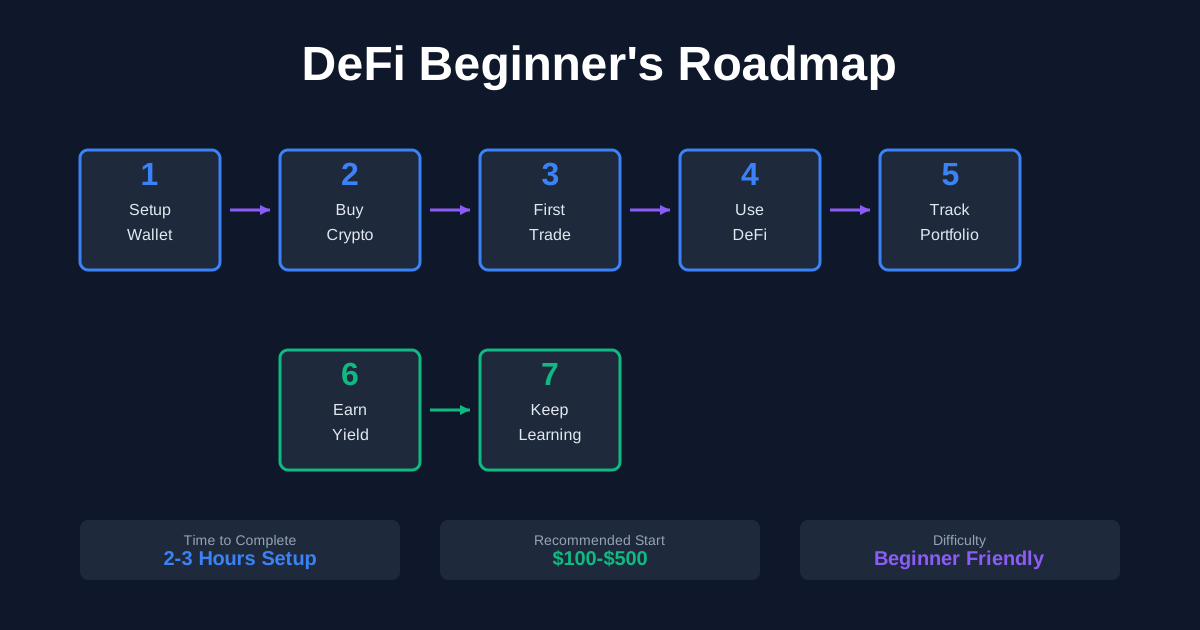
Getting Started with DeFi: Complete Beginner's Roadmap 2025
Your complete step-by-step guide to starting in DeFi. Learn the fundamentals, set up your wallet, make your first trades, and avoid costly mistakes as a DeFi beginner.
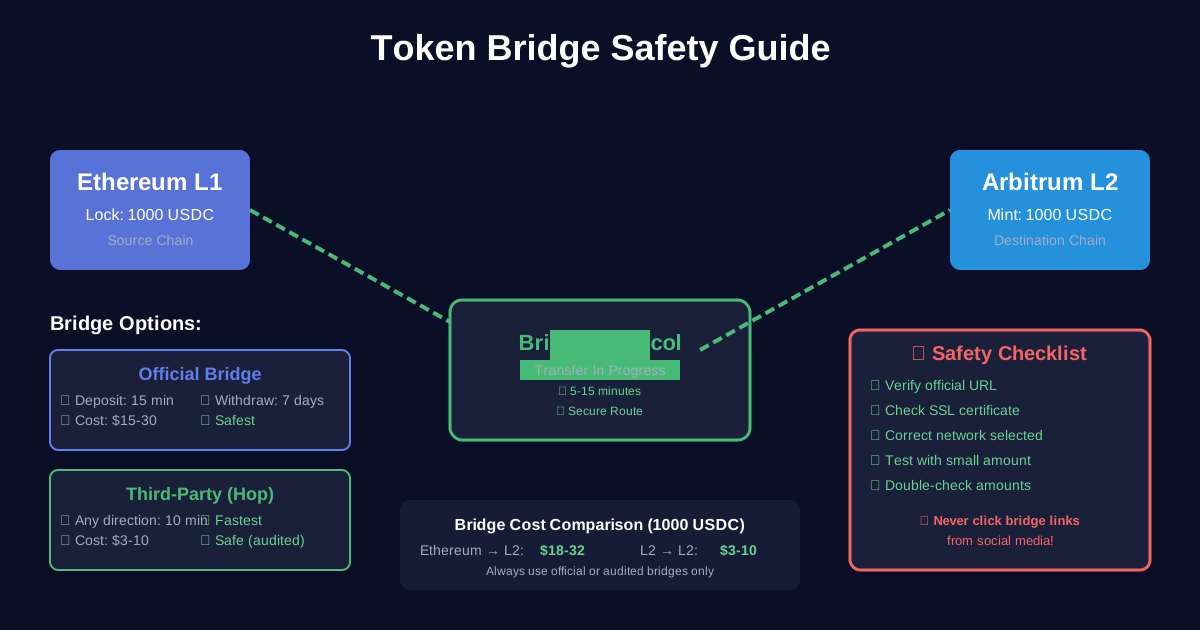
How to Bridge Tokens Between Chains: Complete Safety Guide 2025
Learn to safely bridge crypto between Ethereum, Arbitrum, Base, and other chains. Complete guide covering official bridges, cross-chain protocols, and avoiding scams.
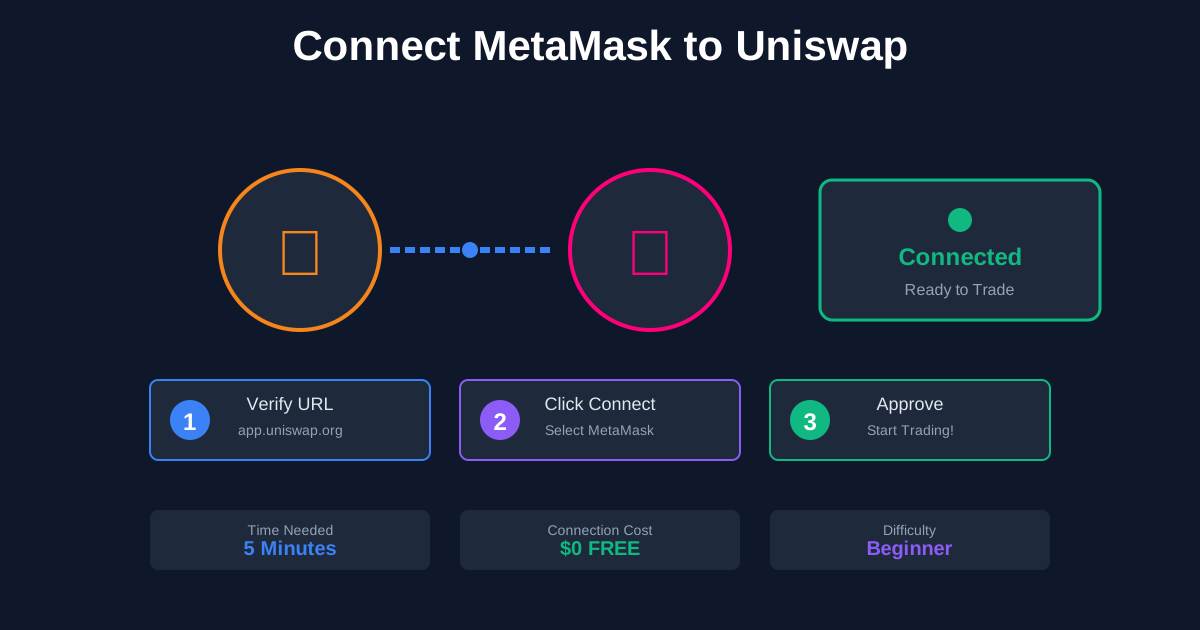
How to Connect MetaMask to Uniswap: Complete Step-by-Step Guide 2025
Learn how to safely connect your MetaMask wallet to Uniswap in 5 minutes. Complete tutorial with screenshots, troubleshooting, and security tips for DeFi beginners.