Understanding Impermanent Loss: A Complete Guide for DeFi Users
Learn what impermanent loss is, how it affects liquidity providers, and strategies to minimize your risk while earning fees in DeFi pools.
Understanding Impermanent Loss: A Complete Guide for DeFi Users
Impermanent loss (IL) is one of the most important concepts for anyone providing liquidity to decentralized exchanges (DEXs) and automated market makers (AMMs). If you're considering becoming a liquidity provider (LP), understanding impermanent loss is crucial to making informed decisions.
What is Impermanent Loss?
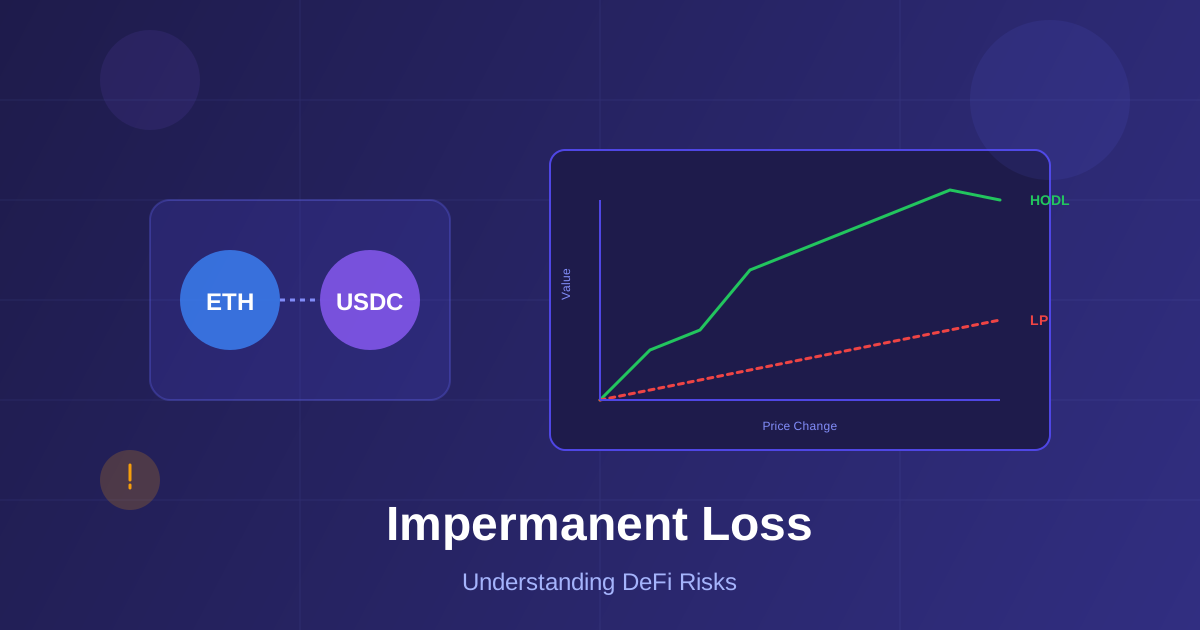
Impermanent loss occurs when you provide liquidity to an AMM pool and the price of your deposited assets changes compared to when you deposited them. The bigger the change, the greater the impermanent loss.
Here's why it happens: When you deposit tokens into a liquidity pool, the AMM uses an algorithm to maintain a constant ratio between the two assets. As prices fluctuate in the broader market, arbitrageurs rebalance the pool by buying the cheaper asset and selling the more expensive one.
A Simple Example
Let's say you deposit 1 ETH and 2,000 USDC into a pool when ETH = $2,000:
- Initial deposit: 1 ETH + 2,000 USDC = $4,000 total value
If ETH price rises to $4,000:
- If you held: 1 ETH ($4,000) + 2,000 USDC = $6,000 total
- In the pool: ~0.707 ETH ($2,828) + ~2,828 USDC = $5,656 total
- Impermanent Loss: $6,000 - $5,656 = $344 (5.7% loss)
The loss is "impermanent" because if the price returns to the original ratio, the loss disappears. However, if you withdraw at the current prices, the loss becomes permanent.
How Much Can You Lose?
The impermanent loss depends on the price change magnitude:
- 1.25x price change: 0.6% loss
- 1.5x price change: 2.0% loss
- 2x price change: 5.7% loss
- 3x price change: 13.4% loss
- 4x price change: 20.0% loss
- 5x price change: 25.5% loss
Uniswap V2 vs V3: Different IL Characteristics
Uniswap V2 (Full Range)
In V2, your liquidity is spread across the entire price curve (0 to infinity). This means:
- Lower capital efficiency
- More predictable impermanent loss
- Works well for stable pairs or long-term holds
Uniswap V3 (Concentrated Liquidity)
In V3, you can concentrate liquidity within a specific price range:
- Higher capital efficiency (earn more fees)
- Higher impermanent loss risk if price exits your range
- Requires active management
Can Trading Fees Offset Impermanent Loss?
Yes! This is the key question for LPs. Trading fees accumulate continuously and can offset impermanent loss, especially in high-volume pools.
Example calculation:
- Pool with 0.3% fee
- $1M daily volume
- Your share: 0.1% of pool
- Daily fees: $300
- Annual fees: ~$109,500
If your impermanent loss is $5,000 over the year, you'd still profit $104,500.
Strategies to Minimize Impermanent Loss
1. Choose Stable Pairs
Pairs like USDC/DAI or USDT/USDC have minimal price divergence, resulting in negligible impermanent loss.
2. Provide Liquidity to Correlated Assets
Assets that move together (like ETH/wstETH or BTC/WBTC) experience less price divergence.
3. High Fee Pools
The 1% fee tier in Uniswap V3 can generate enough fees to offset higher IL risk.
4. Active Management (V3)
Regularly adjust your price ranges to stay within the active trading range.
5. Use Impermanent Loss Protection
Some protocols offer IL protection after a certain time period.
Tools for Calculating Impermanent Loss
Use our Impermanent Loss Calculator to:
- Calculate potential IL for different price scenarios
- Compare V2 vs V3 pool performance
- Estimate fee revenue to see if it offsets IL
- Make data-driven decisions about LP positions
When Should You Provide Liquidity?
Consider providing liquidity when:
- You believe the price will remain relatively stable
- The pool has high trading volume (more fees)
- You plan to hold both assets long-term anyway
- Fee APR is significantly higher than IL risk
Avoid providing liquidity when:
- You expect high volatility
- The pool has low volume (insufficient fees)
- You're bullish on only one of the assets
Conclusion
Impermanent loss is not necessarily a reason to avoid liquidity providing. Many LPs earn substantial profits despite IL because:
- Trading fees accumulate continuously
- IL only matters at withdrawal
- Proper pair selection minimizes risk
The key is to understand the math, use tools to calculate your exposure, and choose pools where fee revenue justifies the IL risk.
Ready to calculate your impermanent loss? Try our IL Calculator now!
Disclaimer: This article is for educational purposes only and does not constitute financial advice. Always do your own research before making investment decisions.
Share this article:
Related Articles
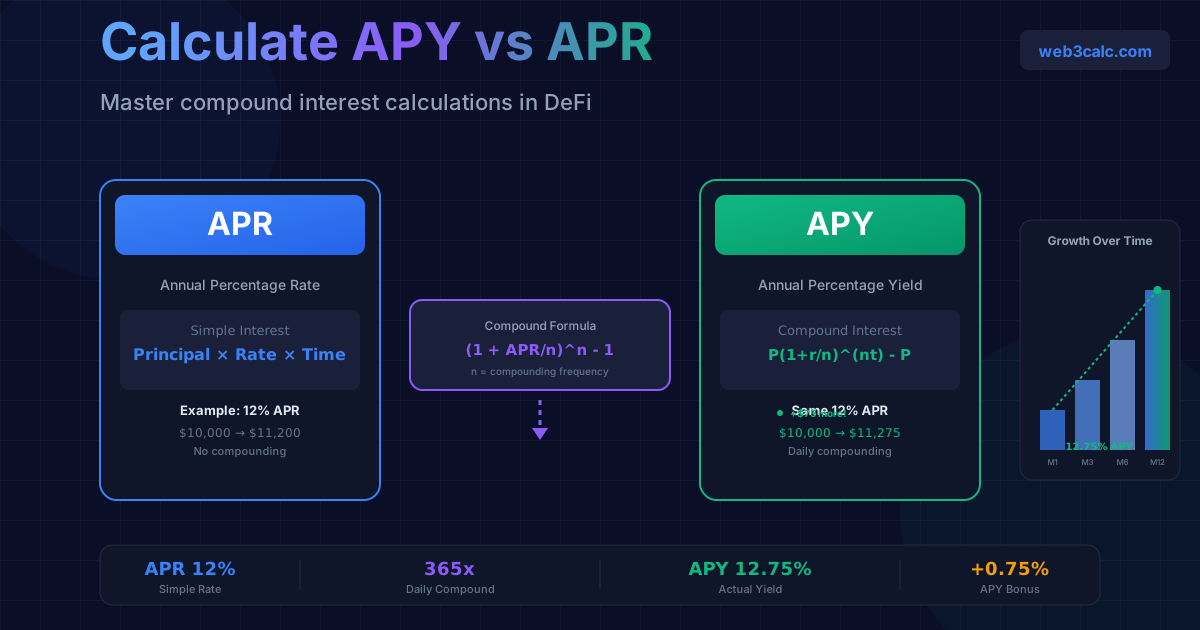
How to Calculate APY vs APR in DeFi: Complete Guide with Examples
Master the difference between APY and APR in DeFi. Learn calculation formulas, understand compound interest, and discover how to maximize your crypto yields.
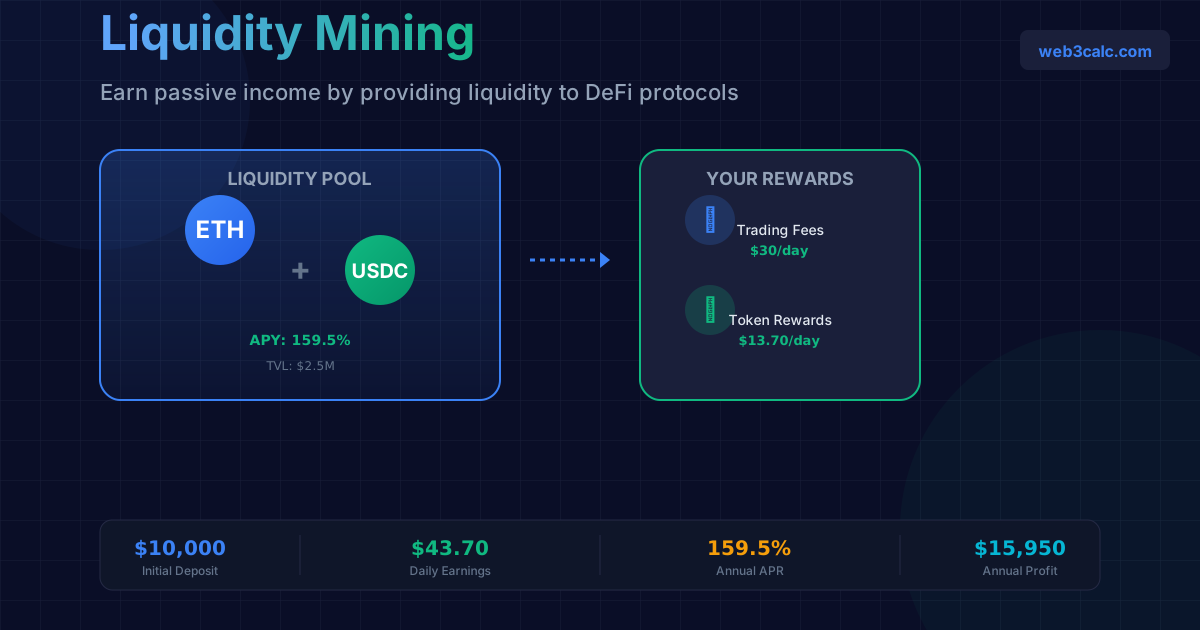
What is Liquidity Mining? Complete Guide to Earning Passive Income in DeFi
Discover how liquidity mining works, learn strategies to maximize your returns, and understand the risks involved in providing liquidity to DeFi protocols.
What is Total Value Locked (TVL)? Complete Guide to DeFi's Most Important Metric
Learn everything about Total Value Locked (TVL) in DeFi. Understand how TVL works, why it matters, and how to use it to evaluate DeFi protocols safely.