How to Calculate Liquidity Pool Returns: Complete ROI Guide for LPs
Master liquidity pool return calculations with our comprehensive guide. Learn to calculate fees, impermanent loss, APY, and true ROI for your LP positions. Make data-driven decisions in DeFi.
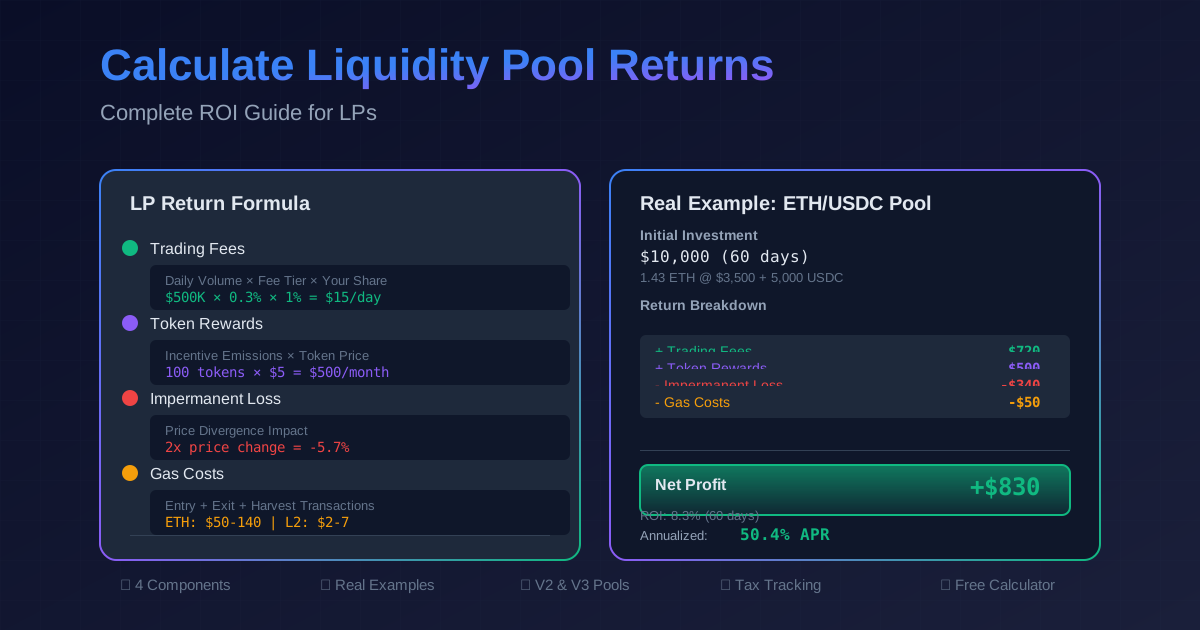
How to Calculate Liquidity Pool Returns: Complete ROI Guide for LPs
Providing liquidity to DeFi pools can be lucrative, but calculating your actual returns is more complex than it appears. Between impermanent loss, trading fees, token rewards, and gas costs, many liquidity providers (LPs) struggle to determine if they're actually profitable.
This comprehensive guide will teach you exactly how to calculate your liquidity pool returns, track performance, and make informed decisions about your LP positions.
Why Accurate LP Return Calculation Matters
The Hidden Complexity
Many LPs think: "Pool shows 50% APY → I'll earn 50% return"
Reality is more complex:
Advertised APY: 50%
- Impermanent Loss: -8%
- Gas Costs: -2%
- Token Emissions (price drop): -15%
= Actual Return: +25%
Without proper calculation, you might:
- ❌ Overestimate returns
- ❌ Miss better opportunities
- ❌ Hold losing positions too long
- ❌ Exit profitable positions too early
With accurate tracking:
- ✅ Know true performance
- ✅ Compare pools objectively
- ✅ Time entries and exits
- ✅ Optimize capital allocation
Understanding LP Return Components
Your total LP return comes from 4 main components:
1. Trading Fees (Usually Positive)
Every swap in the pool generates fees distributed to LPs.
Typical fee tiers:
- 0.01%: Stablecoin pairs (USDC/DAI)
- 0.05%: Correlated pairs (ETH/WETH, WBTC/ETH)
- 0.3%: Standard pairs (ETH/USDC)
- 1%: Exotic/volatile pairs
Example calculation:
Your liquidity: $10,000
Pool size: $1,000,000
Your share: 1%

Daily volume: $500,000
Fee tier: 0.3%
Daily fees generated: $500,000 × 0.003 = $1,500
Your share: $1,500 × 0.01 = $15/day

Monthly: $15 × 30 = $450
Annual: $450 × 12 = $5,400
APR from fees: 54%
2. Impermanent Loss (Usually Negative)
Price divergence between paired tokens causes IL.
IL at different price changes:
Price change: 1.25x → IL: -0.6%
Price change: 1.5x  → IL: -2.0%
Price change: 2x    → IL: -5.7%
Price change: 3x    → IL: -13.4%
Price change: 5x    → IL: -25.5%
Example:
Deposit: 1 ETH ($3,000) + 3,000 USDC
Total: $6,000

ETH price rises to $4,000:
Pool rebalances to: 0.866 ETH + 3,464 USDC
Pool value: $6,928

If you held: 1 ETH ($4,000) + 3,000 USDC = $7,000
IL: $7,000 - $6,928 = $72 (1.03%)
3. Token Rewards (Variable)
Many pools incentivize liquidity with token emissions.
Types of rewards:
- Protocol tokens (e.g., UNI, CAKE)
- Governance tokens
- Boosted rewards (ve-model)
- External incentives
Critical question: What's the token's price trajectory?
Scenario A: Token price stable
Rewards: 1000 tokens × $5 = $5,000 ✅

Scenario B: Token dumps 50%
Rewards: 1000 tokens × $2.50 = $2,500 ❌
4. Gas Costs (Always Negative)
Transaction costs reduce net returns.
Typical costs:
Ethereum Mainnet:
- Enter position: $15-50
- Harvest rewards: $20-40
- Exit position: $15-50
Total: $50-140

Arbitrum/Optimism:
- Enter: $0.50-2
- Harvest: $1-3
- Exit: $0.50-2
Total: $2-7
Impact on returns:
Small position ($1,000):
Gas: $100 = 10% of capital ❌

Large position ($50,000):
Gas: $100 = 0.2% of capital ✅
Step-by-Step: Calculate Your LP Returns
Method 1: Simple ROI Calculation (Quick Estimate)
Formula:
ROI = (Current Value - Initial Investment - Gas Costs) / Initial Investment × 100%
Example:
Step 1: Record initial investment
Date: Jan 1, 2025
Deposited: $10,000 (5,000 USDC + 1.43 ETH @ $3,500)
Gas spent: $30

Step 2: Check current value (30 days later)
Pool shows: $10,650
ETH price: $3,600

Step 3: Calculate ROI
ROI = ($10,650 - $10,000 - $30) / $10,000
ROI = $620 / $10,000 = 6.2%

Annualized: 6.2% × 12 = 74.4% APR
Pros: Quick, easy Cons: Doesn't separate IL from fees
Method 2: Component Breakdown (Accurate)
Formula:
Total Return = Fee Income + Token Rewards - Impermanent Loss - Gas Costs
Detailed example:
Initial Position (Day 0):
1 ETH @ $3,000 + 3,000 USDC = $6,000

Current State (Day 30):
ETH @ $3,500 (16.7% increase)
Pool: 0.918 ETH + 3,213 USDC = $6,426

Component 1: Fee Income
Daily volume: $200,000
Fee tier: 0.3%
Pool size: $5M
Your share: 0.12%
Daily fees: $200K × 0.003 × 0.0012 = $0.72
30-day fees: $21.60

Component 2: Token Rewards
Earned: 50 FARM tokens @ $4 = $200

Component 3: Impermanent Loss
Hold value: 1 ETH ($3,500) + 3,000 USDC = $6,500
Pool value: $6,426
IL: $6,500 - $6,426 = $74 (1.14%)

Component 4: Gas Costs
Enter: $25
Claim rewards: $20
Total gas: $45

Total Return Calculation:
+ Fee income: +$21.60
+ Token rewards: +$200
- Impermanent loss: -$74
- Gas costs: -$45
= Net profit: +$102.60

ROI: $102.60 / $6,000 = 1.71% (30 days)
Annualized: 1.71% × 12 = 20.52%
Method 3: Using Web3 Calculator Tools 🎯
Advantages:
- Instant calculations
- Multiple scenarios
- V2 and V3 support
- Fee projections
- Break-even analysis
How to use:
1. Enter initial prices and amounts
2. Input current/target prices
3. Set fee tier and volume
4. View detailed breakdown:
   - Current value
   - IL amount
   - Fees earned
   - Net ROI
   - Break-even price
Advanced Calculations
Calculating APR vs APY
APR (Annual Percentage Rate): Simple interest APY (Annual Percentage Yield): Compound interest
Formula:
APY = (1 + APR/n)^n - 1

Where n = compounding frequency
Example:
Pool advertises: 50% APR

If you compound monthly (n=12):
APY = (1 + 0.50/12)^12 - 1
APY = (1.0417)^12 - 1
APY = 1.5114 - 1
APY = 51.14%

If you compound daily (n=365):
APY = (1 + 0.50/365)^365 - 1
APY = 64.87%
Real-world impact:
$10,000 invested for 1 year:

50% APR (no compounding): $15,000
50% APR (monthly compound): $15,114
50% APR (daily compound): $16,487

Difference: $1,487 from compounding
Calculating Time-Weighted Returns
For positions where you add/remove liquidity:
Formula:
TWR = [(1 + R1) × (1 + R2) × ... × (1 + Rn)] - 1
Example:
Period 1 (30 days): +5% return
Add $5,000 more capital
Period 2 (30 days): +3% return
Remove $3,000
Period 3 (30 days): +4% return

TWR = (1.05 × 1.03 × 1.04) - 1
TWR = 1.1258 - 1
TWR = 12.58% (90-day return)
Annualized: 12.58% × 4 = 50.3%
Calculating Fees Per Unit of Liquidity
Compare fee efficiency across pools:
Formula:
Fee Efficiency = Daily Fees / TVL × 365 × 100%
Example comparison:
Pool A:
TVL: $10M
Daily volume: $5M
Fee tier: 0.3%
Daily fees: $5M × 0.003 = $15,000
Fee APR: ($15K / $10M) × 365 = 54.75%

Pool B:
TVL: $2M
Daily volume: $1M
Fee tier: 0.3%
Daily fees: $1M × 0.003 = $3,000
Fee APR: ($3K / $2M) × 365 = 54.75%

Same efficiency! Size doesn't matter, volume/TVL ratio does.
IL-Adjusted Returns
Formula:
IL-Adjusted Return = Fee APR - Expected IL%
Example:
Volatile pair (ETH/ALTCOIN):
Fee APR: 80%
Expected IL (based on volatility): 25%
IL-Adjusted Return: 55%

Stable pair (USDC/DAI):
Fee APR: 15%
Expected IL: 0.5%
IL-Adjusted Return: 14.5%

Decision: Volatile pair better IF you can handle risk
Real-World Examples
Example 1: Stablecoin Pool (Low Risk)
Pool: USDC/DAI on Uniswap V3
Initial Investment: $50,000
Date: Jan 1, 2025
Fee tier: 0.01%
Price range: $0.998 - $1.002 (tight)

After 90 Days:
Pool value: $50,450
Price stayed in range: ✅
IL: ~$0 (stablecoins)

Fee breakdown:
Daily volume: $20M
Pool TVL: $100M
Your share: 0.05%
Daily fees: $20M × 0.0001 × 0.0005 = $10
90-day fees: $900

Gas costs:
Enter: $2 (Arbitrum)
3x harvests: $6
Exit: $2
Total: $10

Net Return:
+ Fees: $900
- IL: $0
- Gas: $10
= Profit: $890

ROI: $890 / $50,000 = 1.78%
Annualized: 1.78% × 4 = 7.12%
Analysis: Low but stable returns. Good for risk-averse LPs.
Example 2: ETH/USDC Pool (Medium Risk)
Pool: ETH/USDC on Uniswap V2
Initial Investment: $20,000
Date: Jan 1, 2025
Tokens: 2.86 ETH @ $3,500 + 10,000 USDC
Fee tier: 0.3%

After 60 Days:
ETH price: $4,200 (+20%)
Pool rebalanced to: 2.45 ETH + 10,290 USDC
Pool value: $20,579

Fee calculation:
Daily volume: $100M
Pool TVL: $500M
Your share: 0.004%
Daily fees: $100M × 0.003 × 0.00004 = $120
60-day fees: $7,200

IL calculation:
Hold value: 2.86 ETH ($12,012) + 10,000 USDC = $22,012
Pool value: $20,579
IL: $22,012 - $20,579 = $1,433 (6.5%)

Gas costs: $50 (Ethereum mainnet)

Net Return:
+ Fees: $7,200
- IL: $1,433
- Gas: $50
= Profit: $5,717

ROI: $5,717 / $20,000 = 28.6%
Annualized: 28.6% × 6 = 171.6%
Analysis: High returns but IL ate into profits. Fees compensated well.
Example 3: Volatile Altcoin Pool (High Risk)
Pool: ALTCOIN/ETH on Uniswap V3
Initial Investment: $10,000
Date: Jan 1, 2025
Price range: 20% around current
Fee tier: 1%

After 30 Days:
Token pumped 100% 🚀
Position went out of range after 15 days
Earned fees for only 15 days

Fee earnings (15 days):
Very high volume: $500/day
15-day total: $7,500

IL at 2x price:
IL: -5.7% = -$570

Gas + rebalancing costs: $100

Net Return:
+ Fees (partial): $7,500
- IL: $570
- Gas: $100
= Profit: $6,830

ROI: $6,830 / $10,000 = 68.3% (30 days!)
Analysis: Huge returns but required active management. High risk.
Tools and Calculators
Essential LP Calculation Tools
1. Web3 Calculator IL Calculator ⭐⭐⭐⭐⭐
Features:
- V2 and V3 support
- Fee projections
- Multiple price scenarios
- Break-even analysis
- ROI calculator
Best for: Planning positions
Price: Free
2. DeFi Llama Yields
URL: defillama.com/yields
Features:
- Current pool APYs
- Historical performance
- IL calculator
- Pool comparisons
Best for: Finding opportunities
Price: Free
3. APY.vision
URL: apy.vision
Features:
- Track live positions
- Historical IL
- Fee earnings breakdown
- Multi-pool dashboard
Best for: Tracking active positions
Price: Free (Premium: $20/month)
4. Revert Finance
URL: revert.finance
Features:
- Uniswap V3 focus
- Position simulator
- Fee optimization
- Range analysis
Best for: V3 LPs
Price: Free
5. CoinGecko Yield Farming
URL: coingecko.com/en/yield-farming
Features:
- Multi-protocol yields
- Risk ratings
- Pool TVL trends
- Token prices
Best for: Research
Price: Free
Common Calculation Mistakes
❌ Mistake #1: Ignoring Impermanent Loss
Problem:
Sees: 100% APY
Thinks: I'll double my money!
Reality: 100% APY - 30% IL = 70% actual return
Solution: Always subtract expected IL from advertised APY.
❌ Mistake #2: Not Accounting for Token Depreciation
Problem:
Earns 1000 reward tokens @ $10 = $10,000
Token dumps to $2
Actual value: $2,000 (80% loss)
Solution: Sell or hedge reward tokens regularly.
❌ Mistake #3: Forgetting Gas Costs
Problem:
Small position: $500
Gas to enter/exit: $50
Net return: -10% before even earning
Solution: Use L2s or larger positions on mainnet.
❌ Mistake #4: Using Spot APY for Projections
Problem:
Current APY: 200%
Projects: $10K → $30K in 1 year
Reality: APY drops as TVL grows → $15K actual
Solution: Use historical average APY, not current spike.
❌ Mistake #5: Not Tracking Time Properly
Problem:
Claims: "Made 50% in 3 months!"
Actually: Didn't account for added capital mid-way
Real return: 30%
Solution: Use time-weighted returns for accurate tracking.
Optimization Strategies
1. Choose Optimal Fee Tiers
Rule of thumb:
Correlation | Volatility | Fee Tier
------------|-----------|----------
Very high   | Very low  | 0.01%
High        | Low       | 0.05%
Medium      | Medium    | 0.3%
Low         | High      | 1%

Examples:
USDC/USDT: 0.01%
WBTC/ETH: 0.05%
ETH/USDC: 0.3%
SHIB/ETH: 1%
2. Concentrate Liquidity (V3)
Narrow range = Higher fees, but higher IL risk
Wide range (±50%):
- Capital efficiency: 2x
- Fee APR: 40%
- IL risk: Low

Narrow range (±10%):
- Capital efficiency: 10x
- Fee APR: 200%
- IL risk: High (goes out of range)

Sweet spot: ±20-30%
- Capital efficiency: 4-5x
- Fee APR: 80-100%
- IL risk: Manageable
3. Harvest and Compound Regularly
Compounding impact:
$10K position, 50% APY

No compounding: $15,000 after 1 year
Monthly compound: $15,114 (bonus: $114)
Weekly compound: $15,217 (bonus: $217)
Daily compound: $16,487 (bonus: $1,487)

But consider gas:
If gas = $20 per compound
Daily = $20 × 365 = $7,300 ❌
Monthly = $20 × 12 = $240 ✅

Optimal: Monthly compounding on mainnet
         Weekly on L2s
4. Exit Timing Strategy
When to exit:
Exit if:
1. IL exceeds 6 months of fee earnings
2. Better opportunities arise (+5% higher APY)
3. Token emissions ending soon
4. Pool TVL shrinking (liquidity crisis)
5. Smart contract risks increase

Don't exit if:
1. Temporary price divergence (will revert)
2. Fee APY still exceeds IL
3. In profit and trend continues
4. Gas costs >1% of position
5. Multi-Pool Strategy
Diversification:
Portfolio: $50,000

40% Stable pools (USDC/DAI): $20,000
- Target: 5-10% APY
- Risk: Very low
- Purpose: Stable base

40% Blue-chip pairs (ETH/USDC): $20,000
- Target: 20-40% APY
- Risk: Medium
- Purpose: Core yield

20% High-yield opportunistic: $10,000
- Target: 50-200% APY
- Risk: High
- Purpose: Boost returns

Expected blended return:
(0.4 × 7.5%) + (0.4 × 30%) + (0.2 × 100%)
= 3% + 12% + 20% = 35% overall
Tax Considerations
Taxable Events
In most jurisdictions:
Taxable:
✓ Fee earnings (ordinary income)
✓ Token rewards (ordinary income)
✓ LP token appreciation (capital gains on exit)
✓ Swapping tokens when exiting

Not taxable:
✗ Entering position (just a swap)
✗ IL while in position (unrealized)
✗ Transfers between wallets
Calculating Taxable Income
Example:
Year 2024 LP Activity:

Q1: Earned $2,000 in fees
Q2: Earned $1,500 in fees + $3,000 in tokens
Q3: Earned $1,800 in fees
Q4: Exited position, $5,000 capital gain

Tax summary:
Ordinary income: $8,300 ($2K + $1.5K + $3K + $1.8K)
Capital gains: $5,000
Gas costs (deductible): $200

Report using tools:
- [Crypto Tax Calculator](/tools/crypto-tax)
- Koinly
- CoinTracker
Monitoring and Tracking
Daily Monitoring Checklist
Quick check (2 minutes):
☐ Position still in range? (V3)
☐ ETH/token prices
☐ Pool APY (any major changes?)
☐ TVL trend (growing or shrinking?)
☐ Any smart contract alerts?
Weekly Analysis (15 minutes)
☐ Calculate weekly ROI
☐ Compare to alternative pools
☐ Check for better opportunities
☐ Review IL vs fees earned
☐ Decide: stay, rebalance, or exit?
Monthly Deep Dive (30 minutes)
☐ Full return calculation (all components)
☐ Compare actual vs projected returns
☐ Analyze what worked/didn't work
☐ Update strategy for next month
☐ Tax record updates
Tools for Tracking
Spreadsheet template:
Date | Pool | Initial $ | Current $ | Fees | IL | ROI | Notes
-----|------|-----------|-----------|------|----|----|------
1/1  | ETH  | $10,000   | $10,500   | $600 | -$100 | +5% | Good
2/1  | ETH  | $10,500   | $11,200   | $800 | -$200 | +11.2% | Great

Or use:
- DeBank (portfolio tracking)
- APY.vision (LP-specific)
- Zerion (multi-protocol)
Conclusion: Master Your LP Returns
Calculating liquidity pool returns accurately is essential for:
✅ Making informed decisions - Know if you're profitable ✅ Comparing opportunities - Find best risk-adjusted returns ✅ Optimizing positions - Maximize fee capture, minimize IL ✅ Timing exits - Know when to move capital ✅ Tax compliance - Track all earnings properly
Key takeaways:
- Total return = Fees + Rewards - IL - Gas
- Track all four components separately
- Use tools to automate calculations
- Monitor regularly, adjust strategy
- Consider risk-adjusted returns, not just APY
Start Calculating Your LP Returns
Ready to analyze your liquidity pool performance?
Features:
- Complete ROI calculator
- Fee income projections
- Impermanent loss estimates
- Break-even analysis
- Multiple scenario testing
- V2 and V3 support
Next Steps:
- Learn about Impermanent Loss
- How to Use IL Calculator (Tutorial)
- Choose the Right Liquidity Pool
- DeFi Risk Management Guide
Pro tip: Set up a monthly routine to calculate returns for all LP positions. The 30 minutes invested will help you catch underperforming pools early and reallocate capital to better opportunities.
Have questions about LP return calculations? Drop a comment below or join our community to discuss strategies with other liquidity providers.
Disclaimer: Cryptocurrency and DeFi investments carry significant risks including impermanent loss, smart contract vulnerabilities, and market volatility. This guide is for educational purposes only. Always do your own research and never invest more than you can afford to lose. Consult with a tax professional regarding your specific tax obligations.
Share this article:
Related Articles
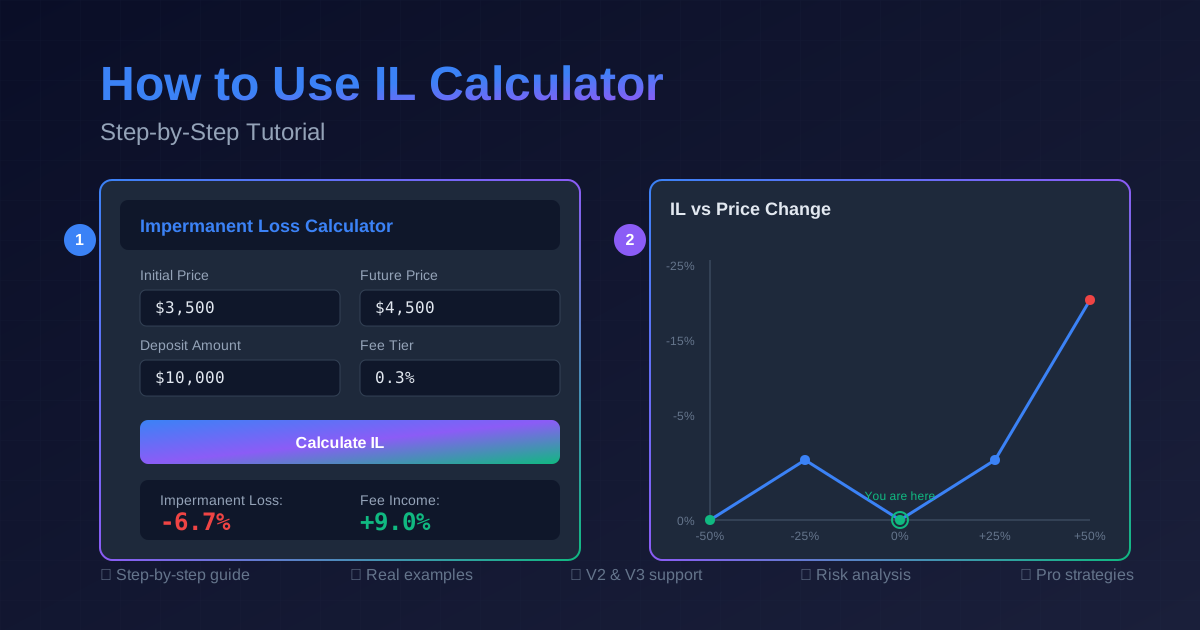
How to Use an Impermanent Loss Calculator: Step-by-Step Guide
Master the art of calculating impermanent loss with our comprehensive guide. Learn to evaluate liquidity pool risks, optimize returns, and make informed DeFi investment decisions.
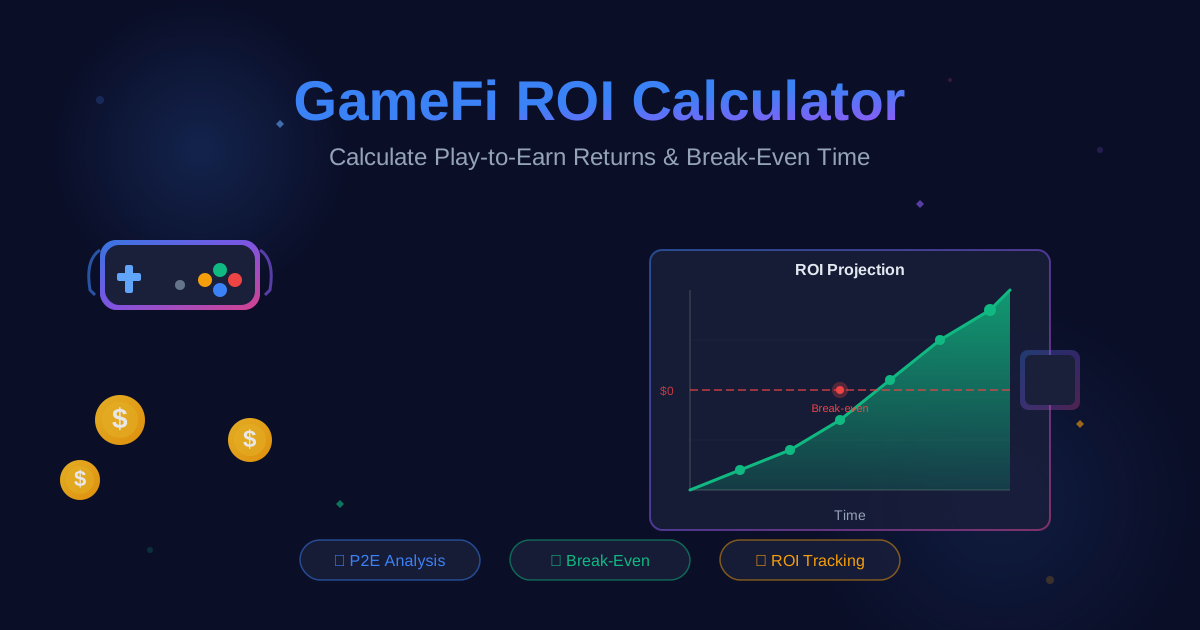
GameFi ROI Calculator: Calculate Play-to-Earn Returns & Break-Even Time
Complete guide to GameFi and Play-to-Earn ROI calculation. Learn how to analyze Axie Infinity, STEPN, Illuvium earnings, NFT breeding costs, scholarship programs, and break-even scenarios with our free P2E calculator.
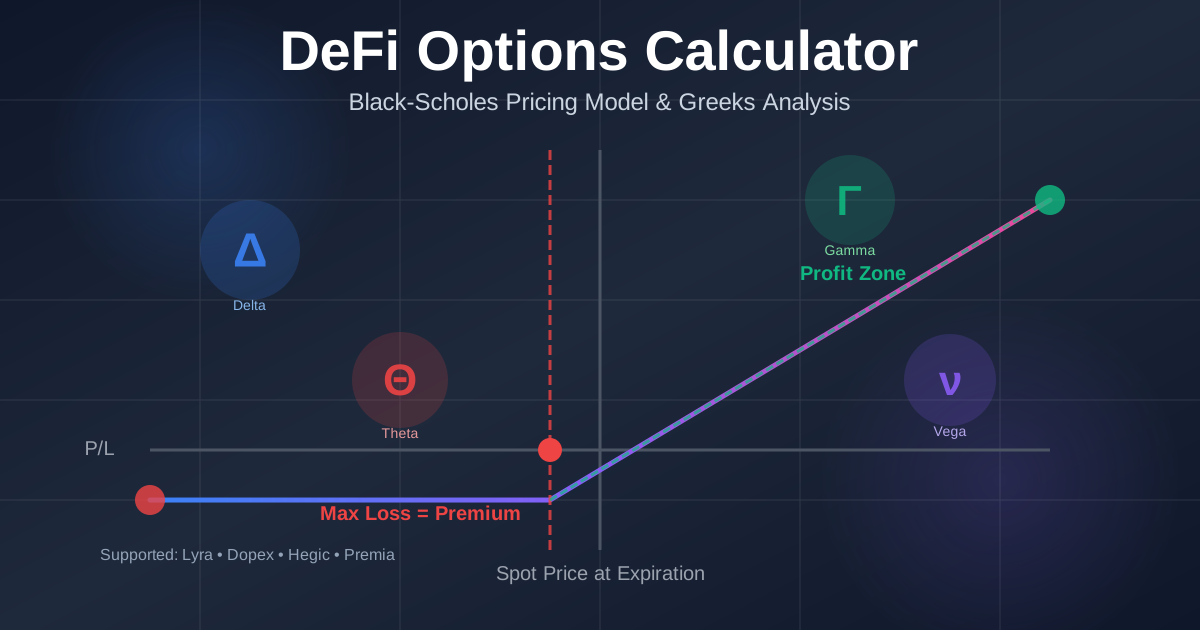
DeFi Options Calculator Guide: Black-Scholes Pricing & Greeks Explained
Complete guide to DeFi options trading with Black-Scholes pricing model, Greeks calculator (Delta, Gamma, Theta, Vega), and strategy analysis for Lyra, Dopex, Hegic, and Premia protocols