How to Use an Impermanent Loss Calculator: Step-by-Step Guide
Master the art of calculating impermanent loss with our comprehensive guide. Learn to evaluate liquidity pool risks, optimize returns, and make informed DeFi investment decisions.
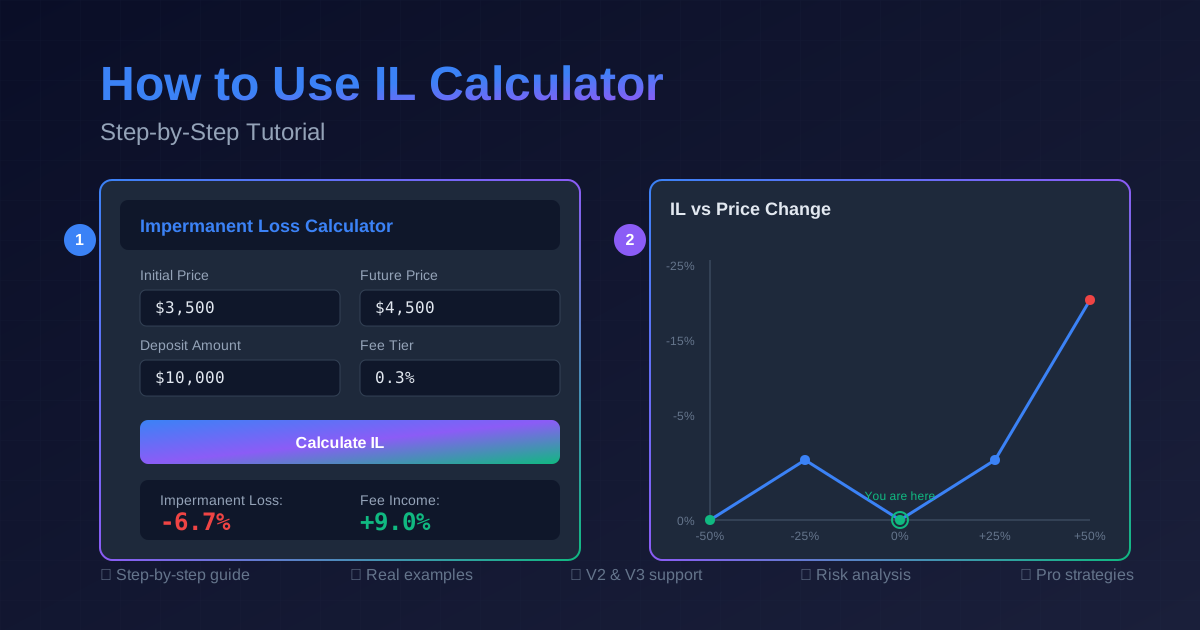
How to Use an Impermanent Loss Calculator: Step-by-Step Guide
If you're providing liquidity on decentralized exchanges (DEXs) like Uniswap, PancakeSwap, or SushiSwap, understanding and calculating impermanent loss (IL) is essential. An impermanent loss calculator helps you evaluate the risk before depositing your assets and track performance after.
In this comprehensive guide, we'll walk you through exactly how to use an IL calculator, interpret the results, and make better decisions as a liquidity provider.
What You'll Learn
- How to input parameters correctly
- Understanding calculator outputs
- Interpreting V2 vs V3 results
- Real-world examples with step-by-step calculations
- Common mistakes to avoid
- Advanced strategies for minimizing IL
Why Use an Impermanent Loss Calculator?
Before diving into liquidity provision, you need to answer critical questions:
- How much IL will I experience if prices change 50%?
- Will the trading fees compensate for my impermanent loss?
- Should I choose Uniswap V2 or V3 for my position?
- What price range should I select for concentrated liquidity?
An IL calculator answers these questions in seconds, helping you avoid costly mistakes.
Step 1: Choose Your Calculator Type
Uniswap V2 Calculators (Full Range)
Best for:
- Stable pairs (USDC/DAI, WBTC/ETH)
- Set-and-forget strategies
- Lower maintenance positions
Use V2 calculators when you want simplicity and don't need to actively manage positions.
Uniswap V3 Calculators (Concentrated Liquidity)
Best for:
- Active liquidity management
- Higher fee capture potential
- Specific price range strategies
V3 calculators require additional inputs like price ranges but offer more precise risk assessment.
👉 Try our Impermanent Loss Calculator - supports both V2 and V3!
Step 2: Gather Required Information
Before using any IL calculator, collect these data points:
For V2 Calculations:
-
Initial Token Prices
- Current price of Token A
- Current price of Token B (usually USDC/USDT at $1)
-
Deposit Amounts
- How many tokens of each asset you're depositing
- Or total USD value you want to invest
-
Future Price Scenarios
- Expected price of Token A after time period
- Multiple scenarios (pessimistic, realistic, optimistic)
-
Pool Fee Tier
- 0.01% (stable pairs)
- 0.05% (most pairs)
- 0.3% (volatile pairs)
- 1% (exotic pairs)
For V3 Calculations (Additional):
-
Price Range
- Minimum price (lower tick)
- Maximum price (upper tick)
- Or percentage range around current price
-
Current Pool Data
- Pool TVL (Total Value Locked)
- 24-hour trading volume
- Historical APR
Step 3: Input Your Parameters
Let's use a real example: ETH/USDC pool on Uniswap V2
Example Scenario:
You want to provide liquidity with $10,000:
Current ETH Price: $3,500
Deposit Amount: $10,000 total value
Pool Fee: 0.3%
Expected Price Range: $3,000 - $4,500
Time Period: 30 days
Expected Daily Volume: $50M
How to Input:
- Select Pool Type: Uniswap V2
- Enter Initial Price: $3,500
- Enter Deposit Amount: $10,000
- Select Fee Tier: 0.3%
- Enter Future Price Scenarios:
- Bearish: $3,000 (-14.3%)
- Base: $3,500 (0%)
- Bullish: $4,500 (+28.6%)
Step 4: Understanding Calculator Results
After clicking "Calculate," you'll see several key metrics. Let's break down each one:
1. Impermanent Loss Percentage
This shows your loss compared to simply holding the tokens.
Example Output:
ETH Price: $4,500 → Impermanent Loss: -6.7%
What this means: If ETH rises from $3,500 to $4,500 (+28.6%), you'll experience 6.7% IL.
In dollar terms: Your $10,000 would be worth $11,800 if you held, but only $11,020 in the pool. The difference ($780) is your impermanent loss.
2. Token Holdings After Rebalancing
The calculator shows how many tokens you'll have after price changes.
Example Output:
Initial: 1.43 ETH + 5,000 USDC
At $4,500: 1.23 ETH + 5,538 USDC
Key insight: When price increases, you'll have fewer ETH and more USDC. The pool automatically rebalances through arbitrage.
3. Fee Revenue Estimation
Based on volume and fee tier, estimate earnings.
Example Output:
Daily Volume: $50M
Your Pool Share: 0.02%
Daily Fees: $30
Monthly Fees: $900 (9% APR)
4. Net ROI (Return on Investment)
Critical metric: Fees earned minus impermanent loss
Example Output:
Impermanent Loss: -$780
Fees Earned (30 days): +$900
Net Profit: +$120 (+1.2% ROI)
Decision point: If fees exceed IL, the position is profitable!
5. Breakeven Analysis
Shows what fee APR is needed to compensate for IL.
Example Output:
IL at this price: -6.7%
Breakeven Fee APR needed: 80% annually
Current Pool APR: 85%
Status: ✅ PROFITABLE
Step 5: Analyzing Different Scenarios
Professional LPs run multiple scenarios before depositing. Here's how:
Scenario Planning Matrix
| Price Change | IL % | Fee Income (30d) | Net Result | Action | |--------------|------|------------------|------------|--------| | -50% ($1,750) | -20% | +$900 | -$1,100 | ❌ AVOID | | -25% ($2,625) | -6.7% | +$900 | +$230 | ⚠️ RISKY | | 0% ($3,500) | 0% | +$900 | +$900 | ✅ GOOD | | +25% ($4,375) | -6.7% | +$900 | +$230 | ✅ OK | | +50% ($5,250) | -20% | +$900 | -$1,100 | ❌ AVOID |
Insight: This ETH/USDC position is profitable only if ETH stays within ±25% of entry price. Outside this range, IL exceeds fee income.
Step 6: V3 Concentrated Liquidity Calculation
V3 calculations add complexity but offer higher returns.
Example: ETH/USDC with Concentrated Range
Current Price: $3,500
Price Range: $3,000 - $4,000 (±14%)
Capital: $10,000
Fee Tier: 0.3%
V3 Calculator Inputs:
- Lower Price Bound: $3,000
- Upper Price Bound: $4,000
- Capital Efficiency: 3.5x (vs V2)
V3-Specific Results:
Liquidity Concentration: 3.5x
Effective Capital: $35,000 (for fee earning)
Daily Fees: $105 (vs $30 in V2)
Monthly Fees: $3,150 (31.5% APR)

⚠️ Risk: Position goes "out of range" if price exits $3,000-$4,000
Out-of-Range Risk:
If ETH drops to $2,800:
- Position becomes 100% USDC
- No longer earning fees
- Must rebalance to resume earning
Pro tip: V3 requires active management. Set price alerts!
Step 7: Comparing Results Across Pools
Use the calculator to compare different liquidity opportunities:
Example Comparison:
| Pool | Fee Tier | Expected IL | Fee APR | Net APR | |------|----------|-------------|---------|---------| | ETH/USDC | 0.3% | -6.7% | 25% | +18.3% | | ETH/USDT | 0.3% | -6.7% | 22% | +15.3% | | WBTC/ETH | 0.3% | -2.5% | 15% | +12.5% | | USDC/DAI | 0.01% | -0.1% | 8% | +7.9% |
Winner: ETH/USDC offers highest net returns despite similar IL to ETH/USDT.
Common Calculator Mistakes to Avoid
❌ Mistake #1: Using Spot Price for Long-Term Calculations
Wrong approach:
Current ETH: $3,500
Input future price: $3,500 (0% change)
Why it's wrong: Prices rarely stay flat. Always test multiple scenarios.
Correct approach:
Scenario 1: $2,800 (-20%)
Scenario 2: $3,500 (0%)
Scenario 3: $4,200 (+20%)
❌ Mistake #2: Ignoring Fee Tier Impact
Example: Two identical pools with different fees:
- Pool A: 0.05% fee → 5% APR
- Pool B: 0.3% fee → 12% APR
The 0.25% difference results in 7% APR difference! Always check fee tiers.
❌ Mistake #3: Overestimating Volume
Wrong: Using 1-day volume spike as baseline.
Correct: Use 30-day average volume for realistic estimates.
Pro tip: In bear markets, volumes drop 60-80%. Adjust expectations accordingly.
❌ Mistake #4: Forgetting Gas Costs
Example calculation:
Monthly Profit: $200
Gas to Enter: $50
Gas to Exit: $50
Gas to Claim Fees: $30
Net Profit: $200 - $130 = $70
Actual ROI: Much lower than expected
Solution: Use Layer 2s (Arbitrum, Optimism, Base) for lower gas fees.
❌ Mistake #5: Not Setting Price Alerts (V3)
For concentrated liquidity positions, going out-of-range means zero fees.
Must-do:
- Set alerts at ±5% from range boundaries
- Have rebalancing plan ready
- Calculate rebalancing cost vs lost fees
Advanced Calculator Features
1. Historical Backtesting
Some calculators let you input historical dates:
Entry Date: Jan 1, 2024 (ETH = $2,200)
Exit Date: Dec 1, 2024 (ETH = $3,500)
Result: Actual IL and fees earned over period
Use case: Validate your strategy against real data.
2. Custom Fee APR Input
If you have better volume data:
Use calculator's estimate: 25% APR
Use your analysis: 18% APR (more conservative)
Compare: 7% difference in expected returns
3. Multiple Position Comparison
Compare up to 5 positions simultaneously:
Position 1: ETH/USDC V2
Position 2: ETH/USDC V3 ($3,000-$4,000)
Position 3: ETH/USDC V3 ($3,200-$3,800)
Position 4: WBTC/ETH V2
Position 5: USDC/DAI V2
Result: Visual comparison showing best risk/reward.
Real-World Calculator Workflow
Here's how professional LPs use calculators:
Daily Routine:
Morning (5 minutes):
- Check current prices
- Run calculator for active positions
- Verify still profitable
- Check if approaching range boundaries (V3)
Weekly (15 minutes):
- Recalculate with new volume data
- Compare actual fees vs projected
- Adjust strategy if needed
- Research new opportunities
Monthly (30 minutes):
- Full position review
- Calculate realized IL and fees
- Rebalance if necessary
- Update market assumptions
Interpreting Risk Levels
Based on calculator results, assess risk:
🟢 Low Risk Positions
Expected IL: <2%
Fee APR: >15%
Net APR: >10%
Example: USDC/DAI, USDC/USDT
🟡 Medium Risk Positions
Expected IL: 2-10%
Fee APR: 15-50%
Net APR: 5-20%
Example: ETH/USDC, WBTC/ETH
🔴 High Risk Positions
Expected IL: >10%
Fee APR: >50% (required to be profitable)
Net APR: Highly variable
Example: Altcoin/ETH pairs
Calculator-Based Decision Framework
Use this framework after running calculations:
Decision Tree:
1. Is Net APR positive across all scenarios?
   ├─ YES → Proceed to step 2
   └─ NO → Consider alternatives

2. Can position survive 50% price swing?
   ├─ YES → Proceed to step 3
   └─ NO → Reduce position size or skip

3. Do you have time to monitor (V3)?
   ├─ YES → Good candidate
   └─ NO → Use V2 instead

4. Are gas costs <10% of expected monthly profit?
   ├─ YES → Execute position
   └─ NO → Increase position size or use L2
Optimizing with Calculator Insights
Strategy 1: Range Optimization (V3)
Test different ranges:
Narrow Range ($3,300-$3,700):
- Capital Efficiency: 6x
- Fee APR: 65%
- Out-of-range risk: HIGH

Medium Range ($3,000-$4,000):
- Capital Efficiency: 3.5x
- Fee APR: 35%
- Out-of-range risk: MEDIUM

Wide Range ($2,500-$4,500):
- Capital Efficiency: 1.8x
- Fee APR: 18%
- Out-of-range risk: LOW
Best choice: Medium range balances returns and risk.
Strategy 2: Fee Tier Selection
Calculator shows impact of fee choice:
ETH/USDC Pool Comparison:
0.05% fee tier: 8% APR (low volume)
0.3% fee tier: 25% APR (high volume)
1% fee tier: 12% APR (very low volume)

Winner: 0.3% - highest activity
Strategy 3: Pair Selection
Compare correlated pairs:
ETH/USDC: High IL risk, High fees
WBTC/ETH: Low IL risk, Medium fees
USDC/DAI: Minimal IL, Low fees

For stable income: USDC/DAI
For highest returns: ETH/USDC
For balanced approach: WBTC/ETH
When Calculator Says "Don't Do It"
Sometimes the calculator reveals a bad opportunity:
Red Flags:
Example Output:
Expected IL: -15%
Fee APR: 8%
Net Result: -7% per month
Translation: You'll lose money even with fees!
Alternative actions:
- Wait for better entry price
- Choose different pair
- Use single-sided staking instead
- Provide liquidity on L2 with higher APRs
Using Calculator Results in Your Strategy
For Conservative LPs:
- Run calculator for ±20% price scenarios
- Only enter if profitable in all scenarios
- Prefer stable pairs (IL <2%)
- Target APR: 8-15%
For Moderate Risk LPs:
- Test ±35% price scenarios
- Accept IL if fees compensate within 30 days
- Mix stable and volatile pairs
- Target APR: 15-30%
For Aggressive LPs:
- Model ±50% swings
- Accept temporary IL for high fee capture
- Focus on V3 concentrated positions
- Target APR: 30%+
Tools and Resources
Essential Calculators:
- Web3 Calculator IL Tool - V2 and V3 support
- DeFi Position Tracker - Monitor active positions
- Gas Fee Calculator - Estimate transaction costs
Complementary Tools:
- Uniswap Analytics - Pool performance data
- DeFi Llama - Compare APRs across protocols
- Dune Analytics - Historical volume charts
Conclusion: Making Informed Decisions
An impermanent loss calculator isn't just a tool—it's your risk management system. By following this guide, you can:
✅ Evaluate opportunities objectively ✅ Avoid costly mistakes ✅ Optimize position parameters ✅ Monitor performance accurately ✅ Adjust strategy based on data
Remember: The best liquidity providers don't guess—they calculate, monitor, and adapt.
Take Action Now
Ready to calculate your impermanent loss risk?
Features:
- Instant calculations for V2 and V3
- Multiple scenario testing
- Fee revenue projections
- Detailed breakeven analysis
- No signup required
Next Steps:
- Learn about Impermanent Loss fundamentals
- Explore DeFi Risk Management strategies
- Compare different Liquidity Pool options
Have questions about using the calculator? Drop a comment below or join our Discord community for real-time support from experienced LPs.
Disclaimer: This guide is for educational purposes only. DeFi involves risks including impermanent loss, smart contract vulnerabilities, and market volatility. Always do your own research and never invest more than you can afford to lose.
Share this article:
Related Articles
Top Impermanent Loss Calculators Compared: Which is Best in 2025?
Compare the best impermanent loss calculators available. Detailed review of features, accuracy, ease of use, and recommendations to help you choose the right IL calculator for your needs.
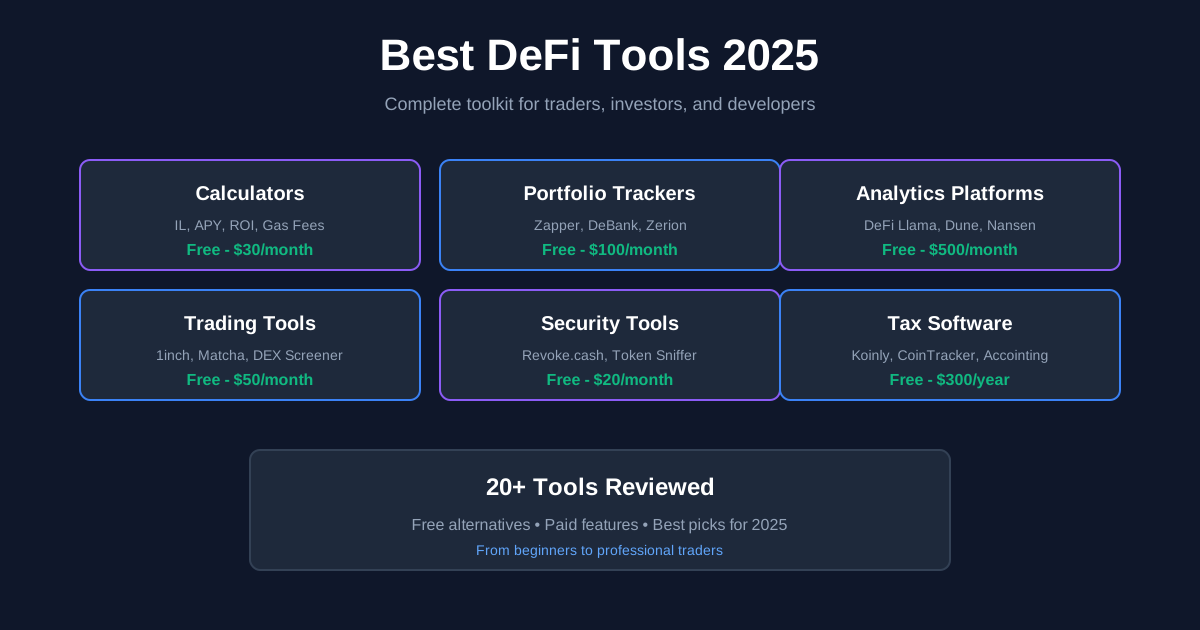
Best Tools for DeFi Traders in 2025: Complete Toolkit Guide
Discover the essential DeFi trading tools every trader needs in 2025. From calculators to analytics platforms, portfolio trackers to security tools - your complete guide to trading DeFi like a pro.
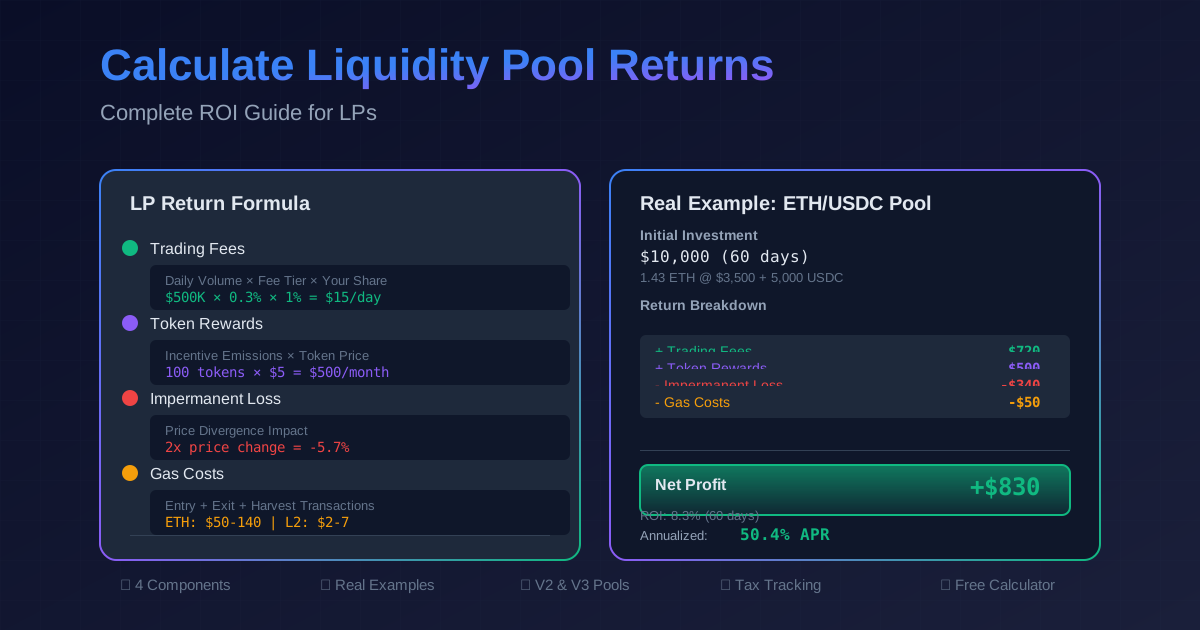
How to Calculate Liquidity Pool Returns: Complete ROI Guide for LPs
Master liquidity pool return calculations with our comprehensive guide. Learn to calculate fees, impermanent loss, APY, and true ROI for your LP positions. Make data-driven decisions in DeFi.