DeFi Risk Management: Complete Guide to Protect Your Investments
DeFi Risk Management: Complete Guide to Protect Your Investments
DeFi offers incredible opportunities—but also significant risks. From smart contract exploits to rug pulls and impermanent loss, the decentralized finance ecosystem presents unique challenges that can wipe out your investment in minutes if you're not careful.
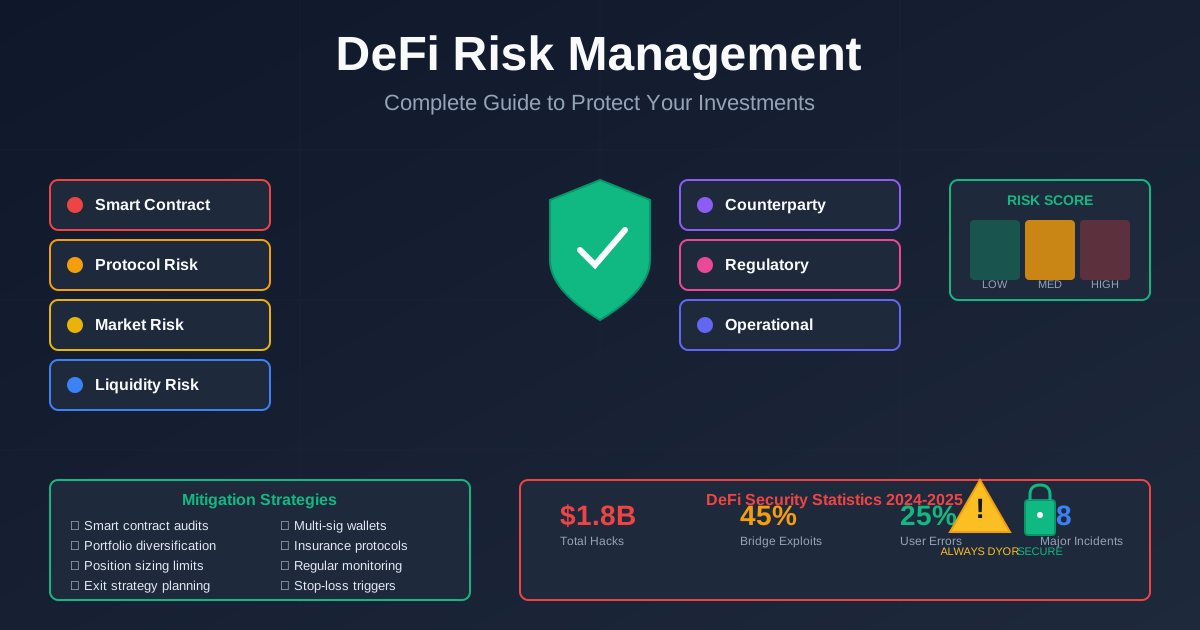
In this comprehensive guide, you'll learn the professional risk management framework used by experienced DeFi investors to protect their capital while still capturing upside potential. We'll cover the 7 major risk categories in DeFi and provide actionable strategies to mitigate each one.
The DeFi Risk Landscape
Before diving into specific risks, understand this fundamental principle:
In DeFi, YOU are responsible for your own security. There's no bank to call, no insurance (mostly), and no chargebacks.
The 7 Major Risk Categories
- Smart Contract Risk - Code vulnerabilities and exploits
- Protocol Risk - Design flaws and economic attacks
- Market Risk - Price volatility and liquidations
- Liquidity Risk - Inability to exit positions
- Counterparty Risk - Dependence on third parties
- Regulatory Risk - Legal uncertainties
- Operational Risk - User errors and key management
Let's examine each category in detail.
1. Smart Contract Risk
Definition: The risk that vulnerabilities in smart contract code lead to theft or loss of funds.
Real-World Examples
The DAO Hack (2016):
- $60M stolen due to reentrancy bug
- Led to Ethereum hard fork (ETH/ETC split)
- Lesson: Even "audited" code can have critical bugs
Poly Network Hack (2021):
- $611M exploited (largest DeFi hack)
- Hacker returned funds (ethical hacker?)
- Lesson: Cross-chain bridge complexity = higher risk
Wormhole Bridge Hack (2022):
- $325M stolen from bridge contract
- Signature verification vulnerability
- Lesson: Bridges are high-value targets
Mitigation Strategies
✅ Strategy 1: Only Use Audited Protocols
Minimum Requirements:
- At least 2 audits from reputable firms
- Audits must be <6 months old
- Check for critical issues in audit report
Top Audit Firms:
- Trail of Bits
- OpenZeppelin
- ConsenSys Diligence
- CertiK
- Quantstamp
- PeckShield
How to Verify:
- Visit protocol's documentation
- Look for "Security" or "Audits" section
- Read audit PDFs (focus on "Critical" and "High" severity findings)
- Check if issues were resolved
✅ Strategy 2: Check Protocol Age and TVL
Safety Benchmarks:
- Age: Protocol >1 year old is safer (time-tested)
- TVL: Higher TVL = more scrutiny from whitehats
- Track Record: Zero exploits in past = good sign (but not guarantee)
Red Flags:
- Protocol <3 months old
- TVL <$10M (less testing, smaller target but easier exploits)
- Recent exploit or hack
✅ Strategy 3: Diversify Across Protocols
Don't Put All Eggs in One Basket:
- Spread capital across 3-5 protocols minimum
- If one is hacked, you don't lose everything
- Mix protocol types (DEX, lending, yield aggregator)
Example Portfolio:
- 30% - Tier 1 protocol (Aave, Compound)
- 30% - Tier 1 protocol (Uniswap, Curve)
- 20% - Tier 2 protocol (SushiSwap, Balancer)
- 15% - Tier 2 protocol (Yearn, Convex)
- 5% - Experimental/new protocols
✅ Strategy 4: Use Insurance Protocols
DeFi Insurance Options:
Nexus Mutual:
- Covers smart contract failures
- Premium: 2-5% annually
- Claims decided by community vote
InsurAce:
- Multi-chain coverage
- Competitive premiums
- Portfolio coverage (multiple protocols)
Risk Harbor:
- Underwriter-backed protection
- Transparent pricing
- Automated claims
When to Buy Insurance:
- Large positions (>$50K)
- New protocols (<1 year old)
- Cross-chain bridges
- High-risk yield farming
Cost-Benefit Analysis:
Position: $100,000
Insurance Cost: 3% annually = $3,000
Break-even: If hack probability > 3%, insurance is worth it

Actual hack rates: ~1-2% of protocols per year
Decision: Insurance makes sense for large positions
2. Protocol Risk
Definition: Risks from the protocol's economic design, governance, or dependencies.
Risk Types
A. Economic Design Flaws
Example: Terra/Luna Collapse (2022)
- $60B market cap evaporated
- Algorithmic stablecoin death spiral
- Lesson: Unsustainable economic models will collapse
Example: Iron Finance Bank Run (2021)
- Partially collateralized stablecoin
- Bank run triggered complete collapse
- Lesson: Insufficient collateralization is dangerous
B. Governance Attacks
Risk: Token holders vote maliciously or governance is captured by whales.
Example: Beanstalk Hack (2022)
- $182M stolen via flash loan governance attack
- Attacker borrowed massive tokens, voted to approve malicious proposal, executed, and repaid loan
- Lesson: Flash loan governance is vulnerable
C. Oracle Manipulation
Risk: Price oracles provide incorrect data, enabling profitable attacks.
Example: Mango Markets Exploit (2022)
- $110M drained via oracle manipulation
- Attacker manipulated price feeds to take overleveraged positions
- Lesson: Oracle choice matters critically
Mitigation Strategies
✅ Strategy 1: Understand the Tokenomics
Key Questions:
- Is the token inflationary or deflationary?
- Where do yields come from? (Real fees or token emissions?)
- What's the token utility? (Governance only, or actual value capture?)
- Are emissions sustainable long-term?
Red Flags:
- Yields >200% with no real revenue
- Unlimited token minting by team
- No token utility beyond farming
- Majority of supply held by team/insiders
✅ Strategy 2: Assess Governance Security
Healthy Governance:
- Timelock on governance changes (48-72 hours)
- Multi-sig control (requires multiple signatures)
- High voting threshold (quorum)
- Transparent governance process
Dangerous Governance:
- Single admin key
- No timelock (instant changes)
- Flash loan governance possible
- Anonymous team
✅ Strategy 3: Verify Oracle Reliability
Good Oracles:
- Chainlink (decentralized, battle-tested)
- Uniswap TWAP (Time-Weighted Average Price)
- Multiple oracle sources
Bad Oracles:
- Single DEX spot price
- Low-liquidity price feeds
- Easily manipulatable sources
3. Market Risk
Definition: Risk from price volatility, liquidations, and adverse market movements.
Risk Types
A. Impermanent Loss (Liquidity Providers)
Risk: Token price divergence causes loss compared to HODLing.
Example Scenario:
- You provide $10,000 to ETH-USDC pool (5 ETH @ $2,000 each)
- ETH pumps to $3,000
- Your position now: 4.08 ETH + $12,247 USDC = $24,490
- If you had just held: 5 ETH = $15,000 + $5,000 USDC = $20,000
- Wait, that's not a loss... let me recalculate
Correct Calculation:
- Start: 5 ETH + $5,000 USDC = $10,000 total
- ETH pumps to $3,000
- Your pool position: 4.08 ETH + $12,247 USDC = $24,484
- If you held: 5 ETH @ $3,000 = $15,000 + $5,000 USDC = $20,000
- Impermanent Loss: $24,484 (pool) vs $20,000 (hold) → Actually profit!
Let me fix this:
Correct IL Scenario:
- Start: 2.5 ETH @ $2,000 + $5,000 USDC = $10,000 total
- ETH drops to $1,000
- Pool rebalances: 3.536 ETH @ $1,000 + $3,536 USDC = $7,072
- If you held: 2.5 ETH @ $1,000 = $2,500 + $5,000 USDC = $7,500
- Impermanent Loss: $428 or 5.7%
Mitigation:
- Calculate expected IL before providing liquidity
- Use our Impermanent Loss Calculator
- Only LP if fees + rewards > expected IL
- Consider single-sided liquidity or stablecoin pairs
B. Liquidation Risk (Borrowers)
Risk: Collateral is liquidated if its value drops below threshold.
Example:
- You deposit $10,000 ETH as collateral
- Borrow $6,000 USDC (60% LTV ratio)
- Liquidation threshold: 75% LTV
- ETH price drops 25% → Your LTV becomes 80%
- You get liquidated, lose your ETH + pay liquidation penalty (5-15%)
Mitigation:
- Maintain low LTV (30-50% max)
- Set price alerts at critical levels
- Keep extra collateral to add if needed
- Use protocols with low liquidation penalties (Maker vs. Compound)
C. Price Volatility
Risk: Sudden price swings cause losses in leveraged positions.
Mitigation:
- Use stop-loss orders (on CEX or DEX with limit orders)
- Never use more than 3x leverage in DeFi
- Keep stablecoin reserves to buy dips
- Dollar-cost average (DCA) instead of lump sum entries
4. Liquidity Risk
Definition: Risk of being unable to exit positions or facing high slippage.
Risk Scenarios
A. Low Pool Liquidity
Problem: Small pool TVL means your trades cause massive slippage.
Example:
- Pool has $100K TVL
- You want to sell $10K tokens
- Your trade = 10% of pool → 5-15% slippage
- You lose $500-$1,500 just from slippage
Mitigation:
- Only provide liquidity to pools with TVL >$1M
- Check Volume/TVL ratio (should be >0.3)
- Test with small trade first
- Use DEX aggregators to split orders
B. Lock-up Periods
Problem: Tokens locked for weeks/months while price crashes.
Example:
- You stake tokens in yield farm with 30-day lock
- Token price drops 50% during lock period
- You can't exit, just watch losses accumulate
Mitigation:
- Avoid lock-up periods if possible
- If locked, only commit capital you can afford to hold long-term
- Diversify lock-up periods (some immediate withdrawal, some locked)
C. Network Congestion
Problem: Can't exit during crash due to high gas fees or network congestion.
Example:
- Market crashes, everyone rushes to exit
- Ethereum gas prices spike to 500+ gwei
- Your $5K position would cost $500 in gas to exit
- You wait, lose more money
Mitigation:
- Use Layer 2 solutions (lower gas fees)
- Keep extra ETH for gas during emergencies
- Set limit orders that execute automatically
- Don't wait until panic to exit
5. Counterparty Risk
Definition: Risk from trusting centralized entities or third parties.
Risk Types
A. Bridge Risk
Problem: Cross-chain bridges have custodial risk and are prime hack targets.
Major Bridge Hacks:
- Ronin Bridge: $625M stolen
- Wormhole: $325M stolen
- Harmony Bridge: $100M stolen
Mitigation:
- Minimize assets on bridges (transfer and immediately use)
- Use most reputable bridges (Stargate, Across, Hop)
- Consider native bridges (Arbitrum, Optimism official bridges)
- Never leave assets sitting on bridge contracts
B. Centralized Stablecoin Risk
Problem: USDC, USDT can be frozen or depegged.
Example: USDC Depeg (March 2023)
- USDC dropped to $0.88 due to Silicon Valley Bank exposure
- Recovered after government intervention
- Lesson: "Stablecoins" aren't always stable
Mitigation:
- Diversify stablecoins (USDC, DAI, USDT mix)
- Use decentralized stablecoins (DAI, LUSD) for large holdings
- Monitor news about backing (especially USDT)
- Have exit strategy if depeg occurs
C. Custody Risk (Centralized Wrappers)
Problem: Wrapped tokens (WBTC, renBTC) rely on custodians.
Mitigation:
- Understand custodian (BitGo for WBTC)
- Prefer decentralized alternatives when possible
- Don't hold wrapped tokens long-term
- Monitor custodian reserves/transparency
6. Regulatory Risk
Definition: Risk that government regulations impact protocol or token value.
Risk Scenarios
Example: Tornado Cash Sanctions (2022)
- US Treasury sanctioned Tornado Cash
- Developers arrested
- dApp frontends taken down
- USDC addresses using it got blacklisted
Example: SEC Actions
- SEC labeled many tokens as securities
- Exchanges delisted tokens
- Token prices crashed 50-90%
Mitigation Strategies
✅ Strategy 1: Understand Regulatory Status
Lower Regulatory Risk:
- Truly decentralized protocols (no company)
- Clear utility tokens (not securities)
- Compliant projects with legal opinions
Higher Regulatory Risk:
- Centralized protocols with known team/company
- Privacy-focused projects (mixers, privacy coins)
- Yield-generating tokens (might be securities)
✅ Strategy 2: Diversify Jurisdictions
- Use protocols from different jurisdictions
- Don't rely solely on US-based projects
- Consider international alternatives
✅ Strategy 3: Stay Informed
- Follow regulatory news (SEC, CFTC, etc.)
- Join protocol Discord/Twitter for updates
- Have exit plan if regulation changes
7. Operational Risk
Definition: Risk from user errors, phishing, and key management failures.
Common User Errors
A. Private Key Loss/Theft
Statistics: ~20% of all BTC is lost due to key loss.
Mitigation:
- Use hardware wallets (Ledger, Trezor) for large holdings
- Write down seed phrase, store in multiple secure locations
- Test recovery process
- Never share seed phrase or enter it on websites
- Use multi-sig wallets for large amounts
B. Phishing and Scams
Common Scams:
- Fake token airdrops (drain wallet)
- Phishing websites (metamask.com vs metamask-app.com)
- Discord/Telegram DM scams (admins never DM first)
- Fake customer support
- Impersonation (fake Elon/Vitalik)
Mitigation:
- Bookmark real URLs, never click links
- Verify contract addresses on Etherscan
- Use separate wallet for interacting with new protocols
- Never approve unlimited token allowances
- Revoke approvals regularly (revoke.cash)
C. Smart Contract Interaction Errors
Example Mistakes:
- Approving unlimited spending (2^256 - 1)
- Connecting wallet to malicious dapp
- Not reading transaction details
- Panic selling with wrong slippage settings
Mitigation:
- Read every transaction before signing
- Start with small test transactions
- Use transaction simulation tools (Tenderly)
- Set reasonable token approval limits
- Use wallet security plugins (Pocket Universe, Fire)
The Complete DeFi Risk Management Framework
Step 1: Risk Assessment Matrix
Before entering any position, score it on this framework:
| Risk Category | Weight | Score (1-10) | Weighted | |---------------|--------|--------------|----------| | Smart Contract Risk | 30% | ? | | | Protocol Risk | 25% | ? | | | Market Risk | 20% | ? | | | Liquidity Risk | 10% | ? | | | Counterparty Risk | 10% | ? | | | Regulatory Risk | 5% | ? | |
Scoring Guide:
- 1-3: Very High Risk (new, unaudited, low TVL)
- 4-6: Medium Risk (established but concerns)
- 7-8: Low Risk (audited, battle-tested)
- 9-10: Very Low Risk (stablecoins, blue chips)
Decision Threshold:
- Total Score 7+: Safe to proceed
- Total Score 5-7: Proceed with caution, reduce position size
- Total Score <5: Avoid or only use with very small amount
Step 2: Position Sizing
Use the Kelly Criterion adapted for DeFi:
Position Size % = (Win Probability × Win Amount - Loss Probability × Loss Amount) / Win Amount

Simplified: Never risk more than 2-5% of portfolio in one position
Example:
- Portfolio: $100,000
- Maximum per position: $5,000 (5%)
- If risk score is low, up to $10,000 (10%)
- For experimental/high-risk: $1,000-$2,000 (1-2%)
Step 3: Diversification Strategy
Multi-Layer Diversification:
Layer 1: Asset Type
- 40% Stablecoins (USDC, DAI)
- 30% Blue-chip crypto (ETH, BTC)
- 20% Mid-caps (UNI, AAVE, LINK)
- 10% Small-caps/experimental
Layer 2: Protocol Diversification
- Don't use just one protocol
- Spread across DEXs, lending, yield
- Mix Tier 1 and Tier 2 protocols
Layer 3: Blockchain Diversification
- 50% Ethereum mainnet
- 30% Layer 2s (Arbitrum, Optimism)
- 20% Alternative L1s (Solana, Avalanche)
Layer 4: Strategy Diversification
- 40% Low-risk (stablecoin yield)
- 40% Medium-risk (LP in major pairs)
- 20% High-risk (new farms, altcoin LPs)
Step 4: Active Monitoring
Daily Monitoring (5 minutes):
- Check positions haven't been exploited
- Review major protocol news
- Monitor liquidation risk if leveraged
Weekly Monitoring (30 minutes):
- Review position performance
- Check if APYs changed significantly
- Rebalance if needed
- Claim and compound rewards
Monthly Monitoring (2 hours):
- Deep dive on protocol health (TVL trends, governance)
- Review overall portfolio allocation
- Research new opportunities
- Update risk scores
Step 5: Exit Strategies
Define Exit Criteria BEFORE Entering:
Profit-Taking:
- Take 50% profits at 2x
- Take 75% profits at 5x
- Let 25% run for moonshots
Loss-Cutting:
- Exit if position down 20-30%
- Exit if protocol TVL drops 50%
- Exit immediately if security concerns
Time-Based:
- Review position every 90 days
- Ask: "Would I enter this position today?"
- If no, consider exiting
Risk Management Checklist (Use Before Every Investment)
Protocol Due Diligence ✅
- [ ] Protocol audited by 2+ reputable firms
- [ ] No critical issues in latest audit
- [ ] Protocol >6 months old OR trusted team with track record
- [ ] TVL >$10M (for positions >$5K)
- [ ] No exploits/hacks in past 12 months
- [ ] Active development team
- [ ] Transparent governance
- [ ] Business model makes sense (revenue, not just token emissions)
Position Sizing ✅
- [ ] Position is <5% of total portfolio (10% max for low-risk)
- [ ] Comfortable losing 100% of this position (worst case)
- [ ] Have diversification across 5+ protocols
- [ ] Not overexposed to single token or chain
Security ✅
- [ ] Using hardware wallet for large positions
- [ ] Verified contract addresses on Etherscan
- [ ] Set reasonable token approval limits (not unlimited)
- [ ] Using separate wallet for risky protocols
- [ ] Bookmarked official protocol URLs
Risk/Reward ✅
- [ ] Expected return >3x the risk
- [ ] Understand where yield comes from
- [ ] Calculated impermanent loss if LP
- [ ] Comfortable with lockup period (if any)
- [ ] Exit strategy defined
Monitoring Plan ✅
- [ ] Set price alerts for liquidation levels
- [ ] Calendar reminder to check position weekly
- [ ] Joined protocol Discord/Twitter for updates
- [ ] Know how to exit quickly if needed
Tools for Risk Management
1. Impermanent Loss Calculator
Calculate IL risk before providing liquidity.
2. DeFi Safety
Protocol security scores and analysis.
3. CertiK Skynet
Real-time protocol monitoring and alerts.
4. Revoke.cash
Revoke dangerous token approvals.
5. Etherscan Contract Verification
Verify contracts are open-source and match audit.
6. DeFi Llama
Track protocol TVL, trends, and metrics.
7. Token Sniffer
Detect scam tokens and rug pulls.
Common Risk Management Mistakes
❌ Mistake 1: FOMO into High APY
Problem: See 500% APY, ape in without research.
Solution: High APY = High Risk. Always research first.
❌ Mistake 2: Not Using Hardware Wallet
Problem: Keep $50K+ in MetaMask on daily-use computer.
Solution: Hardware wallet for anything >$5K.
❌ Mistake 3: Unlimited Token Approvals
Problem: Approve unlimited spending, malicious contract drains wallet.
Solution: Approve only needed amount, revoke old approvals monthly.
❌ Mistake 4: All-In on One Protocol
Problem: 100% of portfolio in one pool, protocol gets hacked.
Solution: Diversify across 5+ protocols minimum.
❌ Mistake 5: Ignoring Warning Signs
Problem: TVL dropping, team anonymous, still stay in position.
Solution: Exit at first red flag, don't hope for recovery.
Conclusion: Your Risk Management Game Plan
Remember: In DeFi, paranoia is a feature, not a bug. The most successful DeFi investors are those who:
- Assume every protocol could be hacked - Position size accordingly
- Diversify relentlessly - Never put all eggs in one basket
- Do their own research - Don't trust, verify
- Have exit strategies - Know when to take profits or cut losses
- Stay informed - Follow protocol updates and security news
- Start small - Test with small amounts before scaling up
- Use proper security - Hardware wallets, revoke approvals, avoid phishing
The Golden Rules:
✅ Only invest what you can afford to lose completely ✅ Diversify across protocols, chains, and asset types ✅ Use audited protocols with proven track records ✅ Monitor positions regularly ✅ Exit at first sign of trouble
Protect Your DeFi Portfolio Today
Use our calculators to make informed, risk-aware decisions:
📊 Impermanent Loss Calculator - Assess LP risk
💰 Staking Rewards Calculator - Calculate real yields
⛽ Gas Fee Calculator - Optimize transaction costs
🔍 Portfolio Tracker - Monitor all positions
Remember: Risk management isn't about avoiding risk entirely—it's about taking calculated risks with proper protection. Stay safe out there!
Tags: #RiskManagement #DeFi #Security #SmartContracts #RugPulls #Audits #ImpermanentLoss
Share this article:
Related Articles

Uniswap V3 Liquidity Mining Guide: Advanced ROI Simulator & Strategy Calculator
# Uniswap V3 Liquidity Mining Guide: Advanced ROI Simulator & Strategy Calculator Uniswap V3 revolutionized DeFi liquidity provision by introducing concentrated liquidity, allowing LPs to earn 4,000...
Portfolio Rebalancing Calculator Guide: Optimize Your Crypto Asset Allocation
# Portfolio Rebalancing Calculator Guide: Optimize Your Crypto Asset Allocation Portfolio rebalancing is one of the most important yet often overlooked aspects of crypto investing. As market prices...
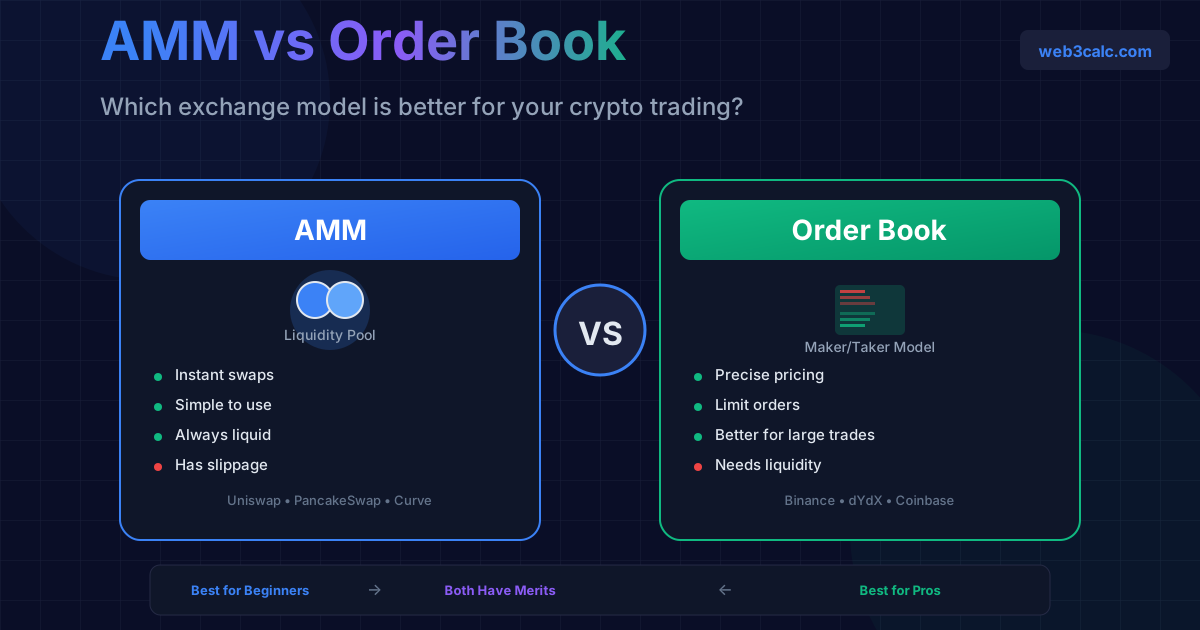
AMM vs Order Book: Which is Better for Crypto Trading?
Understand the key differences between Automated Market Makers (AMMs) and Order Book exchanges. Learn which model suits your trading style and why both matter in DeFi.