DeFi Options Calculator Guide: Black-Scholes Pricing & Greeks Explained
Complete guide to DeFi options trading with Black-Scholes pricing model, Greeks calculator (Delta, Gamma, Theta, Vega), and strategy analysis for Lyra, Dopex, Hegic, and Premia protocols
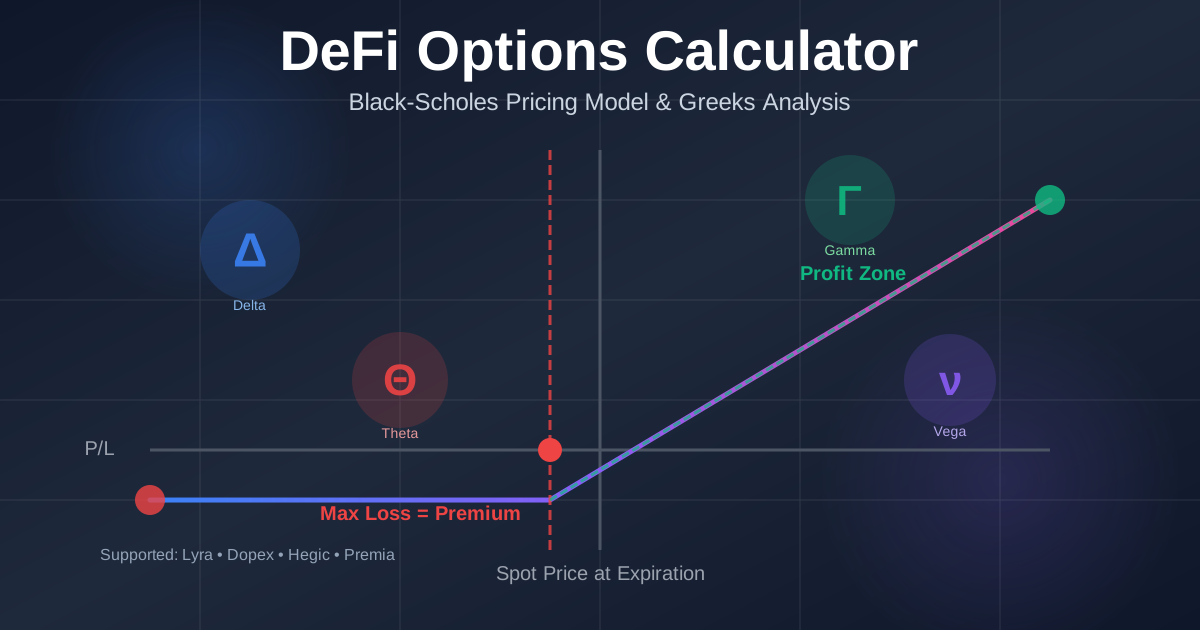
DeFi Options Calculator: Master Options Trading with Black-Scholes Model
Options trading in DeFi has exploded in 2025, with protocols like Lyra Finance, Dopex, Hegic, and Premia offering decentralized options markets with billions in total value locked (TVL). But understanding options pricing and the Greeks can be intimidating for newcomers.
This comprehensive guide explains how to use our DeFi Options Calculator to price options, analyze Greeks sensitivities, and build profitable trading strategies.
What Are Cryptocurrency Options?
Options are financial contracts that give you the right (but not obligation) to buy or sell an asset at a predetermined price (strike price) before or at expiration.
Two Types of Options:
Call Options (Bullish)
- Right to BUY at strike price
- Profit if price goes UP
- Used for: Speculation, leverage, hedging shorts
Put Options (Bearish)
- Right to SELL at strike price
- Profit if price goes DOWN
- Used for: Protection, speculation, hedging longs
Key Terms:
- Premium: Price you pay to buy the option
- Strike Price: Price at which you can exercise the option
- Expiration: Date when option expires
- Spot Price: Current market price of the underlying asset
- Intrinsic Value: Profit if exercised immediately (can be zero)
- Time Value: Premium minus intrinsic value
The Black-Scholes Pricing Model
The Black-Scholes model is the industry-standard formula for pricing European-style options. It calculates theoretical option value based on six inputs:
- Spot Price (S): Current asset price
- Strike Price (K): Exercise price
- Time to Expiry (T): Days until expiration
- Volatility (σ): Expected price movement
- Risk-Free Rate (r): Interest rate (typically 3-5%)
- Option Type: Call or Put
Black-Scholes Formula:
For a Call Option:
C = S × N(d1) - K × e^(-rT) × N(d2)
For a Put Option:
P = K × e^(-rT) × N(-d2) - S × N(-d1)
Where:
d1 = [ln(S/K) + (r + σ²/2)T] / (σ√T)d2 = d1 - σ√TN(x)= Cumulative normal distribution functione= Euler's number (~2.718)
Don't worry! Our calculator does all the complex math for you instantly.
Understanding the Greeks
The "Greeks" measure how option prices change with different variables. They're essential for risk management and strategy building.
Delta (Δ) - Price Sensitivity
What it measures: How much the option price changes for a $1 change in spot price.
- Range: 0 to 1 for calls, -1 to 0 for puts
- Example: Delta of 0.6 means option moves $0.60 for every $1 move in spot
- Usage: Hedging ratios, probability estimates
Deep ITM calls have Delta near 1.0
ATM options have Delta near 0.5
Far OTM calls have Delta near 0.0
Gamma (Γ) - Delta Change Rate
What it measures: Rate of change of Delta with respect to spot price.
- Highest: For ATM options near expiration
- Lowest: For deep ITM or OTM options
- Usage: Managing Delta risk, predicting rapid changes
High Gamma means your Delta hedge needs frequent rebalancing.
Theta (Θ) - Time Decay
What it measures: Daily loss in option value due to time passing.
- Always negative for long options (you lose value daily)
- Accelerates as expiration approaches
- Highest: For ATM options with 0-30 days to expiry
Example: Theta of -$50 means you lose $50 per day from time decay.
Vega (ν) - Volatility Sensitivity
What it measures: How much option price changes for a 1% change in volatility.
- Always positive for long options
- Highest: For ATM options with more time
- Key driver: In crypto markets with high volatility
Crypto typically has 50-150% implied volatility vs 15-30% for stocks.
Rho (ρ) - Interest Rate Sensitivity
What it measures: Sensitivity to 1% change in risk-free rate.
- Less important in crypto than traditional markets
- Still relevant: For yield-bearing collateral protocols
How to Use the DeFi Options Calculator
Step 1: Select Option Type
Choose Call (bullish) or Put (bearish) based on your market outlook.
Step 2: Enter Spot Price
Current market price of the underlying asset.
Example: ETH trading at $2,000
Step 3: Set Strike Price
The price at which you can exercise the option.
Strategy tips:
- ITM (In-The-Money): Strike below spot for calls, above for puts
- ATM (At-The-Money): Strike near spot price
- OTM (Out-of-The-Money): Strike above spot for calls, below for puts
Step 4: Days to Expiry
Time remaining until option expiration.
Common terms:
- Weekly: 7 days (high Theta decay)
- Monthly: 30 days (balanced)
- Quarterly: 90 days (lower Theta, higher Vega)
Step 5: Implied Volatility
Expected price volatility over the option's life.
Crypto volatility ranges:
- Bitcoin: 40-80% typically
- Ethereum: 50-100% typically
- Altcoins: 80-200% during bull markets
Higher volatility = Higher premiums
Step 6: Risk-Free Rate
Typically 3-5% for U.S. Treasury rates. Less impactful than other variables.
Step 7: Select Protocol
Choose your preferred DeFi options platform:
- Lyra Finance (Optimism): AMM-based, $45M TVL, 0.3% fees
- Dopex (Arbitrum): Single-sided pools, $12M TVL, 0.5% fees
- Hegic (Ethereum): Peer-to-pool, $8M TVL, 1.0% fees
- Premia (Arbitrum): Orderbook + AMM hybrid, $18M TVL, 0.4% fees
- Custom: Pure Black-Scholes calculation without protocol fees
Real-World Examples
Example 1: Bullish Call Option
Scenario: You're bullish on ETH, currently at $2,000.
Setup:
- Option Type: Call
- Spot Price: $2,000
- Strike Price: $2,100 (5% OTM)
- Days to Expiry: 30
- Volatility: 80%
- Protocol: Lyra Finance
Results:
- Premium: $156.24
- Delta: 0.4523 (45% price sensitivity)
- Theta: -$8.34/day (time decay)
- Breakeven: $2,256.24
- Max Profit: Unlimited
- Max Loss: $156.24 (premium paid)
Analysis: Option becomes profitable if ETH rises above $2,256 within 30 days. You have 45% of spot price movement (Delta).
Example 2: Protective Put (Insurance)
Scenario: You hold 10 ETH at $2,000 and want downside protection.
Setup:
- Option Type: Put
- Spot Price: $2,000
- Strike Price: $1,800 (10% OTM)
- Days to Expiry: 60
- Volatility: 70%
- Protocol: Dopex
Results:
- Premium: $89.50 per ETH = $895 total
- Delta: -0.3210 (32% hedge ratio)
- Protection: Locks in minimum exit price of $1,710.50
- Cost: $895 for 60 days of insurance (~4.5% of portfolio)
Analysis: If ETH drops to $1,500, your put is worth $300/ETH, limiting loss to -14.5% instead of -25%.
Example 3: Straddle (Volatility Play)
Scenario: Major ETH upgrade coming, expecting large move but uncertain direction.
Setup:
- Buy Call: Strike $2,000
- Buy Put: Strike $2,000
- Days to Expiry: 14
- Volatility: 120% (pre-event)
Results:
- Total Premium: $245 (call) + $243 (put) = $488
- Breakeven Points: $1,512 or $2,488
- Profit: If price moves >24% in either direction
Analysis: High Vega strategy profits from volatility expansion and large price moves.
Popular Option Strategies
1. Long Call - Bullish Speculation
When to use: Strongly bullish, want leverage
Risk: Limited to premium paid Reward: Unlimited upside Greeks: Positive Delta, negative Theta
2. Long Put - Bearish Speculation
When to use: Bearish outlook, downside protection
Risk: Limited to premium paid Reward: Strike price minus premium Greeks: Negative Delta, negative Theta
3. Covered Call - Income Generation
Setup: Own asset + sell call option
When to use: Neutral to slightly bullish, generate yield
Risk: Limited upside if price spikes above strike Reward: Premium income + asset appreciation to strike
Example: Own ETH at $2,000, sell $2,200 call for $80 premium. If ETH stays below $2,200, keep premium. If above, sell at $2,200.
4. Protective Put - Portfolio Insurance
Setup: Own asset + buy put option
When to use: Protect profits, hedge risk
Risk: Premium cost (insurance fee) Reward: Downside protection
Example: Hold ETH at $2,000, buy $1,800 put for $90. Maximum loss is $290 ($200 + $90 premium).
5. Straddle - Volatility Bet
Setup: Buy call + put at same strike
When to use: Expect large move, uncertain direction
Risk: High premium (double the cost) Reward: Profit from large moves either way
Best for: Event-driven trades (hard forks, regulations, etc.)
6. Bull Call Spread
Setup: Buy lower strike call + sell higher strike call
When to use: Moderately bullish, want to reduce cost
Risk: Limited (difference in strikes minus net premium) Reward: Limited (max profit at higher strike)
Example: Buy $2,000 call for $150, sell $2,200 call for $60. Net cost $90, max profit $110.
7. Bear Put Spread
Setup: Buy higher strike put + sell lower strike put
When to use: Moderately bearish, reduce cost
Risk: Limited to net premium paid Reward: Limited (difference in strikes minus premium)
8. Iron Condor - Range-Bound
Setup: Sell OTM call + put, buy further OTM call + put
When to use: Low volatility, price stays in range
Risk: Limited but on both sides Reward: Net premium collected
Advanced strategy: Requires managing four legs
DeFi Options Protocols Comparison
Lyra Finance (Optimism)
Model: Automated Market Maker (AMM)
Pros:
- Deep liquidity on ETH options
- Low slippage for retail traders
- Optimism L2 = low gas fees
- Dynamic volatility pricing
Cons:
- Limited asset pairs
- AMM model has price impact
- Still evolving protocol
Best for: Retail traders, frequent trading
Dopex (Arbitrum)
Model: Single-Sided Staking Option Vaults (SSOVs)
Pros:
- Atlantic options (fungible, transferable)
- Creative products (weekly options)
- Good APY for liquidity providers
- Low gas on Arbitrum
Cons:
- Lower liquidity than Lyra
- More complex UX
- Liquidity fragmented across epochs
Best for: LP yield seekers, advanced traders
Hegic (Ethereum)
Model: Peer-to-Pool (P2P)
Pros:
- Pioneer in DeFi options
- On-chain settlement
- Simple UX
- Multi-asset support
Cons:
- High Ethereum gas fees
- Larger spreads
- Lower liquidity post-2023
Best for: On-chain purists, large trades
Premia (Arbitrum)
Model: Hybrid (Orderbook + AMM)
Pros:
- Best of both worlds (liquidity + pricing)
- Advanced order types
- Range orders
- Professional-grade features
Cons:
- More complex interface
- Still growing TVL
- Learning curve for beginners
Best for: Sophisticated traders, market makers
Risk Management Tips
1. Size Your Positions Properly
Rule of thumb: Never risk more than 2-5% of capital per trade.
Options have defined risk (premium paid), but losses can still be 100%.
2. Monitor Theta Decay
Options lose value daily due to time decay. Don't hold long options through expiration unless exercising.
Danger zone: Last 7-14 days before expiry (Theta accelerates)
3. Understand Volatility Crush
After major events (hard forks, announcements), volatility collapses. This hurts long option holders even if you got the direction right.
Example: Buy call before ETH upgrade. Price rises 5% but volatility drops from 120% to 60%. You might still lose money.
4. Use Stop Losses
Unlike spot trading, options can go to zero. Set stop losses at 50% of premium paid to limit damage.
5. Start Small
Paper trade or use tiny positions while learning. Options are leveraged instruments with complex risk profiles.
6. Watch Liquidity
Low liquidity = wide bid-ask spreads = harder to exit at fair prices. Stick to high-volume protocols and assets.
Common Mistakes to Avoid
1. Buying Far OTM Options
"Lottery ticket" options (very low Delta) rarely pay off. The odds are against you.
Better: Buy ATM or slightly OTM options for better probability of profit.
2. Ignoring Implied Volatility
Buying options when IV is at historical highs means you're paying inflated premiums. Check IV rank before entering.
Tool: Compare current IV to 30-day average IV.
3. Holding Through Expiration
Options decay fastest in the last 2 weeks. Roll to next month or close early to preserve value.
4. Not Hedging Greeks
If you're running a strategy, hedge your Delta exposure if you don't want directional risk.
Example: Selling covered calls? Consider buying protective puts.
5. Overleveraging
Just because options are leveraged doesn't mean you should use 10x leverage. Start conservative.
6. Forgetting About Fees
Protocol fees (0.3-1%) + gas costs add up. Factor these into your breakeven calculations.
Advanced Topics
Volatility Smile
In reality, implied volatility isn't constant across strikes. It forms a "smile" shape:
- OTM puts: Higher IV (crash protection demand)
- ATM options: Mid-range IV
- OTM calls: Slightly higher IV
Our calculator uses constant volatility (Black-Scholes assumption), but real markets show volatility smiles.
Volatility Surface
IV also varies by time to expiration. Longer-dated options often have different IV than near-term options.
Term structure: Maps IV across different expiration dates.
Delta Hedging
Market makers delta-hedge to remain neutral to price movements.
Example: Sell 1 ETH call with Delta 0.5 → Buy 0.5 ETH spot to hedge.
As price moves, rebalance the hedge (due to Gamma).
Volatility Trading
Advanced traders trade volatility itself, not just direction.
Strategies:
- Buy straddles before events (long volatility)
- Sell iron condors in low volatility (short volatility)
- Calendar spreads (trade time decay differences)
Tax Implications
Disclaimer: Consult a tax professional. This is general information only.
United States
- Capital gains/losses on options profits
- Short-term (<1 year) taxed as ordinary income
- Long-term (>1 year) taxed at lower capital gains rate
Tracking Trades
Keep detailed records:
- Entry/exit dates and prices
- Premiums paid/received
- Protocol fees
- Exercise/assignment history
Tool: Use our Crypto Tax Calculator to track all trades.
Frequently Asked Questions
What's the minimum capital needed for options trading?
Most DeFi protocols have no minimum, but realistically $500-$1,000 to make fees worthwhile. Start small while learning.
Can I lose more than my premium?
For buyers: No, max loss is premium paid (defined risk) For sellers: Yes, selling naked options has unlimited risk
Always start as a buyer (long options) until you deeply understand the risks.
How do I know what strike to choose?
Depends on strategy:
- Speculation: OTM strikes for leverage
- Hedging: ATM or slightly OTM for cost efficiency
- Income: Sell OTM covered calls above your exit price
What's better: CEX or DeFi options?
CEX (Deribit, Binance):
- Pros: Higher liquidity, more strikes, better execution
- Cons: Custody risk, KYC required, centralized
DeFi (Lyra, Dopex):
- Pros: Self-custody, permissionless, transparent
- Cons: Lower liquidity, fewer strikes, learning curve
Use CEX for large trades, DeFi for self-sovereignty.
How accurate is Black-Scholes for crypto?
Black-Scholes assumptions (constant volatility, normal returns) don't perfectly fit crypto's fat-tailed distributions and volatility clustering.
However: It's still the industry standard and provides good approximations for short-term options.
More accurate: Models like Heston (stochastic volatility) or jump-diffusion, but these are complex.
Should I exercise or sell my option?
Almost always sell before expiration rather than exercising.
Why? Options have time value that's lost upon exercise. Selling captures both intrinsic + time value.
Exception: Immediate price spike on expiration day where you must exercise to capture value.
What's implied volatility rank (IV Rank)?
Measures where current IV sits relative to past 52 weeks:
IV Rank = (Current IV - 52W Low IV) / (52W High IV - 52W Low IV) × 100
- High IV Rank (>75%): Good for selling options (collect high premiums)
- Low IV Rank (<25%): Good for buying options (cheaper premiums)
How do I roll an option?
Rolling = Closing current position and opening a new one (later expiration or different strike).
Example: Own Feb $2,000 call → Roll to March $2,100 call
Why roll?
- Extend time if thesis still intact
- Adjust strike to current conditions
- Avoid final week Theta decay
Conclusion
DeFi options offer powerful tools for speculation, hedging, and income generation. Understanding Black-Scholes pricing and the Greeks is essential for successful options trading.
Key takeaways:
- ✅ Options give you leverage and defined risk
- ✅ Delta, Gamma, Theta, Vega govern option price changes
- ✅ Black-Scholes model provides theoretical pricing
- ✅ Start with simple strategies (long calls/puts) before complex spreads
- ✅ Manage risk with position sizing and stop losses
- ✅ Choose the right DeFi protocol for your needs
Try our calculator: DeFi Options Calculator
Practice with different scenarios, understand how Greeks change, and develop your options trading skills risk-free before trading with real capital.
Related Tools
- Trading P&L Calculator - Track your options trading performance
- Yield Farming Calculator - Compare yields across DeFi protocols
- Impermanent Loss Calculator - Understand LP risks
- Portfolio Tracker - Monitor your options positions
Further Reading
- What is Impermanent Loss? - Understanding DeFi risks
- Best DeFi Tools 2025 - Comprehensive toolkit
- Yield Farming Guide - Maximize DeFi returns
- DeFi Security Best Practices - Protect your funds
Disclaimer: This guide is for educational purposes only. Options trading carries significant risk. Always do your own research and never invest more than you can afford to lose. DeFi protocols are experimental and may contain smart contract risks.
Share this article:
Related Articles
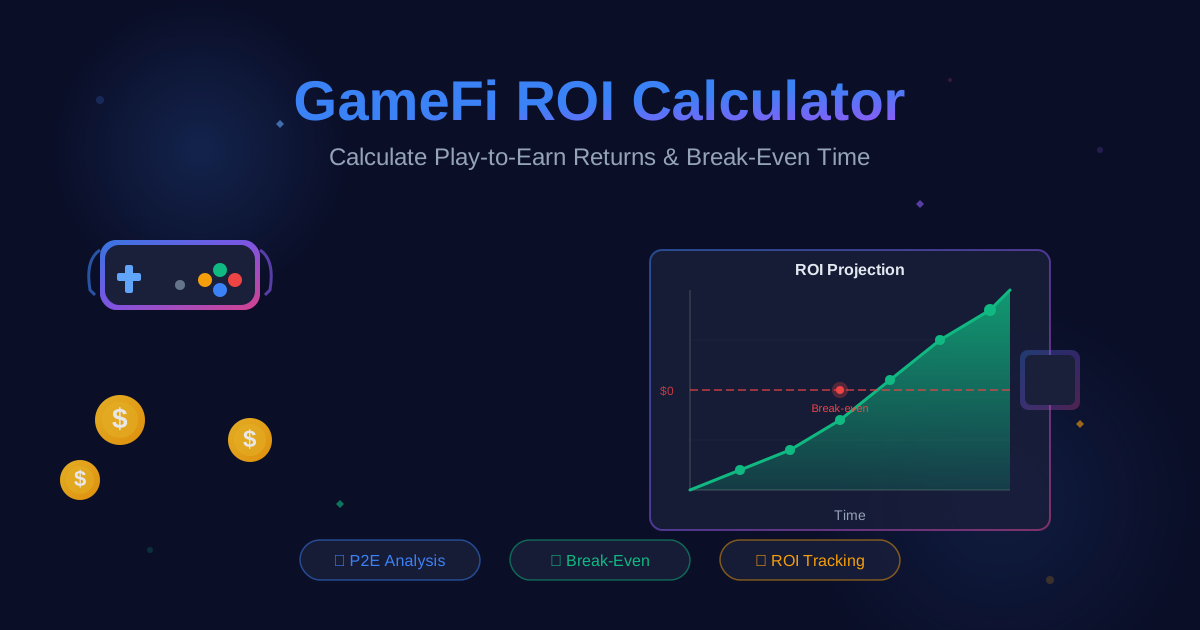
GameFi ROI Calculator: Calculate Play-to-Earn Returns & Break-Even Time
Complete guide to GameFi and Play-to-Earn ROI calculation. Learn how to analyze Axie Infinity, STEPN, Illuvium earnings, NFT breeding costs, scholarship programs, and break-even scenarios with our free P2E calculator.
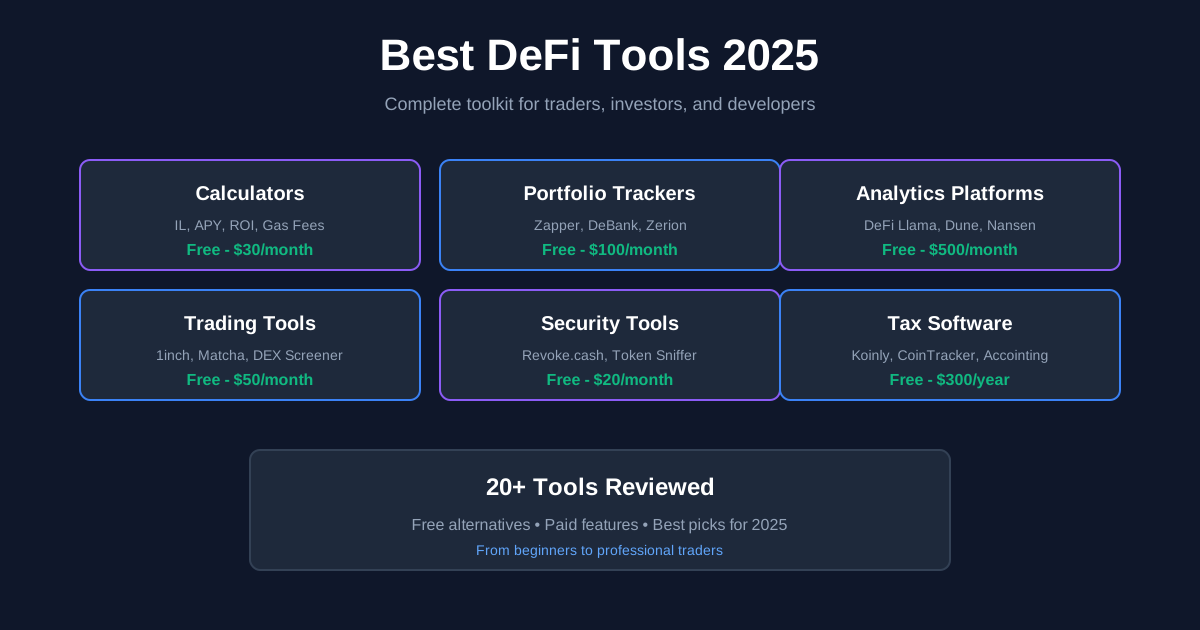
Best Tools for DeFi Traders in 2025: Complete Toolkit Guide
Discover the essential DeFi trading tools every trader needs in 2025. From calculators to analytics platforms, portfolio trackers to security tools - your complete guide to trading DeFi like a pro.
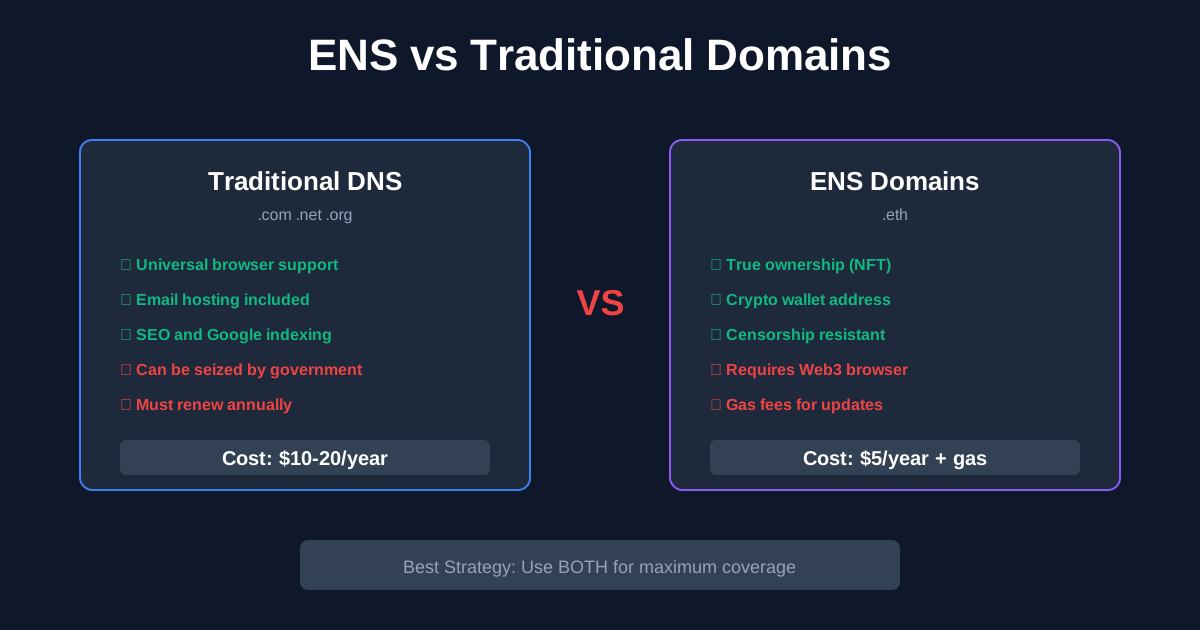
ENS vs Traditional Domains: Complete Comparison 2025
Comprehensive comparison of ENS domains and traditional DNS domains. Learn the differences, pros, cons, costs, and which domain system is right for your needs.