Understanding Slippage in DEX Trading: Complete Guide 2025
Understanding Slippage in DEX Trading: Complete Guide 2025
If you've ever traded on a decentralized exchange (DEX) like Uniswap or PancakeSwap, you've likely encountered slippage—the difference between the expected price of a trade and the actual execution price. Understanding slippage is crucial for optimizing your DeFi trading strategy and minimizing unexpected losses.
In this comprehensive guide, we'll break down everything you need to know about slippage: what causes it, how to calculate it, strategies to minimize it, and advanced techniques to protect your trades from excessive slippage and MEV attacks.
What is Slippage?
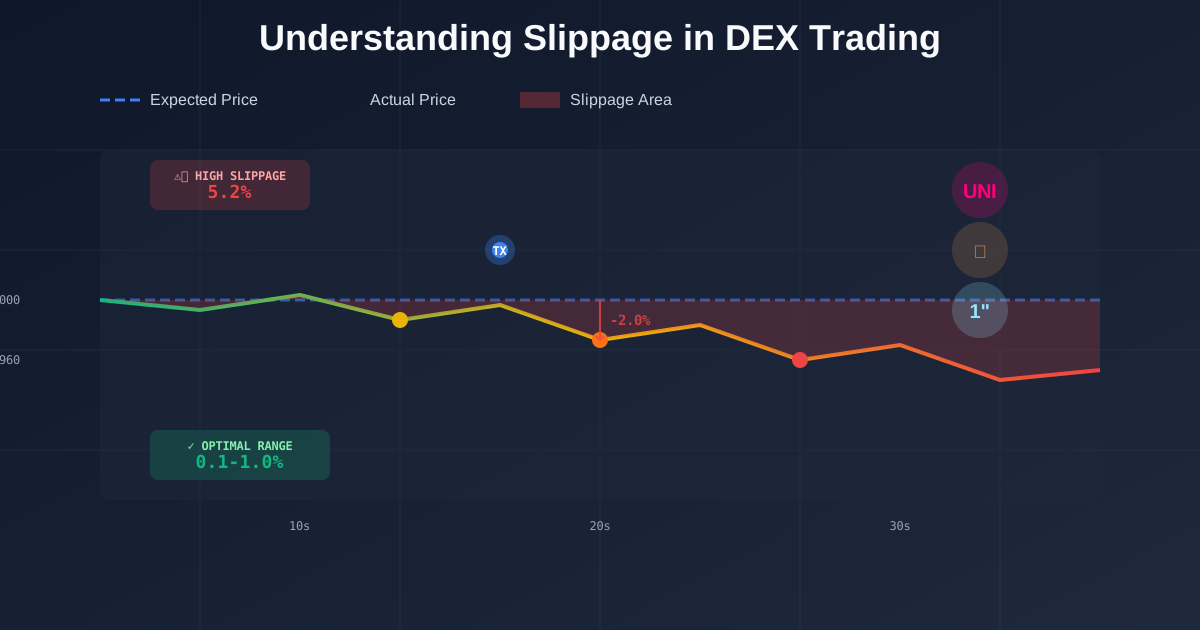
Slippage occurs when the price at which your trade executes differs from the price you expected when you initiated the transaction. This happens because cryptocurrency prices are constantly fluctuating, and the actual execution price depends on the state of the liquidity pool at the moment your transaction is confirmed on the blockchain.
Real-World Example
Imagine you want to swap 1 ETH for USDC on Uniswap:
- Expected Price: When you click "Swap," the interface shows you'll receive 2,000 USDC
- Actual Execution: By the time your transaction is confirmed (10-30 seconds later), you only receive 1,980 USDC
- Slippage: 20 USDC or 1% slippage
Types of Slippage
Positive Slippage (Rare):
- You receive more tokens than expected
- Example: Expected 100 USDT, received 101 USDT
- Happens when price moves in your favor during transaction processing
Negative Slippage (Common):
- You receive fewer tokens than expected
- Example: Expected 100 USDT, received 98 USDT
- Occurs when price moves against you or liquidity is low
What Causes Slippage?
1. Low Liquidity
The primary cause of high slippage is insufficient liquidity in the trading pair pool.
Low Liquidity Pool Example:
- Pool has only $10,000 total value locked (TVL)
- You want to swap $1,000 worth of tokens
- Your trade represents 10% of the pool → High slippage (5-15%)
High Liquidity Pool Example:
- Pool has $50 million TVL
- You swap $1,000
- Your trade represents 0.002% of the pool → Low slippage (<0.1%)
2. Trade Size (Price Impact)
Larger trades cause more price impact, which directly contributes to slippage.
Price Impact Formula (Simplified):
Price Impact ≈ (Trade Size / Pool Liquidity) × 100%
Example Calculation:
- Pool: 1,000 ETH + 2,000,000 USDC
- Your trade: 50 ETH
- Price Impact: (50 / 1,000) × 100% = 5%
3. Volatility
During periods of high market volatility, prices can change rapidly between when you submit a transaction and when it's confirmed.
High Volatility Scenarios:
- Major market news announcements
- Large token unlocks or airdrops
- Flash crashes or pumps
- Network congestion causing delayed confirmations
4. Network Congestion
When the blockchain network is congested:
- Transactions take longer to confirm
- More time for price to move against you
- Higher chance of being frontrun by MEV bots
Transaction Timing:
- Normal conditions: 10-20 seconds
- High congestion: 1-5 minutes
- Extreme congestion: 10+ minutes
5. MEV and Frontrunning
MEV (Maximal Extractable Value) bots can detect your pending transaction and place their own transaction ahead of yours to profit from the price movement.
Frontrunning Example:
- You submit a $10,000 buy order for Token X
- MEV bot detects your pending transaction
- Bot places their buy order first with higher gas
- Your transaction executes at a higher price
- Bot sells immediately for profit
How to Calculate Slippage
Basic Slippage Formula
Slippage % = ((Expected Price - Actual Price) / Expected Price) × 100
Calculation Example 1: Token Swap
Scenario: Swapping ETH for USDC on Uniswap
- Expected output: 2,000 USDC
- Actual output: 1,960 USDC
- Slippage = ((2,000 - 1,960) / 2,000) × 100 = 2%
Calculation Example 2: Price Impact
Before trade:
- Pool: 1,000 ETH + 2,000,000 USDC
- Price: 2,000 USDC per ETH
Your trade: Buy 50 ETH
After trade:
- Pool: 950 ETH + 2,100,000 USDC (you added 100k USDC)
- New price: 2,210 USDC per ETH
- Average execution price: 2,100 USDC per ETH
- Price impact: ((2,100 - 2,000) / 2,000) × 100 = 5%
Slippage Tolerance Setting
Most DEXs allow you to set a slippage tolerance (e.g., 0.5%, 1%, 5%):
- Too Low: Transaction might fail if price moves slightly
- Too High: Risk of receiving much less than expected
- Recommended: 0.5-1% for stable pairs, 1-3% for volatile pairs
Slippage vs. Price Impact: What's the Difference?
Price Impact
- The effect your trade itself has on the price
- Predictable and calculable before trading
- Depends on your trade size relative to pool liquidity
- Always happens on DEX trades
Slippage
- The difference between expected and actual execution price
- Unpredictable (due to volatility, congestion, MEV)
- Can be positive or negative
- Includes price impact + market movement + frontrunning
Example Breakdown:
- Price Impact: 2% (your trade moves the price)
- Market Movement: 0.5% (price changed while pending)
- MEV Frontrunning: 0.3% (bot got ahead of you)
- Total Slippage: 2.8%
How to Minimize Slippage: 8 Proven Strategies
1. Trade During Low Volatility Periods
Best Times to Trade:
- When no major news is expected
- During "quiet" market hours
- Avoid trading immediately after announcements
Volatility Indicators:
- Check 24-hour price change
- Look at trading volume spikes
- Use volatility indexes (if available)
2. Split Large Orders
Instead of one large trade, split it into multiple smaller trades.
Example:
- ❌ Single trade: $100,000 → 5-8% slippage
- ✅ 10 trades of $10,000 each → 0.5-1% slippage per trade
Tools for splitting:
- Manual splitting (wait between trades)
- TWAP (Time-Weighted Average Price) bots
- Smart order routing aggregators
3. Use DEX Aggregators
DEX aggregators find the best prices across multiple exchanges and automatically split your trade for optimal execution.
Top DEX Aggregators:
- 1inch: Routes across 100+ DEXs
- Matcha (0x): Professional trading interface
- Paraswap: Low fees, great routing
- CowSwap: MEV protection built-in
Benefits:
- Better prices (5-10% savings on average)
- Automatic route optimization
- Often lower slippage than single DEX
4. Choose High-Liquidity Pools
Always check the pool's total value locked (TVL) before trading.
Liquidity Tiers:
- Very High Liquidity: $10M+ TVL → <0.1% slippage for normal trades
- High Liquidity: $1M-$10M TVL → 0.1-0.5% slippage
- Medium Liquidity: $100K-$1M TVL → 0.5-2% slippage
- Low Liquidity: <$100K TVL → 2-20%+ slippage (avoid!)
Where to Check Liquidity:
- DEX interface (shows pool TVL)
- DeFi Llama
- Dex Screener
- CoinGecko (pool data)
5. Adjust Slippage Tolerance Correctly
Slippage Tolerance Guidelines:
| Trading Pair Type | Recommended Tolerance | Notes | |------------------|----------------------|-------| | Stablecoin-Stablecoin | 0.1-0.3% | USDC/USDT, DAI/USDC | | Major-Major | 0.5-1% | ETH/WBTC, ETH/USDC | | Major-Altcoin | 1-3% | ETH/UNI, BNB/CAKE | | Low Liquidity | 3-10% | New tokens, small pools |
Warning: Setting slippage >5% makes you vulnerable to MEV attacks and sandwich attacks.
6. Use Limit Orders (When Available)
Some DEXs now offer limit orders:
- Uniswap X: Gasless swaps with limit pricing
- dYdX: Advanced order types
- 1inch Limit Order Protocol: Free limit orders
Benefits:
- Zero slippage (trade at exact price or don't trade)
- No gas fees if order doesn't fill
- Protection from frontrunning
7. Increase Gas Price During Congestion
Faster confirmation = less time for price to move against you.
Gas Strategy:
- Normal market: Standard gas
- Volatile market: Fast gas (1.5x standard)
- Urgent trade: Rapid gas (2x standard)
Tools:
- Ethereum Gas Tracker
- Gas Now
- Built-in wallet gas estimators
8. Use MEV Protection Tools
Protect your trades from frontrunning and sandwich attacks.
MEV Protection Options:
- Flashbots Protect RPC: Free MEV protection for Ethereum
- CowSwap: Built-in MEV protection via batch auctions
- 1inch Fusion Mode: MEV-resistant order execution
- Private RPCs: Submit transactions privately
Advanced Slippage Strategies
Strategy 1: Time-Weighted Average Price (TWAP)
Execute large orders over time to minimize price impact.
TWAP Example:
- Total trade: $50,000
- Split into 20 orders of $2,500
- Execute every 15 minutes over 5 hours
- Result: 70% less slippage than single trade
TWAP Tools:
- Revert Finance
- DeFi Saver
- Custom smart contracts
Strategy 2: Concentrated Liquidity Pools (Uniswap V3)
Uniswap V3 concentrates liquidity in specific price ranges, offering:
- Deeper liquidity at current price
- Lower slippage for in-range trades
- Better capital efficiency
When to Use V3 vs V2:
- V3: Better for liquid pairs with stable price
- V2: Better for volatile or low-liquidity pairs
Strategy 3: Layer 2 Solutions
Trade on Layer 2 networks for:
- Lower gas fees (split orders more economically)
- Faster confirmations (less price movement)
- Growing liquidity
Top L2 DEXs:
- Arbitrum: Uniswap, Sushiswap, Camelot
- Optimism: Velodrome, Uniswap
- Base: Uniswap, Aerodrome
- Polygon zkEVM: QuickSwap
Common Slippage Mistakes to Avoid
❌ Mistake 1: Setting Slippage Too High "Just in Case"
Risk: Makes you vulnerable to sandwich attacks where MEV bots profit from your high tolerance.
Solution: Use appropriate slippage for the pair (0.5-2% for most trades).
❌ Mistake 2: Ignoring Price Impact Warnings
Risk: Executing trades with 10%+ price impact, losing significant value.
Solution: If price impact >5%, consider splitting the trade or using a different route.
❌ Mistake 3: Trading Illiquid Tokens Without Research
Risk: Extreme slippage (20-50%+), potential honeypot scams.
Solution: Check pool liquidity on Dex Screener before trading new tokens.
❌ Mistake 4: Not Using DEX Aggregators
Risk: Missing better prices available on other DEXs.
Solution: Always check 1inch or Matcha before large trades.
❌ Mistake 5: Trading During High Network Congestion
Risk: Delayed confirmations, higher slippage, failed transactions.
Solution: Monitor gas prices and wait for lower congestion when possible.
Real-World Slippage Case Studies
Case Study 1: The $500K Mistake
Scenario:
- Trader wanted to buy $500,000 worth of a mid-cap altcoin
- Pool had only $2M liquidity
- Set slippage tolerance to 10% "to ensure it goes through"
Outcome:
- Price impact: 8%
- MEV sandwich attack: Additional 7% loss
- Total loss: $75,000 in slippage
Lesson: Split large orders and use MEV protection.
Case Study 2: Positive Slippage Win
Scenario:
- Trader set slippage tolerance to 1% during volatile market
- Placed buy order for ETH during a flash crash
- Price bounced back while transaction was pending
Outcome:
- Expected: 1 ETH for $2,000
- Received: 1 ETH for $1,950
- Positive slippage: $50 gain
Lesson: Volatility can work in your favor, but it's rare.
Case Study 3: Failed Transaction Hell
Scenario:
- Trader set slippage to 0.1% for a volatile token
- Tried 10 times, all transactions failed
- Wasted $200 in gas fees
Outcome:
- Eventually increased slippage to 2%
- Trade executed successfully
- Total cost: $200 wasted gas + original trade
Lesson: Set appropriate slippage tolerance based on pair volatility.
Tools to Monitor and Reduce Slippage
1. Dex Screener
- Check pool liquidity before trading
- See historical slippage data
- Monitor trading volume
URL: https://dexscreener.com
2. Token Price Calculator (Our Tool)
Compare prices across multiple chains and DEXs instantly.
3. 1inch Network
Best DEX aggregator for optimal routing.
4. Etherscan Gas Tracker
Monitor network congestion to time your trades.
5. DeFi Llama
Check protocol liquidity and TVL data.
Slippage on Different Blockchains
Ethereum
- Pros: Highest liquidity, most DEX options
- Cons: High gas fees, network congestion
- Typical Slippage: 0.1-1% for major pairs
Binance Smart Chain (BSC)
- Pros: Low fees, fast confirmations
- Cons: Lower liquidity than Ethereum
- Typical Slippage: 0.3-2% for major pairs
Arbitrum & Optimism (L2s)
- Pros: Low fees, fast, growing liquidity
- Cons: Still less liquidity than Ethereum mainnet
- Typical Slippage: 0.2-1.5% for major pairs
Solana
- Pros: Extremely fast, very low fees
- Cons: Different DEX mechanics, occasional network issues
- Typical Slippage: 0.1-1% for major pairs
FAQ: Slippage in DEX Trading
What's a safe slippage tolerance?
For most trades, 0.5-1% is safe. Stablecoin swaps can use 0.1-0.3%, while volatile tokens may need 2-5%.
Can slippage be avoided completely?
No, but it can be minimized. Using limit orders (when available) eliminates slippage but trades may not execute.
Is high slippage always bad?
Yes. High slippage means you're losing value on your trade. If you see >5% slippage, reconsider the trade.
What's the difference between slippage and fees?
Fees are explicit costs (gas, trading fees). Slippage is the implicit cost from price movement.
Do all DEXs have the same slippage?
No. Slippage varies based on:
- Pool liquidity
- AMM algorithm (V2 vs V3)
- Network congestion
- MEV activity
How do DEX aggregators reduce slippage?
They split your trade across multiple DEXs and pools, finding the optimal route for best execution price.
Key Takeaways
✅ Slippage is the difference between expected and actual execution price
✅ Main causes: Low liquidity, large trade size, volatility, network congestion, MEV attacks
✅ Minimize slippage by: Using DEX aggregators, splitting large orders, trading during low volatility, choosing high-liquidity pools
✅ Set appropriate slippage tolerance: 0.5-1% for most trades, higher only when necessary
✅ Use MEV protection to avoid frontrunning and sandwich attacks
✅ Monitor price impact warnings before executing trades
✅ Layer 2 solutions offer lower fees and faster confirmations
Ready to Optimize Your Trades?
Understanding slippage is essential for successful DeFi trading. Use our calculators to plan your trades and minimize losses:
📊 Impermanent Loss Calculator - Calculate IL before providing liquidity
💱 Token Price Calculator - Compare prices across DEXs
⛽ Gas Fee Calculator - Optimize transaction timing
💰 DCA Calculator - Plan dollar-cost averaging strategy
Have questions about slippage or DEX trading? Drop a comment below!
Tags: #Slippage #DEX #DeFi #Uniswap #Trading #PriceImpact #MEV #Frontrunning
Share this article:
Related Articles
Best DEX Platforms: Complete Comparison 2025
Compare the top 10 decentralized exchanges (DEX) for trading and liquidity provision. In-depth analysis of Uniswap, PancakeSwap, Curve, dYdX, and more with TVL, fees, and feature comparisons.
AMM vs Order Book: Which is Better for Crypto Trading?
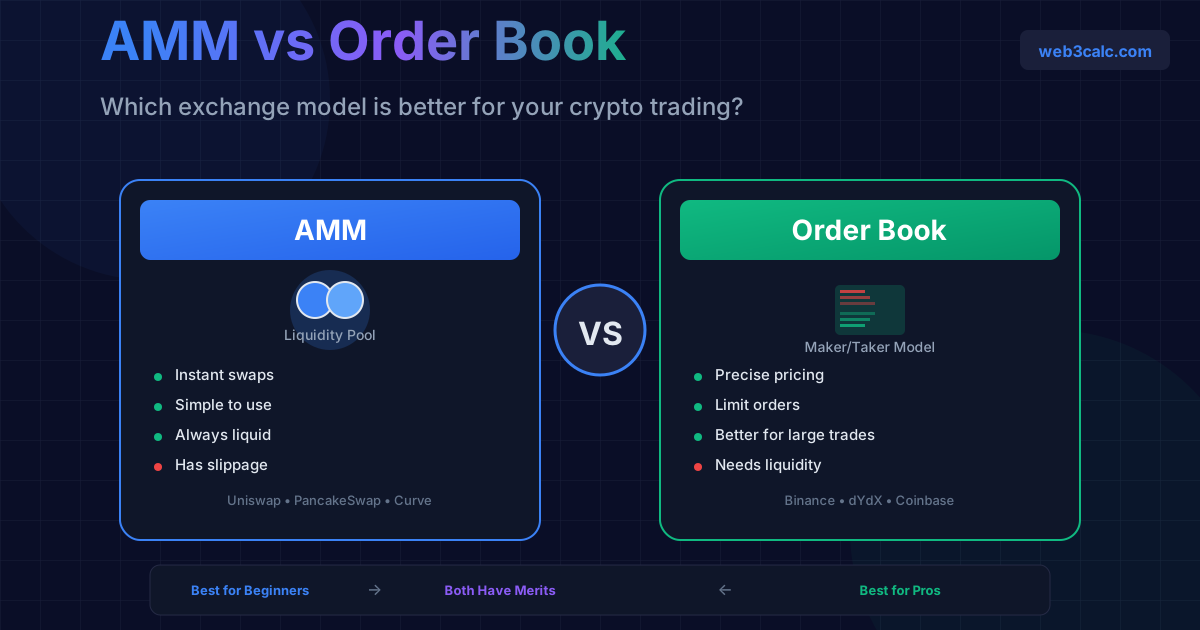
Understand the key differences between Automated Market Makers (AMMs) and Order Book exchanges. Learn which model suits your trading style and why both matter in DeFi.
How to Choose a Liquidity Pool: Complete Guide for DeFi Investors
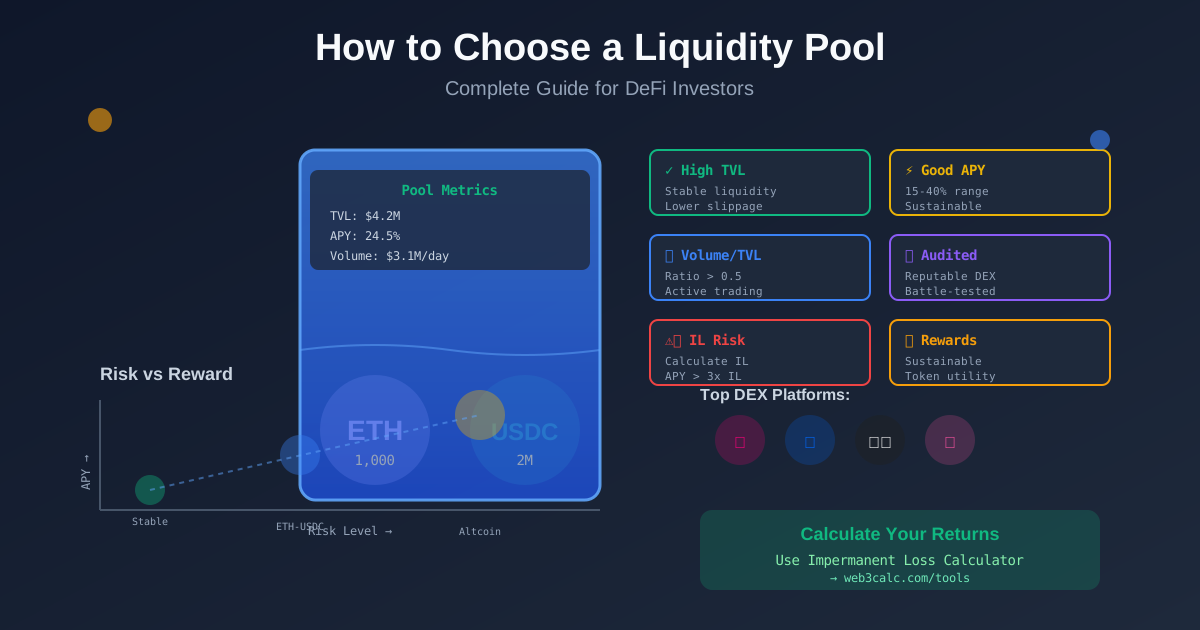
# How to Choose a Liquidity Pool: Complete Guide for DeFi Investors Choosing the right liquidity pool can make the difference between earning **50%+ APY** and losing money to impermanent loss. With...