AMM vs Order Book: Which is Better for Crypto Trading?
Understand the key differences between Automated Market Makers (AMMs) and Order Book exchanges. Learn which model suits your trading style and why both matter in DeFi.
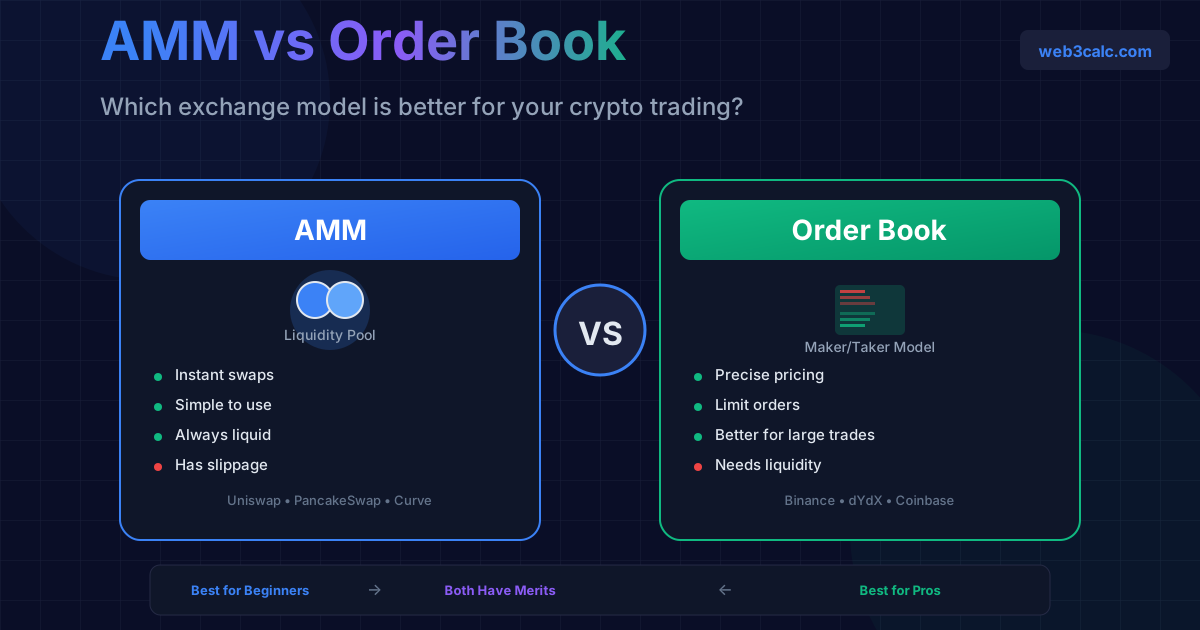
AMM vs Order Book: Which is Better for Crypto Trading?
When it comes to trading cryptocurrencies, two fundamental models dominate the space: Automated Market Makers (AMMs) and Order Book exchanges. Understanding the differences between these two systems is crucial for making informed trading decisions and choosing the right platform for your needs.
What is an Order Book Exchange?
Order book exchanges are the traditional model used by centralized exchanges (CEXs) like Binance, Coinbase, and Kraken. They're also used by decentralized platforms like dYdX and Serum.
How Order Books Work
An order book is a list of buy and sell orders organized by price level:
- Makers place limit orders specifying the price they want to trade at
- Takers place market orders that match with existing limit orders
- The exchange acts as a matching engine, connecting buyers with sellers
- Orders are executed when buy and sell prices overlap
Example:
Sell Orders (Asks):
1.5 ETH @ $2,005
2.0 ETH @ $2,003
3.0 ETH @ $2,001

Current Price: $2,000

Buy Orders (Bids):
2.5 ETH @ $1,999
3.0 ETH @ $1,997
4.0 ETH @ $1,995
If you place a market order to buy 2 ETH, it would execute at $2,001 (matching the lowest ask).
Advantages of Order Books
✅ Precise Price Control
- Set exact entry and exit prices
- Use limit orders, stop losses, and advanced order types
- No slippage on limit orders (you get the price you want or nothing)
✅ Capital Efficiency
- No need to lock capital in liquidity pools
- Trade with leverage (on platforms that support it)
- Instant order cancellation without penalties
✅ Better for Large Trades
- Deep order books reduce slippage
- Professional traders prefer order books
- More sophisticated trading strategies possible
✅ Price Discovery
- Market-driven pricing based on supply and demand
- Transparent bid-ask spreads
- Reflects true market sentiment
Disadvantages of Order Books
❌ Liquidity Fragmentation
- Requires active market makers
- Low-volume pairs may have poor liquidity
- Wide bid-ask spreads on less popular tokens
❌ Complexity
- Steeper learning curve for beginners
- Need to understand order types
- Can be overwhelming for simple swaps
❌ Front-Running Risk (On-Chain)
- In decentralized order books, MEV bots can front-run
- Higher gas costs for placing/canceling orders
- Transaction finality delays
❌ Centralization (CEXs)
- Most order book exchanges are centralized
- Custody risk (not your keys, not your coins)
- KYC requirements
What is an Automated Market Maker (AMM)?
AMMs revolutionized DeFi by eliminating the need for traditional order books. Platforms like Uniswap, PancakeSwap, and Curve use this model.
How AMMs Work
Instead of matching buyers with sellers, AMMs use liquidity pools and a mathematical formula to determine prices:
- Liquidity providers deposit token pairs into pools
- A pricing algorithm (like x*y=k) determines the exchange rate
- Traders swap directly with the pool
- Prices adjust automatically based on the pool's token ratio
Example (Constant Product Formula):
In a pool with 100 ETH and 200,000 USDC:
- k = 100 × 200,000 = 20,000,000
- Current price: 200,000 ÷ 100 = $2,000 per ETH
If you swap 10,000 USDC for ETH:
- New USDC: 210,000
- k ÷ 210,000 = 95.24 ETH remaining
- You receive: 100 - 95.24 = 4.76 ETH
- New price: 210,000 ÷ 95.24 = $2,205 per ETH
The price automatically increased due to the trade!
Advantages of AMMs
✅ Always Available Liquidity
- Trade anytime, 24/7, no waiting for matches
- No need for active market makers
- Works even for low-volume tokens
✅ Simple & User-Friendly
- Easy to understand: specify input, get output
- No order types to learn
- Perfect for quick swaps
✅ Permissionless Listing
- Anyone can create a liquidity pool
- No centralized authority approving tokens
- Promotes innovation and new projects
✅ Passive Income for LPs
- Earn trading fees by providing liquidity
- Additional token rewards (yield farming)
- No active management needed (in V2 pools)
✅ Decentralized & Trustless
- Non-custodial (you control your keys)
- No KYC requirements
- Censorship-resistant
Disadvantages of AMMs
❌ Slippage
- Price changes as you trade
- Large trades cause significant slippage
- No guaranteed execution price
❌ Impermanent Loss
- Liquidity providers can lose money from price divergence
- Risk increases with volatile pairs
- Use our Impermanent Loss Calculator to estimate risks
❌ Capital Inefficiency
- Liquidity spread across all price ranges (in V2)
- Much capital sits idle, unused
- Lower returns for LPs compared to concentrated liquidity
❌ MEV & Front-Running
- Vulnerable to sandwich attacks
- Bots can extract value from your trades
- Can result in worse execution prices
❌ Gas Fees
- Every swap requires an on-chain transaction
- High gas costs on Ethereum mainnet
- Can be expensive for small trades
Key Differences: Side-by-Side Comparison
🔄 Price Determination
- AMM: Algorithmic (x*y=k formula)
- Order Book: Market-driven (supply/demand)
💧 Liquidity
- AMM: Pool-based (passive)
- Order Book: Order-based (active makers)
💱 Trading
- AMM: Instant swaps
- Order Book: Maker/taker model
📉 Slippage
- AMM: Always present
- Order Book: Only on market orders
🎯 Price Control
- AMM: No (market orders only)
- Order Book: Yes (limit orders)
💰 Capital Efficiency
- AMM: Lower (V2), Higher (V3)
- Order Book: High
👤 Ease of Use
- AMM: Very simple
- Order Book: More complex
⛽ Gas Costs
- AMM: Medium-High
- Order Book: Low-High (depending on chain)
💵 Liquidity Provider Income
- AMM: Trading fees + incentives
- Order Book: Spread capture (market makers)
⚠️ Risk for LPs
- AMM: Impermanent loss
- Order Book: Inventory risk
🌐 Decentralization
- AMM: Fully decentralized
- Order Book: Varies (CEX vs DEX)
✅ Best For
- AMM: Quick swaps, small trades
- Order Book: Large trades, precise pricing
Hybrid Models: The Best of Both Worlds?
Some platforms are combining AMM and order book features:
1. Order Book AMMs
Example: dYdX V3 (transitioning to V4)
- Uses an order book interface
- Backed by liquidity pools
- Offers leverage and advanced features
2. Concentrated Liquidity AMMs
Example: Uniswap V3
- LPs provide liquidity in specific price ranges
- Mimics order book depth
- Higher capital efficiency (up to 4000x)
3. Request for Quote (RFQ)
Example: 0x, 1inch Fusion
- Professional market makers provide quotes
- Users get best price from multiple sources
- Combines AMM pools and market maker liquidity
4. Virtual AMMs (vAMMs)
Example: Perpetual Protocol, GMX
- Order book-like interface
- AMM pricing mechanism underneath
- Used for perpetual futures and derivatives
Which Model is Better for You?
Choose Order Books If You:
✅ Are an experienced trader ✅ Need precise price control (limit orders) ✅ Execute large trades regularly ✅ Want to use leverage ✅ Trade high-volume pairs ✅ Don't mind CEX custody (for better liquidity)
Best Platforms:
- Centralized: Binance, Coinbase Pro, Kraken
- Decentralized: dYdX, Serum (Solana), Vertex Protocol
Choose AMMs If You:
✅ Are a beginner or casual trader ✅ Want simple, quick swaps ✅ Trade low-volume or new tokens ✅ Value decentralization and self-custody ✅ Want to earn passive income as LP ✅ Prefer no KYC
Best Platforms:
- Ethereum: Uniswap, Curve, Balancer
- BSC: PancakeSwap, Biswap
- Arbitrum: Camelot, Trader Joe
- Solana: Raydium, Orca
Use Both!
Many traders use a hybrid approach:
- AMMs for small swaps, new tokens, and LP opportunities
- Order books for large trades, precise entries/exits, and leverage
Real-World Trading Scenarios
Scenario 1: Swapping $100 of ETH to USDC
AMM Approach (Uniswap):
- Connect wallet
- Enter amount
- Review quote (includes slippage)
- Confirm transaction
- Done in 15 seconds
- Gas: ~$10-30
Order Book Approach (Coinbase Pro):
- Login to exchange
- Navigate to ETH/USDC
- Place limit or market order
- Wait for execution
- Withdraw to wallet (additional gas)
- Gas: $5-15 + withdrawal fees
Winner: AMM (faster, more convenient for small amounts)
Scenario 2: Trading $50,000 of ETH to USDC
AMM Approach:
- Significant slippage (~1-3%)
- Pay $500-1,500 in slippage
- Higher gas fees
- Instant execution
Order Book Approach:
- Minimal slippage with limit order
- Better price execution
- Lower fees (0.1-0.5% maker/taker)
- Pay $50-250 in fees
Winner: Order Book (much better for large trades)
Scenario 3: Buying a New Low-Cap Token
AMM Approach:
- Token available immediately after launch
- Create pool permissionlessly
- High slippage but trades available
- Risk of rug pulls
Order Book Approach:
- Need CEX listing (takes weeks/months)
- Often not available for new projects
- Better protection from scams (listing requirements)
Winner: AMM (only option for new tokens)
Scenario 4: Providing Liquidity to Earn Passive Income
AMM Approach:
- Deposit tokens into pool
- Earn trading fees automatically
- Additional token rewards
- Risk: impermanent loss
- Use IL Calculator
Order Book Approach:
- Become a market maker
- Requires active management
- Profit from bid-ask spread
- Risk: inventory risk
- Need sophisticated bots/strategies
Winner: AMM (much more accessible for retail)
Advanced Considerations
Impermanent Loss in AMMs
AMMs have a unique risk called impermanent loss. When prices change, LPs can end up with less value than if they'd just held the tokens.
Example:
- Deposit: 1 ETH ($2,000) + 2,000 USDC
- ETH rises to $4,000
- Pool rebalances: 0.707 ETH + 2,828 USDC = $5,656
- If held: 1 ETH + 2,000 USDC = $6,000
- Loss: $344 (5.7% impermanent loss)
However, trading fees can offset this loss. Learn more in our Impermanent Loss guide.
MEV (Maximal Extractable Value)
Both models are vulnerable to MEV, but in different ways:
AMMs:
- Sandwich attacks (front-run + back-run your trade)
- Use MEV protection (Flashbots, CowSwap)
- Set appropriate slippage tolerance
Order Books:
- Front-running limit orders
- Time-bandit attacks on DEXs
- Less problematic on CEXs
Gas Optimization
AMMs:
- Batch transactions when possible
- Use L2s (Arbitrum, Optimism)
- Consider alternative chains (BSC, Polygon)
- Aggregate swaps (1inch, Matcha)
Order Books:
- Single transaction for execution
- Multiple transactions for order placement/cancellation
- Can be gas-intensive on-chain
The Future: Convergence of Models
The crypto space is evolving toward hybrid solutions:
Upcoming Innovations
-
Intent-Based Trading
- Users specify intent ("Buy X amount of Y")
- Solvers find best execution (AMM, order book, or both)
- Example: 1inch Fusion, Cow Protocol
-
Cross-Chain Liquidity
- Unified liquidity across chains
- No need to bridge tokens first
- Example: Thorchain, Stargate
-
Dynamic AMMs
- Parameters adjust based on market conditions
- Hybrid pricing mechanisms
- Example: DODO, Maverick Protocol
-
Professional Market Makers in DeFi
- Institutional liquidity providers
- Better prices and deeper liquidity
- Bridging CeFi and DeFi
Best Practices for Trading
For AMM Trading:
- ✅ Check slippage before large swaps
- ✅ Use price aggregators (1inch, Matcha) to find best rates
- ✅ Set appropriate slippage tolerance (0.5-1% for normal tokens)
- ✅ Enable MEV protection when available
- ✅ Consider gas costs relative to trade size
- ✅ Verify token contract to avoid scams
For Order Book Trading:
- ✅ Use limit orders for better prices
- ✅ Check order book depth before large trades
- ✅ Set stop losses to manage risk
- ✅ Use maker orders to avoid taker fees
- ✅ Consider time-in-force options
- ✅ Monitor for slippage on market orders
Tools to Help You Trade
Whether you prefer AMMs or order books, these tools will help:
For AMM Users:
- Impermanent Loss Calculator - Estimate IL before providing liquidity
- Multi-chain Token Price - Compare prices across different AMMs
- DeFi Llama - Find best APY for liquidity provision
- 1inch - Price aggregation across multiple AMMs
For Order Book Users:
- TradingView - Advanced charting and analysis
- CoinGecko - Compare prices across CEXs
- Token Terminal - Track DEX metrics and volume
- DexScreener - Monitor order book DEXs
Conclusion: There's No Single "Best" Model
Both AMMs and order books have their place in the crypto ecosystem:
- AMMs democratized market making and made DeFi accessible to everyone
- Order books provide better execution for professional traders and large trades
- Hybrid models are emerging to combine the best of both worlds
Your choice depends on:
- Trade size
- Desired price control
- Need for decentralization
- Available liquidity
- Trading frequency
- Experience level
Most successful traders use both models depending on the situation. Start with AMMs for simplicity, then explore order books as you gain experience.
What's Your Trading Style?
Now that you understand the differences, which model do you prefer? Try both and see what works for your needs!
For quick swaps and DeFi exploration:
- Use AMMs like Uniswap, PancakeSwap, or Trader Joe
For serious trading and large positions:
- Use order book exchanges like Binance, dYdX, or Vertex
For passive income:
- Provide liquidity on AMMs and use our tools to optimize returns
Ready to Start Trading?
Use our free tools to make better trading decisions:
- Impermanent Loss Calculator - Before providing liquidity
- Multi-chain Token Price - Compare prices across exchanges
- ENS Checker - Get your Web3 identity
Disclaimer: This article is for educational purposes only and does not constitute financial advice. Cryptocurrency trading carries significant risk. Always do your own research and never invest more than you can afford to lose.
Share this article:
Related Articles
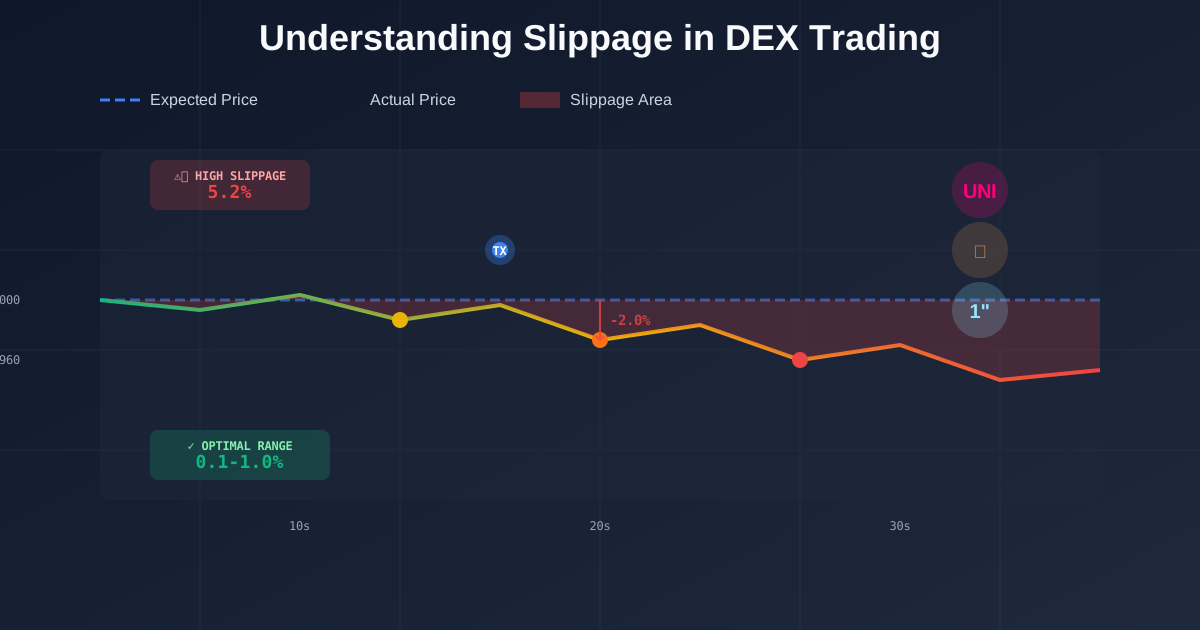
Understanding Slippage in DEX Trading: Complete Guide 2025
# Understanding Slippage in DEX Trading: Complete Guide 2025 If you've ever traded on a decentralized exchange (DEX) like Uniswap or PancakeSwap, you've likely encountered **slippage**—the differenc...
Best DEX Platforms: Complete Comparison 2025
Compare the top 10 decentralized exchanges (DEX) for trading and liquidity provision. In-depth analysis of Uniswap, PancakeSwap, Curve, dYdX, and more with TVL, fees, and feature comparisons.
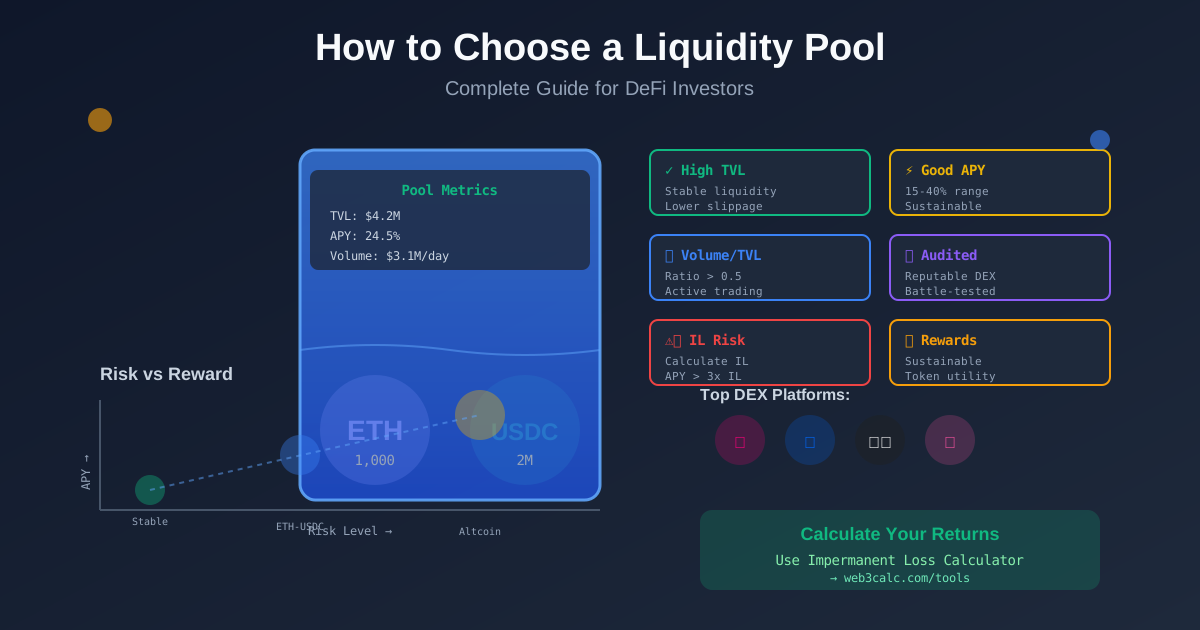
How to Choose a Liquidity Pool: Complete Guide for DeFi Investors
# How to Choose a Liquidity Pool: Complete Guide for DeFi Investors Choosing the right liquidity pool can make the difference between earning **50%+ APY** and losing money to impermanent loss. With...