How to Calculate Crypto Trading Profit and Loss: Complete Guide
Master crypto trading P&L calculations with our comprehensive guide. Learn formulas, tax implications, fee optimization, and performance metrics for successful trading.
How to Calculate Crypto Trading Profit and Loss: Complete Guide
Trading cryptocurrency can be exciting and potentially profitable, but accurately tracking your profits and losses is crucial for success. Whether you're day trading Bitcoin, swing trading altcoins, or HODLing for the long term, understanding your trading P&L (Profit and Loss) helps you make better decisions, optimize your strategy, and stay compliant with tax regulations.
TL;DR:
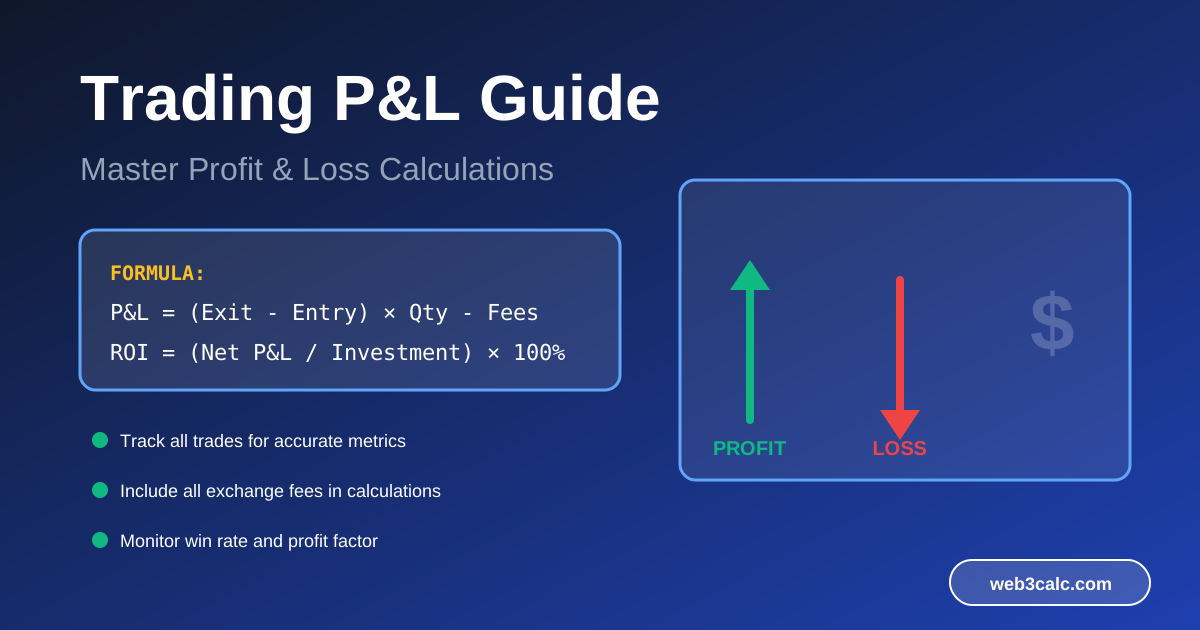
- P&L = (Exit Price - Entry Price) × Quantity - Fees
- Always account for exchange fees (0.1-0.6% per trade)
- Track every trade for tax reporting
- Calculate ROI: (Net Profit / Investment) × 100%
- Use our Trading P&L Calculator for instant results
Table of Contents
- Understanding Trading P&L
- Basic P&L Formula
- Accounting for Fees
- Long vs Short Positions
- Performance Metrics
- Tax Implications
- Real-World Examples
- Common Mistakes
Understanding Trading P&L
Trading Profit and Loss (P&L) measures the financial outcome of your trades. It answers the fundamental question: "Did I make money on this trade?"
Components of P&L
1. Gross P&L The raw difference between your entry and exit values before fees:
Gross P&L = (Exit Price - Entry Price) × Quantity
2. Net P&L The actual profit or loss after all costs:
Net P&L = Gross P&L - Total Fees
3. Return on Investment (ROI) The percentage return relative to your initial investment:
ROI = (Net P&L / Entry Value) × 100%
Why Calculate P&L?
Track Performance
- Identify which strategies work
- Measure improvement over time
- Compare with market benchmarks
Risk Management
- Monitor position sizes
- Calculate risk/reward ratios
- Set appropriate stop losses
Tax Compliance
- Report capital gains accurately
- Minimize tax liability legally
- Avoid penalties and audits
Strategy Optimization
- Analyze win rates
- Calculate profit factors
- Refine entry/exit timing
Basic P&L Formula
Let's break down the essential formula with a simple example:
Formula Components
Entry Value = Entry Price × Quantity
Exit Value = Exit Price × Quantity
Gross P&L = Exit Value - Entry Value
Total Fees = Entry Fee + Exit Fee
Net P&L = Gross P&L - Total Fees
ROI = (Net P&L / Entry Value) × 100%
Example: Bitcoin Trade
Trade Details:
- Entry: Buy 0.5 BTC at $30,000
- Exit: Sell 0.5 BTC at $35,000
- Exchange: Binance (0.1% maker/taker)
Calculations:
Entry Value = $30,000 × 0.5 = $15,000
Exit Value = $35,000 × 0.5 = $17,500
Gross P&L = $17,500 - $15,000 = $2,500

Entry Fee = $15,000 × 0.1% = $15.00
Exit Fee = $17,500 × 0.1% = $17.50
Total Fees = $15.00 + $17.50 = $32.50

Net P&L = $2,500 - $32.50 = $2,467.50
ROI = ($2,467.50 / $15,000) × 100% = 16.45%
Result: Profit of $2,467.50 (16.45% ROI)
Accounting for Fees
Exchange fees can significantly impact your profitability, especially for frequent traders. Understanding fee structures is crucial.
Common Exchange Fee Types
1. Trading Fees
- Maker Fees: Orders that add liquidity (limit orders)
- Taker Fees: Orders that remove liquidity (market orders)
- Typically 0.1-0.6% per trade
2. Withdrawal Fees
- Fixed fee per withdrawal
- Varies by cryptocurrency
- Can be substantial for small amounts
3. Network Fees
- Gas fees (Ethereum, BSC, etc.)
- Required for on-chain transactions
- Separate from exchange fees
Exchange Fee Comparison
| Exchange | Maker Fee | Taker Fee | Notes | |----------|-----------|-----------|-------| | Binance | 0.10% | 0.10% | 25% discount with BNB | | Coinbase Pro | 0.40% | 0.60% | Volume-based tiers | | Kraken | 0.16% | 0.26% | Decreases with volume | | KuCoin | 0.10% | 0.10% | 20% discount with KCS | | Bybit | 0.10% | 0.10% | Varies by contract |
Fee Optimization Strategies
1. Use Limit Orders Maker fees are almost always lower than taker fees. Place limit orders instead of market orders when possible.
2. Volume Discounts Many exchanges offer reduced fees for high-volume traders. Check if you qualify for lower tiers.
3. Exchange Tokens Hold native tokens (BNB, KCS) for fee discounts:
- Binance: 25% discount with BNB
- KuCoin: 20% discount with KCS
4. Batch Transactions Consolidate multiple small trades into larger ones to minimize fee impact.
5. Calculate Break-Even Know your break-even price including fees:
Break-Even Price = Entry Price × (1 + Total Fee %)
Fee Impact Example
Trade: $10,000 worth of ETH
Scenario 1: High Fees (0.6%)
Entry Fee: $60
Exit Fee: $60
Total Fees: $120
Required Gain: 1.2% just to break even
Scenario 2: Low Fees (0.1%)
Entry Fee: $10
Exit Fee: $10
Total Fees: $20
Required Gain: 0.2% to break even
Impact: High fees require 6x larger price movement to break even!
Long vs Short Positions
P&L calculations differ between long (buy) and short (sell) positions.
Long Position (Buy)
Profit when price goes up.
Formula:
P&L = (Exit Price - Entry Price) × Quantity - Fees
Example:
Entry: Buy 1 ETH at $2,000
Exit: Sell 1 ETH at $2,500
P&L = ($2,500 - $2,000) × 1 = $500
Short Position (Sell)
Profit when price goes down.
Formula:
P&L = (Entry Price - Exit Price) × Quantity - Fees
Example:
Entry: Short 1 ETH at $2,000
Exit: Cover at $1,500
P&L = ($2,000 - $1,500) × 1 = $500
Liquidation Risk
For leveraged shorts, monitor liquidation price:
Liquidation Price = Entry Price × (1 + 1/Leverage)
Example: Short ETH at $2,000 with 10x leverage:
Liquidation = $2,000 × (1 + 1/10) = $2,200
If ETH hits $2,200, your position gets liquidated!
Performance Metrics
Beyond simple P&L, advanced metrics help evaluate trading performance.
1. Win Rate
Percentage of profitable trades:
Win Rate = (Winning Trades / Total Trades) × 100%
Interpretation:
- 50-60%: Good for most strategies
- 40-50%: Acceptable if wins > losses
- <40%: Strategy needs improvement
Example:
Total Trades: 20
Winning Trades: 14
Win Rate = (14 / 20) × 100% = 70%
2. Average Win/Loss
Average Win = Total Profits / Number of Wins
Average Loss = Total Losses / Number of Losses
Goal: Average Win should be ≥ Average Loss
Example:
Total Profits: $5,000 (10 wins)
Total Losses: $2,000 (10 losses)

Avg Win = $5,000 / 10 = $500
Avg Loss = $2,000 / 10 = $200
Ratio = 2.5:1 (Excellent!)
3. Profit Factor
Ratio of gross profits to gross losses:
Profit Factor = Total Profits / Total Losses
Interpretation:
- <1.0: Losing strategy
- 1.0-1.5: Break-even to marginal
- 1.5-2.0: Good
-
2.0: Excellent
Example:
Total Profits: $10,000
Total Losses: $4,000
Profit Factor = $10,000 / $4,000 = 2.5
4. Risk/Reward Ratio
Expected profit vs potential loss per trade:
R/R Ratio = Potential Profit / Potential Loss
Best Practice: Aim for ≥ 1:2 (risk $1 to make $2)
Example:
Entry: $30,000 BTC
Stop Loss: $29,000 (risk $1,000)
Target: $34,000 (profit $4,000)
R/R = $4,000 / $1,000 = 4:1
5. Sharpe Ratio
Risk-adjusted return (advanced):
Sharpe Ratio = (Avg Return - Risk-Free Rate) / Std Deviation
Interpretation:
- <1: Poor risk-adjusted returns
- 1-2: Good
-
2: Excellent
Use our Trading P&L Calculator to automatically track these metrics!
Tax Implications
Crypto trading is taxable in most jurisdictions. Accurate P&L tracking is essential for compliance.
United States (IRS)
Tax Treatment:
- Crypto = Property (not currency)
- Every trade = Taxable event
- Must report on Form 8949 and Schedule D
Short-Term Capital Gains
- Held < 1 year
- Taxed as ordinary income (10-37%)
Long-Term Capital Gains
- Held > 1 year
- Preferential rates (0%, 15%, 20%)
Capital Losses
- Offset gains dollar-for-dollar
- Up to $3,000 deductible against ordinary income
- Carry forward unlimited losses
Example:
Short-term gain: $10,000
Long-term loss: $5,000
Net gain: $5,000

Tax (22% bracket):
Short-term: $10,000 × 22% = $2,200
Long-term: $0 (loss offsets)
Total Tax: $2,200
European Union
Tax treatment varies by country:
Germany
- Tax-free after 1 year holding
- <1 year: Progressive tax (0-45%)
UK
- Capital Gains Tax (10% or 20%)
- £12,300 annual allowance (2023)
France
- Flat 30% tax on crypto gains
- Option for progressive scale
Portugal
- No capital gains tax on crypto (for now)
Record-Keeping Requirements
What to Track:
- Date and time of trade
- Asset traded (BTC, ETH, etc.)
- Quantity bought/sold
- Price in fiat (USD, EUR, etc.)
- Total fees paid
- Exchange used
- Wallet addresses (if applicable)
Accounting Methods:
FIFO (First In, First Out)
- Sell oldest coins first
- Default method in most countries
- Usually results in higher taxes (early coins cheaper)
LIFO (Last In, First Out)
- Sell newest coins first
- Can reduce taxes in bull markets
Specific Identification
- Choose which exact coins to sell
- Maximum tax optimization
- Requires meticulous records
Example: FIFO vs LIFO
Purchase History:
- Jan 1: Buy 1 BTC at $20,000
- Feb 1: Buy 1 BTC at $30,000
- Mar 1: Sell 1 BTC at $40,000
FIFO:
Cost Basis: $20,000 (Jan purchase)
Gain: $40,000 - $20,000 = $20,000
LIFO:
Cost Basis: $30,000 (Feb purchase)
Gain: $40,000 - $30,000 = $10,000
LIFO results in $10,000 less taxable gain!
Tax Software
Consider crypto tax software for automated tracking:
- CoinTracker: Popular, supports 300+ exchanges
- Koinly: Great UI, affordable
- TaxBit: Institutional-grade
- ZenLedger: Tax professional preferred
Export trades from our calculator to CSV for easy import!
Real-World Examples
Let's walk through complete scenarios from entry to exit.
Example 1: Successful Day Trade
Trader Profile: Active day trader on Binance
Trade Setup:
- Asset: Bitcoin (BTC)
- Entry: $30,000
- Quantity: 0.1 BTC
- Exit: $31,500 (same day)
- Fees: 0.1% maker/taker
Step-by-Step Calculation:
- Entry Value
Entry Value = $30,000 × 0.1 = $3,000
Entry Fee = $3,000 × 0.1% = $3.00
Total Entry Cost = $3,003.00
- Exit Value
Exit Value = $31,500 × 0.1 = $3,150
Exit Fee = $3,150 × 0.1% = $3.15
Net Proceeds = $3,146.85
- P&L Calculation
Gross P&L = $3,150 - $3,000 = $150
Total Fees = $3.00 + $3.15 = $6.15
Net P&L = $150 - $6.15 = $143.85
ROI = ($143.85 / $3,000) × 100% = 4.80%
Result: $143.85 profit (4.80% ROI) in one day
Tax Note: Short-term gain, taxed as ordinary income.
Example 2: Loss-Making Swing Trade
Trader Profile: Swing trader on Coinbase Pro
Trade Setup:
- Asset: Ethereum (ETH)
- Entry: $2,000
- Quantity: 5 ETH
- Exit: $1,800 (1 week later)
- Fees: 0.4% maker, 0.6% taker
Calculation:
- Entry
Entry Value = $2,000 × 5 = $10,000
Entry Fee = $10,000 × 0.4% = $40.00
Total Cost = $10,040.00
- Exit
Exit Value = $1,800 × 5 = $9,000
Exit Fee = $9,000 × 0.6% = $54.00
Net Proceeds = $8,946.00
- P&L
Gross Loss = $9,000 - $10,000 = -$1,000
Total Fees = $40 + $54 = $94.00
Net Loss = -$1,000 - $94 = -$1,094
ROI = (-$1,094 / $10,000) × 100% = -10.94%
Result: -$1,094 loss (-10.94% ROI)
Tax Benefit: Can offset other gains or deduct $3,000 against income (US).
Example 3: Multiple Trades Portfolio
Trader Profile: Medium-activity trader, 10 trades/month
Monthly Trades:
- BTC: +$500
- ETH: -$200
- BTC: +$300
- SOL: +$150
- ETH: -$100
- BTC: +$450
- ADA: +$80
- DOT: -$150
- BTC: +$220
- AVAX: +$100
Aggregate Analysis:
Total P&L = $500 - $200 + $300 + $150 - $100
          + $450 + $80 - $150 + $220 + $100
        = $1,350

Total Investment = $15,000
Winning Trades = 7
Losing Trades = 3
Win Rate = 70%

Total Wins = $1,800
Total Losses = $450
Avg Win = $1,800 / 7 = $257.14
Avg Loss = $450 / 3 = $150.00
Profit Factor = $1,800 / $450 = 4.0

ROI = ($1,350 / $15,000) × 100% = 9.0%
Excellent Performance:
- 70% win rate
- 4.0 profit factor
- Average wins 1.7x larger than losses
- 9% monthly return
Common Mistakes to Avoid
1. Ignoring Fees
Mistake: Calculating P&L without including exchange fees.
Impact: Overestimating profits, especially for frequent traders.
Example:
Without Fees: $1,000 profit
With 0.2% Fees: $980 profit
Difference: $20 (2% error)

Over 50 trades: $1,000 in missing fees!
Solution: Always include fees in calculations. Use our calculator which accounts for all fee types.
2. Not Tracking Trades
Mistake: Failing to record trade details for taxes.
Impact:
- Inaccurate tax returns
- Penalties and audits
- Missed loss deductions
Solution: Log every trade immediately. Export to CSV from our calculator.
3. Revenge Trading
Mistake: Trying to quickly recover losses with larger positions.
Impact:
- Emotional decisions
- Bigger losses
- Account blow-up
Example:
Loss 1: -$500
Revenge Trade (2x size): -$1,200
Total Loss: -$1,700 (3.4x original)
Solution: Stick to your strategy. Use stop losses. Take breaks after losses.
4. Over-Trading
Mistake: Making too many trades, paying excessive fees.
Impact: "Death by a thousand cuts" - small fees add up.
Example:
100 trades/month × $20 fees = $2,000/month
Annual fees: $24,000!

Must make $24,000 profit just to break even
Solution: Trade less frequently. Focus on quality setups.
5. Wrong Cost Basis
Mistake: Using incorrect accounting method (FIFO/LIFO).
Impact: Overpaying taxes or IRS disputes.
Example:
FIFO: $20,000 gain
LIFO: $10,000 gain
Tax Difference (22%): $2,200!
Solution: Understand your jurisdiction's rules. Use crypto tax software.
6. Forgetting Slippage
Mistake: Not accounting for slippage on large market orders.
Impact: Actual execution price differs from expected.
Example:
Expected: Buy at $30,000
Actual: Buy at $30,150 (0.5% slippage)
On $10,000 trade: $50 loss
Solution: Use limit orders. Check order book depth. Split large orders.
7. Ignoring Withdrawal Fees
Mistake: Only tracking trading fees, not withdrawal costs.
Impact: Hidden costs reduce net profits.
Example:
Trading Profit: $500
Withdrawal Fee: $25 (ETH network)
Net Profit: $475 (5% less!)
Solution: Factor in all costs. Batch withdrawals when possible.
Tools and Resources
Free Tools
Web3Calc Trading P&L Calculator
- Calculate single trade P&L instantly
- Track multiple trades
- Export to CSV for taxes
- Performance metrics
- Try it now →
Complementary Calculators
- Crypto Tax Calculator - Estimate capital gains tax
- Portfolio Tracker - Monitor overall performance
- DCA Calculator - Plan dollar-cost averaging
- Gas Fee Calculator - Optimize transaction costs
Premium Software
Tax Software
- CoinTracker ($59-$999/year)
- Koinly ($49-$279/year)
- TaxBit (Enterprise pricing)
Trading Journals
- Edgewonk ($79 lifetime)
- TraderSync ($49-$129/month)
- Trademetria ($29-$79/month)
Educational Resources
Books
- "Technical Analysis of Financial Markets" - John Murphy
- "Trading in the Zone" - Mark Douglas
- "The Intelligent Investor" - Benjamin Graham
Courses
- How to DCA into Crypto - Our guide
- Understanding Crypto Taxes - Tax essentials
- Trading Strategy Basics - Getting started
Conclusion
Accurate P&L calculation is the foundation of successful crypto trading. By:
- Using the correct formulas
- Accounting for all fees
- Tracking every trade
- Calculating performance metrics
- Understanding tax implications
- Avoiding common mistakes
You'll make better trading decisions, optimize your strategy, and stay compliant with regulations.
Key Takeaways
✅ Always include fees in P&L calculations ✅ Track every trade for taxes and performance analysis ✅ Calculate ROI to measure efficiency of capital ✅ Monitor win rate and profit factor for strategy health ✅ Keep detailed records for 7+ years ✅ Use automation to save time and reduce errors
Next Steps
- Start Calculating: Use our Trading P&L Calculator for your trades
- Track Performance: Export your trade history to CSV
- Optimize Strategy: Analyze your metrics to improve
- Plan for Taxes: Review tax implications in your jurisdiction
- Learn More: Read our guides on crypto taxes and trading strategies
Happy trading! 🚀
Disclaimer: This guide is for educational purposes only and does not constitute financial or tax advice. Cryptocurrency trading involves substantial risk of loss. Consult with qualified professionals for personalized advice. Tax laws vary by jurisdiction and change frequently.
Frequently Asked Questions
Q: Do I pay taxes on every crypto trade? A: In most jurisdictions (including the US), yes. Every crypto-to-crypto or crypto-to-fiat trade is a taxable event. HODLing without selling is not taxable.
Q: What's a good win rate for crypto trading? A: 50-60% is solid. Professional traders often have 40-50% but win more on winners than they lose on losers. Focus on profit factor, not just win rate.
Q: Should I use FIFO or LIFO for taxes? A: Depends on your jurisdiction. US requires FIFO by default unless you track specific lots. LIFO can reduce taxes in bull markets. Consult a tax professional.
Q: How often should I calculate my P&L? A: Daily for active traders, weekly for moderate trading, monthly minimum. Regular tracking helps identify patterns and improve strategy.
Q: Can I deduct crypto trading losses? A: Yes, in most jurisdictions. In the US, losses offset gains plus up to $3,000 against ordinary income annually. Excess losses carry forward.
Q: Do exchange fees affect my cost basis? A: Yes, fees paid to acquire crypto increase your cost basis (reduce taxable gain). Fees paid to sell reduce proceeds (also reduce gain).
Ready to calculate your trading P&L? Try our free calculator now →
Share this article:
Related Articles
Multi-Sig Wallet Calculator Guide: Optimize Your DAO Treasury Gas Costs
# Multi-Sig Wallet Calculator Guide: Optimize Your DAO Treasury Gas Costs Managing a DAO treasury or corporate crypto holdings? Multi-signature wallets are essential for security, but understanding...
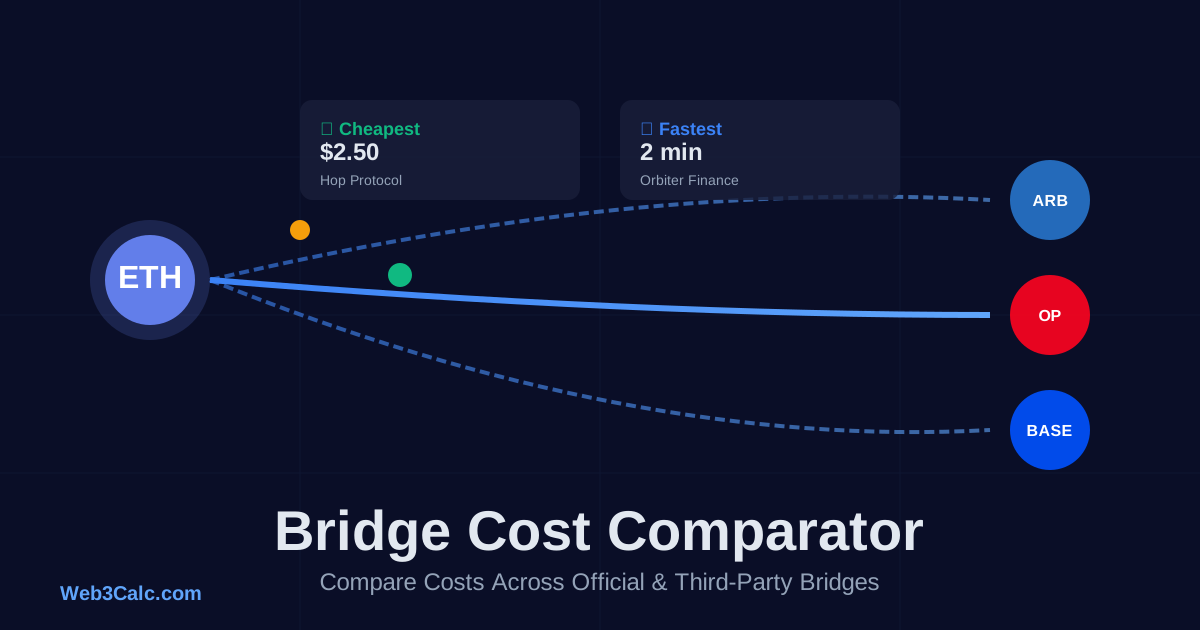
Complete Guide to Crypto Bridge Costs: Compare Fees & Find the Cheapest Route
Learn how to compare crypto bridge costs across official and third-party bridges. Compare Arbitrum, Optimism, Hop, Across, and more. Save money on your cross-chain transfers.
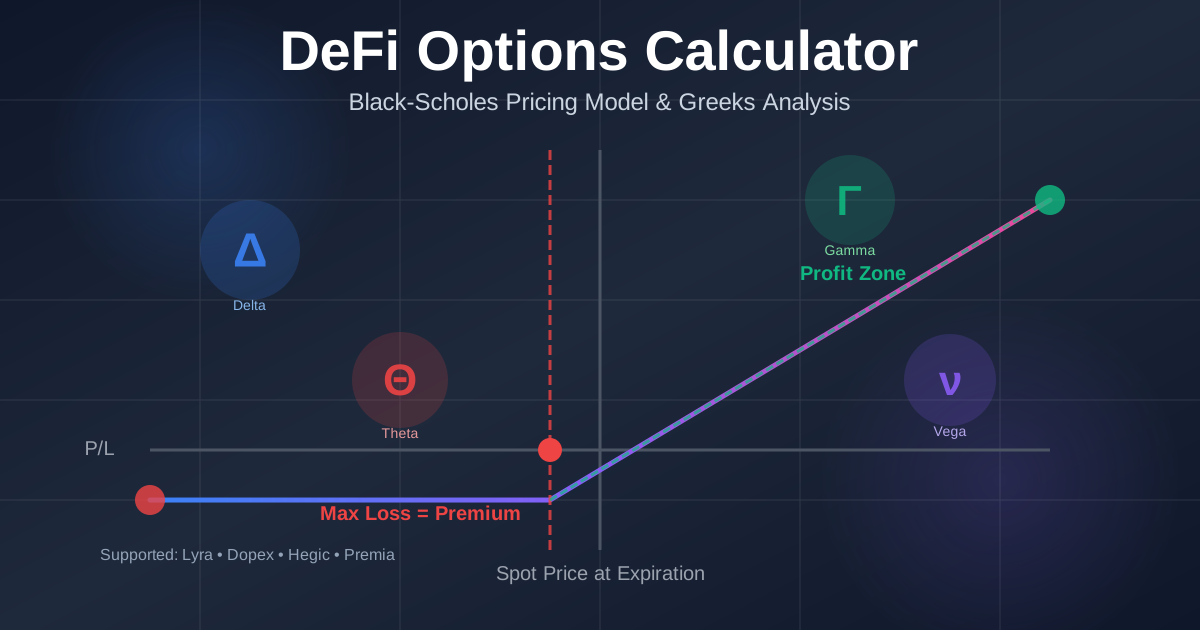
DeFi Options Calculator Guide: Black-Scholes Pricing & Greeks Explained
Complete guide to DeFi options trading with Black-Scholes pricing model, Greeks calculator (Delta, Gamma, Theta, Vega), and strategy analysis for Lyra, Dopex, Hegic, and Premia protocols