Complete Guide to Crypto Bridge Costs: Compare Fees & Find the Cheapest Route
Learn how to compare crypto bridge costs across official and third-party bridges. Compare Arbitrum, Optimism, Hop, Across, and more. Save money on your cross-chain transfers.
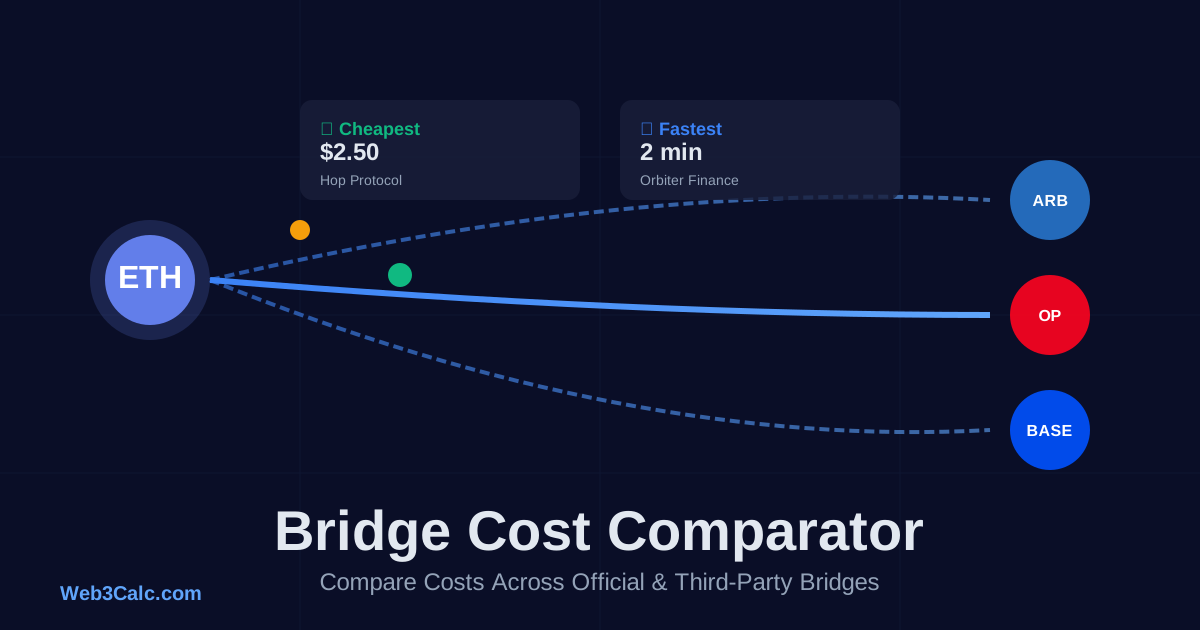
Complete Guide to Crypto Bridge Costs: Compare Fees & Find the Cheapest Route
Transferring crypto between blockchains can be expensive and confusing. With dozens of bridge options available, how do you find the cheapest and safest route? This comprehensive guide will teach you everything you need to know about comparing crypto bridge costs.
What Are Crypto Bridges?
Crypto bridges are protocols that enable you to transfer tokens and data between different blockchain networks. They're essential infrastructure for the multi-chain ecosystem, allowing users to move assets between Ethereum, Layer 2 networks (Arbitrum, Optimism, Base), and other blockchains.
Why Do We Need Bridges?
Blockchains don't natively communicate with each other. Without bridges:
- Your ETH on Ethereum stays on Ethereum
- You can't use Arbitrum's low fees with your Ethereum assets
- DeFi opportunities on other chains are inaccessible
Bridges solve this by locking your tokens on one chain and minting equivalent tokens on another, or by facilitating atomic swaps.
Types of Crypto Bridges
1. Official Bridges (Native Bridges)
Official bridges are built and maintained by the blockchain teams themselves.
Examples:
- Arbitrum Bridge - For Ethereum ↔ Arbitrum transfers
- Optimism Bridge - For Ethereum ↔ Optimism transfers
- Base Bridge - For Ethereum ↔ Base transfers
- zkSync Bridge - For Ethereum ↔ zkSync transfers
Advantages:
- ✅ Highest security (backed by the protocol itself)
- ✅ No bridge fees (usually free, only gas costs)
- ✅ Longest track record
- ✅ Best for large amounts
Disadvantages:
- ❌ Slow withdrawals (7-day challenge period for Optimistic Rollups)
- ❌ Only supports their specific chain
- ❌ Higher gas costs on Ethereum mainnet
2. Third-Party Bridges
Independent protocols that support multiple chains and faster transfers.
Examples:
- Hop Protocol - Multi-chain support, liquidity-based
- Across Protocol - Optimistic bridging, very fast
- Stargate Finance - LayerZero-based, wide chain support
- Orbiter Finance - Fastest transfers, lower fees
Advantages:
- ✅ Fast transfers (minutes instead of days)
- ✅ Multi-chain support
- ✅ Lower gas costs
- ✅ Better user experience
Disadvantages:
- ❌ Additional smart contract risk
- ❌ Bridge fees (0.04% - 0.10%)
- ❌ Liquidity limitations
- ❌ More complex security model
Understanding Bridge Costs
Bridge costs consist of multiple components:
1. Gas Fees
Source Chain Gas: Cost to initiate the bridge transaction
- Ethereum: $5-50 (depending on network congestion)
- Layer 2s (Arbitrum, Optimism, Base): $0.30-$2
- Polygon: $0.05-$0.20
Destination Chain Gas: Cost to receive tokens
- Usually included in the bridge transaction
- Some bridges require a separate claim transaction
2. Bridge Protocol Fees
Third-party bridges charge fees for their service:
| Bridge | Fee | Notes | |--------|-----|-------| | Official Bridges | 0% | Free (only gas costs) | | Hop Protocol | 0.04% | Plus small LP fee | | Across Protocol | 0.05% | Varies by route | | Stargate | 0.06% | Plus LayerZero fees | | Orbiter | 0.10% | Fixed percentage |
3. Hidden Costs
- Slippage: For liquidity-based bridges
- Time value: Waiting 7 days has opportunity cost
- Multiple transactions: Some bridges require separate claim steps
- Failed transactions: Gas is lost even if bridge fails
Cost Comparison Examples
Example 1: Bridging $10,000 USDC from Ethereum to Arbitrum
Option A: Arbitrum Official Bridge
- Source gas (Ethereum): $25
- Bridge fee: $0
- Destination gas: $0 (included)
- Time: 10 minutes
- Total cost: $25 (0.25%)
Option B: Hop Protocol
- Source gas (Ethereum): $20
- Bridge fee: $4 (0.04%)
- Destination gas: $0
- Time: 5 minutes
- Total cost: $24 (0.24%)
- Winner: Slightly cheaper + 2x faster ✅
Option C: Across Protocol
- Source gas (Ethereum): $18
- Bridge fee: $5 (0.05%)
- Destination gas: $0
- Time: 3 minutes
- Total cost: $23 (0.23%)
- Winner: Cheapest + fastest ✅✅
Example 2: Bridging $100 ETH from Arbitrum to Optimism
Official Bridge (via Ethereum)
- Arbitrum → Ethereum: $0.50 gas + 7 days wait
- Ethereum → Optimism: $25 gas + 10 minutes
- Total: $25.50 + 7 days
Hop Protocol (Direct)
- Gas: $1.50
- Bridge fee: $4 (0.04%)
- Time: 5 minutes
- Total: $5.50 + 5 minutes
- Winner: 5x cheaper + instant ✅✅✅
Example 3: Small Amount ($50 USDC)
For small amounts, gas costs matter more than percentage fees:
Arbitrum Official Bridge
- Gas: $25
- Fee: $0
- Total: $25 (50% of transfer!)
Orbiter Finance
- Gas: $1
- Bridge fee: $0.05 (0.10%)
- Total: $1.05 (2.1%)
- Winner: 24x cheaper ✅
Key Insight: For small amounts (<$500), always use third-party bridges with low fixed costs.
How to Choose the Right Bridge
Decision Framework
Large amount (>$50,000)?
├─ Yes → Use official bridge (security priority)
└─ No → Continue

Need funds urgently?
├─ Yes → Use Across/Orbiter (fastest)
└─ No → Continue

Optimize for cost only?
├─ Yes → Compare all options in calculator
└─ No → Use recommended bridge (balanced)

Going from L2 → L2?
├─ Yes → Never use official (too slow/expensive)
└─ No → Compare options
Security Considerations
High Security (Official Bridges)
- ✅ Use for amounts >$50,000
- ✅ Use when you can wait 7 days
- ✅ Use for your life savings
- ✅ Lowest smart contract risk
Medium Security (Audited Third-Party)
- ✅ Use for <$50,000
- ✅ Check audit status first
- ✅ Prefer higher TVL bridges
- ✅ Examples: Hop, Across, Stargate
Lower Security (New/Unaudited)
- ⚠️ Only use for small test amounts
- ⚠️ Check smart contract age
- ⚠️ Verify community feedback
- ⚠️ Examples: Newer bridges
Bridge Comparison Table
| Bridge | Type | Security | Speed | Cost | Best For | |--------|------|----------|-------|------|----------| | Arbitrum Bridge | Official | ⭐⭐⭐⭐⭐ | 10 min (7d withdraw) | $ | Large amounts | | Optimism Bridge | Official | ⭐⭐⭐⭐⭐ | 10 min (7d withdraw) | $ | Large amounts | | Base Bridge | Official | ⭐⭐⭐⭐⭐ | 10 min | $ | ETH ↔ Base | | Hop Protocol | 3rd Party | ⭐⭐⭐⭐ | 5 min | $$ | L2 ↔ L2 | | Across | 3rd Party | ⭐⭐⭐⭐ | 2-3 min | $$ | Fast transfers | | Stargate | 3rd Party | ⭐⭐⭐ | 5 min | $$$ | Multi-chain | | Orbiter | 3rd Party | ⭐⭐⭐ | 1-2 min | $ | Small amounts |
Common Bridging Scenarios
Scenario 1: Moving to L2 for Trading
Goal: Bridge funds from Ethereum to Arbitrum for DEX trading
Best Choice: Across Protocol
- Why: Fast (3 min), good fees, high liquidity
- Cost: ~$23 for $10,000
- Alternative: Hop if Across is unavailable
Scenario 2: L2 to L2 Transfers
Goal: Move USDC from Arbitrum to Optimism
Best Choice: Hop Protocol
- Why: Direct L2↔L2 routes, no Ethereum detour
- Cost: ~$5 for $10,000
- Alternative: Stargate for more exotic pairs
Scenario 3: Large DeFi Position
Goal: Bridge $500,000 to participate in Aave on Arbitrum
Best Choice: Arbitrum Official Bridge
- Why: Maximum security, fee is negligible
- Cost: ~$25 (0.005%)
- Time: Can afford 10 min deposit time
Scenario 4: Daily Small Payments
Goal: Bridge $100-500 regularly for payments
Best Choice: Orbiter Finance
- Why: Lowest fixed costs, fast
- Cost: ~$1-2 per transfer
- Alternative: Across for slightly larger amounts
Advanced Tips
1. Time Your Bridges
Gas prices vary by time of day:
- Cheapest: Weekend mornings (UTC)
- Most expensive: Weekday US business hours
- Tool: Use Gas Fee Calculator to monitor prices
2. Batch Your Transfers
Instead of bridging 5 times at $5 each ($25 total):
- Bridge once for $8 (economies of scale)
- Save $17 (68% reduction)
3. Monitor Historical Costs
Bridge costs change based on:
- Network congestion
- Bridge liquidity
- Market volatility
- Time of day
Our Bridge Cost Comparator tracks these trends.
4. Use Native Tokens When Possible
Bridging ETH is cheaper than ERC-20 tokens:
- ETH transfer: ~21,000 gas
- USDC transfer: ~65,000 gas (3x more expensive)
Convert on destination chain if possible.
5. Consider Opportunity Cost
Official bridge withdrawal (7 days):
- If you earn 10% APY in DeFi
- 7 days = 0.19% opportunity cost
- On $10,000 = $19 cost
Sometimes paying $5 bridge fee to save 7 days is worth it.
Bridge Security Checklist
Before using any bridge:
- [ ] Check audit reports (Consensys, Trail of Bits, etc.)
- [ ] Verify TVL (higher = more battle-tested)
- [ ] Check age (>1 year preferred)
- [ ] Read recent bridge reviews
- [ ] Test with small amount first
- [ ] Verify contract addresses
- [ ] Check for recent hacks/issues
- [ ] Ensure adequate liquidity
Common Bridge Mistakes to Avoid
1. Wrong Network Selected
Problem: Sending to Arbitrum but selecting Optimism Result: Lost funds Solution: Triple-check destination before confirming
2. Insufficient Gas on Destination
Problem: Need gas to claim on destination chain Result: Tokens stuck Solution: Bridge small ETH first for gas
3. Using Unaudited Bridges
Problem: New bridge with no audits Result: Hack leads to lost funds Solution: Stick to established bridges
4. Ignoring Slippage
Problem: Large transfer on low-liquidity bridge Result: 2-5% slippage loss Solution: Check liquidity, split large transfers
5. Not Saving TX Receipts
Problem: Bridge issue, no proof of transfer Result: Hard to get support Solution: Always save transaction hashes
Bridge Cost Calculator Tool
Use our Bridge Cost Comparator to:
✅ Compare all bridges in one place
✅ Get real-time cost estimates
✅ Find the cheapest route automatically
✅ See security ratings
✅ Calculate time vs. cost tradeoffs
Features:
- Official vs. third-party comparison
- Gas + bridge fee breakdown
- Security ratings (TVL, audits)
- Time estimation
- Historical cost trends
Frequently Asked Questions
Q: Are official bridges always safer?
A: Generally yes, but audited third-party bridges like Hop and Across have excellent security records. For amounts >$50k, prefer official bridges.
Q: Why do withdrawals take 7 days?
A: Optimistic Rollups (Arbitrum, Optimism) use a "challenge period" where validators can dispute invalid transactions. This security measure ensures the bridge can't be exploited.
Q: Can I speed up official bridge withdrawals?
A: Use third-party bridges like Hop that provide instant liquidity and handle the 7-day wait for you.
Q: What happens if a bridge gets hacked?
A: Your funds may be lost. This is why:
- Use audited bridges only
- Don't bridge more than you can afford to lose
- Prefer official bridges for large amounts
- Check insurance options (Nexus Mutual)
Q: How do I bridge NFTs?
A: Most bridges don't support NFTs. Use specialized NFT bridges like:
- Hop Protocol (some collections)
- Connext Network
- Chainlink CCIP (coming soon)
Q: What's the maximum I can bridge?
A: Depends on bridge liquidity:
- Official bridges: Unlimited
- Hop Protocol: $1-5M typical
- Smaller bridges: $100k-500k
- Check liquidity before large transfers
Q: Are bridge fees tax deductible?
A: Consult a tax professional, but generally:
- US: May be deductible as transaction fees
- EU: Varies by country
- Always keep receipts
Real Bridge Cost Examples (December 2024)
Based on current network conditions:
Ethereum → Arbitrum ($10,000 USDC)
| Bridge | Gas | Fee | Total | Time | Winner | |--------|-----|-----|-------|------|--------| | Official | $25 | $0 | $25 | 10 min | Security | | Hop | $20 | $4 | $24 | 5 min | - | | Across | $18 | $5 | $23 | 3 min | Best ✅ |
Arbitrum → Optimism ($1,000 USDC)
| Bridge | Gas | Fee | Total | Time | Winner | |--------|-----|-----|-------|------|--------| | Official | $25 | $0 | $25 + 7d | - | - | | Hop | $1.50 | $0.40 | $1.90 | 5 min | Best ✅ | | Stargate | $2 | $0.60 | $2.60 | 5 min | - |
Ethereum → Base ($100 ETH)
| Bridge | Gas | Fee | Total | Time | Winner | |--------|-----|-----|-------|------|--------| | Official | $25 | $0 | $25 | 10 min | Best ✅ | | Hop | $20 | $4 | $24 | 5 min | - | | Across | $22 | $5 | $27 | 3 min | - |
Conclusion
Choosing the right crypto bridge can save you significant money:
- Small amounts (<$500): Use Orbiter or Across
- Medium amounts ($500-$50k): Use Hop or Across
- Large amounts (>$50k): Use official bridges
- L2 ↔ L2: Always use third-party bridges
- Speed priority: Use Across or Orbiter
- Security priority: Use official bridges
Pro Tip: Always compare costs with our Bridge Cost Comparator before bridging. Different routes can have 5-10x cost differences.
Related Tools
- Gas Fee Calculator - Compare gas costs across chains
- Token Price Calculator - Check prices before bridging
- Wallet Security Checker - Ensure your wallet is secure
Stay Updated
Bridge costs change frequently. Bookmark our Bridge Cost Comparator to always get:
- Real-time cost estimates
- Latest bridge options
- Security ratings updates
- New bridge launches
Disclaimer: Bridge costs are estimates and may vary. Always verify costs on the bridge platform before proceeding. This guide is for educational purposes only and not financial advice.
Last updated: December 11, 2025
Share this article:
Related Articles
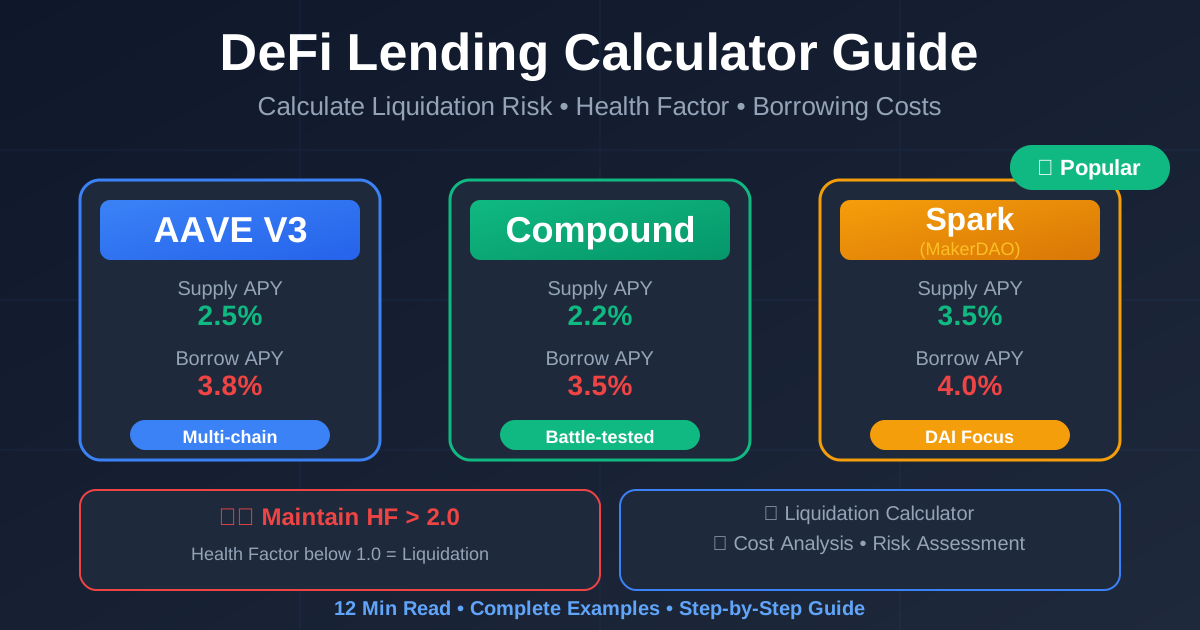
DeFi Lending Guide: How to Calculate Liquidation Risk & Optimize Borrowing Positions
Complete guide to DeFi lending on Aave, Compound, and MakerDAO. Learn to calculate health factors, liquidation prices, and optimize your borrowing positions safely.
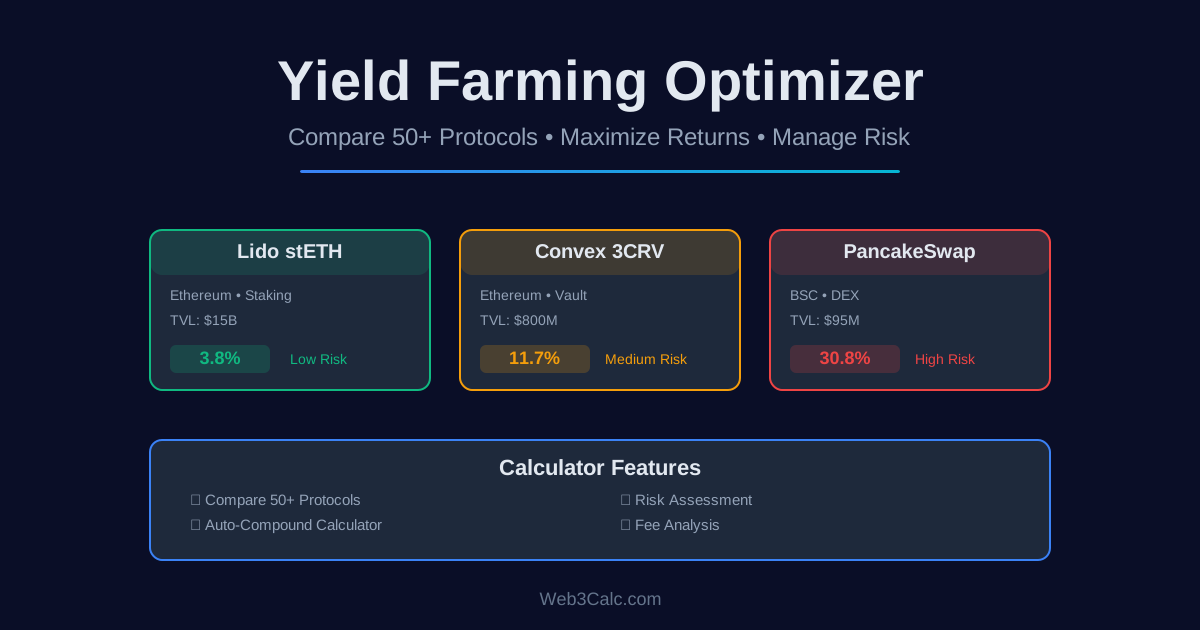
Yield Farming Optimizer Guide: Maximize DeFi Returns in 2024
Complete guide to yield farming across 50+ protocols. Learn to calculate returns, compare APYs, manage risk, and optimize your DeFi strategy with auto-compounding.

Uniswap V3 Liquidity Mining Guide: Advanced ROI Simulator & Strategy Calculator
# Uniswap V3 Liquidity Mining Guide: Advanced ROI Simulator & Strategy Calculator Uniswap V3 revolutionized DeFi liquidity provision by introducing concentrated liquidity, allowing LPs to earn 4,000...