Complete Guide to Token Swap Aggregators: Finding the Best DEX Rates in 2026
Learn how DEX aggregators like 1inch, Paraswap, and CowSwap work. Compare swap rates, optimize gas fees, and protect against MEV attacks with our comprehensive guide.
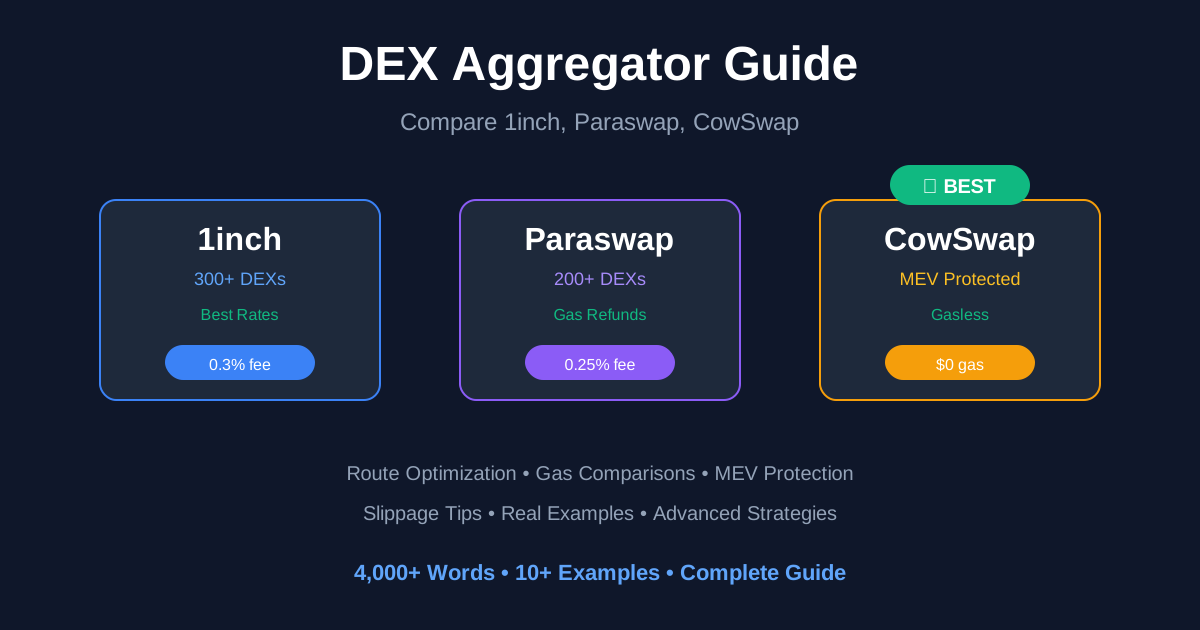
Complete Guide to Token Swap Aggregators: Finding the Best DEX Rates in 2026
Token swap aggregators have revolutionized how traders exchange cryptocurrencies on decentralized exchanges (DEXs). Instead of manually checking prices across dozens of platforms, aggregators do the heavy lifting—comparing rates, optimizing routes, and saving you money on every trade.
In this comprehensive guide, we'll explore how DEX aggregators work, compare the top platforms (1inch, Paraswap, CowSwap, and more), and teach you strategies to get the best rates while protecting yourself from MEV attacks and excessive slippage.
What is a Token Swap Aggregator?
A token swap aggregator is a tool that searches multiple decentralized exchanges simultaneously to find you the best price when swapping one cryptocurrency for another. Think of it as a "price comparison engine" for DeFi.
The Problem: Fragmented Liquidity
In traditional finance, if you want to exchange USD for EUR, you go to a bank or currency exchange. In DeFi, liquidity is spread across hundreds of DEXs:
- Uniswap (the largest DEX by volume)
- Curve (specialized in stablecoins)
- Balancer (multi-token pools)
- Sushiswap (Uniswap fork with rewards)
- PancakeSwap (BSC's largest DEX)
- And 200+ more...
Each DEX has different liquidity pools, different fee structures, and different prices for the same token pair. Checking them all manually is impossible.
The Solution: Aggregators
DEX aggregators solve this by:
- Querying multiple DEXs in real-time (often 50-300+ platforms)
- Calculating optimal routes (sometimes splitting your trade across multiple DEXs)
- Estimating gas costs and factoring them into the best price
- Executing the swap through a single transaction
The result? You get better rates than any single DEX could offer, often saving 0.5-2% per trade.
How DEX Aggregators Work: Under the Hood
Let's break down the technical process of how aggregators find the best rates.
1. Price Discovery
When you initiate a swap (e.g., 1 ETH → USDC), the aggregator:
- Queries 50-300+ DEX liquidity pools
- Retrieves current prices and available liquidity
- Accounts for each DEX's fee structure (0.05% to 1%)
- Calculates price impact (how your trade size affects the price)
This happens in less than 2 seconds using cached data and parallel API calls.
2. Route Optimization
Here's where aggregators shine. Instead of routing 100% of your trade through one DEX, they might split it:
Example:
Swap 10 ETH for USDC:
- Route 1: 6 ETH → Uniswap V3 (0.05% fee pool) → 12,050 USDC
- Route 2: 3 ETH → Curve (stablecoin pool) → 6,030 USDC
- Route 3: 1 ETH → Balancer (weighted pool) → 2,010 USDC
Total: 20,090 USDC

vs. Routing 100% through Uniswap V2: 19,950 USDC
Savings: 140 USDC (0.7% better rate)
The aggregator uses algorithms (like 1inch's "Pathfinder" or Paraswap's "MultiPath") to find the optimal split across multiple routes.
3. Gas Cost Estimation
A better rate doesn't always mean more profit. If Route A saves you $10 but costs $15 in gas, you're losing money.
Smart aggregators:
- Estimate gas costs for each route
- Factor gas into the "net output" calculation
- Recommend the most profitable route after gas
Example:
Small Swap (100 USDC → DAI):
- Route A: 99.95 DAI, gas: $8 → Net: $91.95
- Route B: 99.90 DAI, gas: $0 (CowSwap gasless) → Net: $99.90 ✅
For small swaps, gasless execution often wins.
4. Smart Contract Execution
Once you approve the swap, the aggregator's smart contract:
- Executes trades across multiple DEXs in a single transaction
- Uses flash swaps to avoid needing intermediate tokens
- Reverts the entire transaction if any leg fails (atomicity)
This ensures you either get the exact rate quoted or the transaction fails (no partial fills at worse prices).
Top DEX Aggregators Compared
1inch Network
Networks: 12+ chains (Ethereum, BSC, Polygon, Arbitrum, Optimism, Avalanche, Fantom, Gnosis, Aurora, Klaytn, ZkSync Era, Base)
DEXs Covered: 300+
Key Features:
- Pathfinder Algorithm: Splits trades across up to 50+ routes simultaneously
- Limit Orders: Set target prices and execute automatically
- RFQ (Request for Quote): Access professional market makers for large trades
- Chi Gastoken: Get gas refunds via staking 1INCH tokens
- Fusion Mode: Gasless swaps with MEV protection (similar to CowSwap)
Fee Structure:
- 0.3% on aggregated swaps (often offset by better rates)
- 0% on limit orders
Best For:
- Traders prioritizing best absolute rates (usually wins on large trades $10K+)
- Multi-chain users (widest network support)
- Advanced traders using limit orders and RFQ
Pros:
✅ Most DEXs covered (300+)
✅ Best rate accuracy
✅ Excellent for large trades ($50K+)
✅ Limit order support
Cons:
❌ Higher gas costs on some routes
❌ Complex UI for beginners
❌ 0.3% fee can negate savings on small trades
Paraswap
Networks: 8+ chains (Ethereum, BSC, Polygon, Avalanche, Arbitrum, Optimism, Fantom, zkSync Era)
DEXs Covered: 200+
Key Features:
- MultiPath Routing: Advanced algorithm that tests 1000+ route combinations
- ParaSwap Boost: Pays you gas refunds in PSP tokens
- Delta Execution: Guarantees you get at least the quoted rate or better
- MEV Protection: Optional private transactions via Flashbots
Fee Structure:
- 0.25% on swaps (lower than 1inch)
- Gas refunds via PSP token rewards
Best For:
- Medium to large trades ($1K-$50K)
- Users who want gas refunds (stake PSP)
- Traders who prioritize route transparency
Pros:
✅ Lower fees (0.25% vs 1inch's 0.3%)
✅ Gas refunds in PSP tokens
✅ Excellent route visualization
✅ Delta Execution protection
Cons:
❌ Fewer DEXs than 1inch
❌ PSP token incentives may not cover gas on Ethereum mainnet
❌ Slightly slower quote updates
CowSwap (CoW Protocol)
Networks: Ethereum, Gnosis Chain
DEXs Covered: All major Ethereum DEXs (via solvers)
Key Features:
- Batch Auctions: Groups multiple swaps together to find optimal prices
- Gasless Execution: No gas fees paid by users (solvers pay gas)
- MEV Protection: Immune to sandwich attacks via off-chain order matching
- CoW (Coincidence of Wants): Direct peer-to-peer swaps when possible
Fee Structure:
- Dynamic fee based on market conditions (typically 0.1-0.3%)
- No gas fees
Best For:
- Small to medium trades ($100-$10K) where gas savings matter
- Users wanting maximum MEV protection
- Stablecoin swaps (often finds CoW matches)
Pros:
✅ Completely gasless
✅ Best MEV protection
✅ Great for stablecoin swaps
✅ Surplus optimization (you often get better than quoted rate)
Cons:
❌ Only on Ethereum and Gnosis Chain
❌ Slower execution (batch auctions take 30s-2min)
❌ May not be best rate for exotic token pairs
0x Protocol
Networks: 7+ chains (Ethereum, BSC, Polygon, Arbitrum, Optimism, Avalanche, Fantom)
DEXs Covered: 100+
Key Features:
- RFQ System: Professional market makers provide quotes for large trades
- API for Developers: Easy integration for wallets and dApps
- Gasless Approvals: EIP-2612 permit() support
- Meta-transactions: Gasless swaps via relayers
Fee Structure:
- 0.15% on aggregated swaps (lowest fee)
- Additional fees may apply from integrated dApps
Best For:
- Developers building swap functionality into dApps
- Institutional traders using RFQ
- Wallets like MetaMask (uses 0x under the hood)
Pros:
✅ Lowest fees (0.15%)
✅ Best for integrations (clean API)
✅ RFQ for institutional trades
✅ Fast execution
Cons:
❌ Fewer DEXs than 1inch/Paraswap
❌ Less transparent routing
❌ Consumer UI less polished
Jupiter Aggregator (Solana)
Networks: Solana only
DEXs Covered: All Solana DEXs (Orca, Raydium, Saber, Lifinity, Phoenix, etc.)
Key Features:
- Best Solana rates by far (70%+ of Solana DEX volume)
- Limit Orders: Set price targets and execute automatically
- DCA (Dollar Cost Averaging): Automated recurring buys
- JUP Token: Governance and fee discounts
Fee Structure:
- 0.1% on most swaps
- 0% on limit orders and DCA
Best For:
- All Solana users (no competition)
- Traders using limit orders and DCA
Pros:
✅ Dominant on Solana (best rates)
✅ Low fees (0.1%)
✅ Limit orders and DCA features
✅ Fast execution
Cons:
❌ Solana only (not multi-chain)
❌ Network congestion can cause failures
Comparison Table: Which Aggregator to Use?
🥇 1inch
- Networks: 12+ chains
- DEXs Covered: 300+
- Fee: 0.3%
- Gas Costs: High
- MEV Protection: Optional
- Best For: Large trades ($10K+)
- Limit Orders: ✅ Yes
- Speed: Fast
🥈 Paraswap
- Networks: 8+ chains
- DEXs Covered: 200+
- Fee: 0.25%
- Gas Costs: Medium
- MEV Protection: Optional
- Best For: Medium trades ($1K-$10K)
- Limit Orders: ❌ No
- Speed: Fast
🥉 CowSwap
- Networks: 2 chains (Ethereum, Gnosis)
- DEXs Covered: All major DEXs
- Fee: 0.1-0.3%
- Gas Costs: $0 (Gasless)
- MEV Protection: ✅ Built-in
- Best For: Small trades (<$1K)
- Limit Orders: ❌ No
- Speed: Slow (30s-2min batch auctions)
🔧 0x Protocol
- Networks: 7+ chains
- DEXs Covered: 100+
- Fee: 0.15%
- Gas Costs: Medium
- MEV Protection: ❌ No
- Best For: Developers & API integration
- Limit Orders: ❌ No
- Speed: Fast
⚡ Jupiter (Solana)
- Networks: 1 (Solana only)
- DEXs Covered: All Solana DEXs
- Fee: 0.1%
- Gas Costs: Low (Solana fees)
- MEV Protection: Partial
- Best For: Solana users
- Limit Orders: ✅ Yes
- Speed: Very fast
Winner by Use Case:
- Large trades ($10K+): 1inch (best rates)
- Medium trades ($1K-$10K): Paraswap (good rates + gas refunds)
- Small trades (<$1K): CowSwap (gasless + MEV protection)
- Solana swaps: Jupiter (only option, best rates)
- MEV protection priority: CowSwap
- Developer integration: 0x Protocol
Understanding Slippage and How to Optimize It
Slippage is the difference between the expected price of a trade and the actual executed price. It occurs due to:
- Price Movement: Market prices change between transaction submission and confirmation
- Price Impact: Your trade size moves the market price (especially in low-liquidity pools)
- Network Congestion: Delayed confirmation allows prices to shift
Slippage Tolerance Settings
Most aggregators ask you to set a slippage tolerance (e.g., 0.5%, 1%, 2%):
- Low tolerance (0.1-0.5%): Transaction fails if price moves more than this → Good for stable markets
- Medium tolerance (0.5-1%): Standard setting → Good for most trades
- High tolerance (1-5%): Transaction likely succeeds even if price moves → Good for volatile tokens or low liquidity
Example:
Swap 1 ETH for USDC (expected: 2,000 USDC)
Slippage tolerance: 0.5%

Price movement scenarios:
- 0.2% movement (1,996 USDC) → ✅ Transaction succeeds
- 0.6% movement (1,988 USDC) → ❌ Transaction reverts
How to Minimize Slippage
-
Trade During Low Volatility
- Avoid swapping during major news events
- Check volatility indicators before large trades
-
Split Large Trades
- Instead of 50 ETH in one swap, do 5x 10 ETH swaps
- Price impact decreases exponentially with smaller trade sizes
-
Use Limit Orders
- Set a target price and wait for it to be reached
- 1inch and Jupiter support on-chain limit orders
-
Choose High-Liquidity Pairs
- ETH/USDC has deeper liquidity than SHIB/PEPE
- Check Total Value Locked (TVL) in pools before swapping
-
Use CowSwap for Stablecoins
- Batch auctions find better rates with minimal slippage
- CoW (Coincidence of Wants) eliminates slippage entirely for peer-to-peer matches
MEV Protection: Defending Against Sandwich Attacks
MEV (Maximal Extractable Value) refers to profits that miners/validators extract by reordering, inserting, or censoring transactions. In DeFi swaps, this manifests as sandwich attacks.
What is a Sandwich Attack?
A bot detects your pending swap in the mempool and:
- Frontrun: Places a buy order before yours (pushing the price up)
- Your Trade: Executes at the inflated price
- Backrun: Sells immediately after (capturing profit from the price difference)
You lose money. On large trades, sandwich attacks can cost 1-3%.
How to Protect Yourself
1. Use CowSwap (Best Protection)
- Orders are off-chain until execution (not visible in mempool)
- Batch auctions prevent frontrunning
- Surplus optimization means you often get better than expected rates
2. Use Flashbots Protect (Ethereum)
- Private RPC endpoint hides your transaction from public mempool
- Only validators using Flashbots can see your transaction
- Works with MetaMask, 1inch, Paraswap
3. Set Low Slippage Tolerance
- 0.1-0.3% slippage makes sandwich attacks unprofitable
- Risk: transaction may fail if prices move
4. Use Private Transactions
- 1inch Fusion Mode and Paraswap's MEV protection route through private channels
- Costs slightly more in fees but saves on MEV
5. Trade on L2s (Arbitrum, Optimism, Base)
- Centralized sequencers reduce MEV risk
- Gas costs are 10-100x lower
- Still some MEV risk, but much less than Ethereum mainnet
Gas Optimization Strategies
Gas fees can eat into profits, especially on Ethereum mainnet. Here's how to minimize them:
1. Use Layer 2 Networks
- Arbitrum: 90% cheaper gas than Ethereum
- Optimism: 85% cheaper gas
- Base: 95% cheaper gas
- zkSync Era: 80% cheaper gas
Most aggregators support L2s. For example, swapping on Arbitrum costs $0.50 vs $15 on Ethereum mainnet.
2. Choose Gasless Aggregators
- CowSwap: Always gasless
- 1inch Fusion Mode: Gasless for supported pairs
- 0x Gasless Swaps: Available via some integrated dApps
3. Batch Multiple Swaps
- Some aggregators allow bundling multiple swaps into one transaction
- Save gas on contract deployment and approval costs
4. Optimize Approval Amounts
- Instead of unlimited approvals, approve exact amounts
- Revoke approvals after large trades to reduce security risk
5. Monitor Gas Prices
- Use tools like Gas Tracker to swap during low-gas periods
- Ethereum gas is cheapest on weekends and holidays
- Set max gas price limits to avoid overpaying
Real-World Examples: When to Use Each Aggregator
Example 1: Small Stablecoin Swap ($200 USDC → DAI)
Best Choice: CowSwap
CowSwap:
- Output: 199.80 DAI
- Gas: $0 (gasless)
- Net: $199.80

1inch:
- Output: 199.85 DAI
- Gas: $8
- Net: $191.85

Paraswap:
- Output: 199.82 DAI
- Gas: $10
- Net: $189.82
Why CowSwap wins: Gasless execution outweighs slightly worse rate.
Example 2: Medium ETH Swap (5 ETH → USDC, ~$10K)
Best Choice: Paraswap
Paraswap:
- Output: 10,025 USDC
- Gas: $12
- PSP gas refund: $5
- Net: $10,018

1inch:
- Output: 10,032 USDC
- Gas: $18
- Net: $10,014

CowSwap:
- Output: 10,015 USDC
- Gas: $0
- Net: $10,015
Why Paraswap wins: Best net output after gas refunds.
Example 3: Large WBTC Swap (2 WBTC → ETH, ~$100K)
Best Choice: 1inch
1inch:
- Output: 51.25 ETH
- Gas: $25
- Net: $102,475

Paraswap:
- Output: 51.18 ETH
- Gas: $18
- Net: $102,342

CowSwap:
- Output: 51.20 ETH
- Gas: $0
- Net: $102,400
Why 1inch wins: Superior rate more than offsets higher gas. On $100K+ trades, gas becomes negligible (0.025%).
Example 4: Volatile Token Swap (PEPE → ETH, high volatility)
Best Choice: CowSwap or 1inch Limit Order
For volatile tokens:
- High slippage risk (prices can move 5-10% during transaction)
- MEV bots target these swaps (easy profit)
Strategy:
- Use CowSwap for immediate MEV-protected execution
- Or set 1inch limit order at target price and wait
Advanced Tips for Power Users
1. Use Limit Orders for Better Rates
Instead of swapping at current market price, set a limit order:
Current ETH price: $2,000
Your limit buy: $1,950

Wait for price to dip, order executes automatically
Savings: $50 per ETH (2.5%)
Supported on: 1inch, Jupiter
2. Compare Multiple Aggregators Before Swapping
Don't trust one aggregator blindly. Check 2-3 before executing:
- Use our Token Swap Aggregator to compare
- Takes 10 seconds, can save 0.5-1%
3. Factor in Tax Implications
In many jurisdictions, every swap is a taxable event:
- Swapping ETH → USDC triggers capital gains tax
- Track all swaps for tax reporting
- Use our Crypto Tax Calculator to estimate taxes
4. Monitor Liquidity Depth
Before large trades, check liquidity on Dex Screener or DefiLlama:
- Low liquidity = high slippage
- Consider splitting trade or using OTC desks for $1M+ swaps
5. Use Private RPC for Large Trades
Protect $50K+ swaps from MEV by using:
- Flashbots Protect RPC
- Blocker RPC
- Private endpoints from Alchemy/Infura
Common Mistakes to Avoid
❌ Mistake 1: Using Unlimited Token Approvals
Risk: If aggregator contract is hacked, attacker drains your wallet
Solution: Approve exact amounts or revoke approvals after use
❌ Mistake 2: Ignoring Gas Costs on Small Trades
Risk: $8 gas on $50 swap = 16% loss
Solution: Use CowSwap or wait for lower gas prices
❌ Mistake 3: Setting Slippage Too High
Risk: MEV bots sandwich attack you, costing 1-5%
Solution: Use 0.5% or lower, increase only if transaction fails
❌ Mistake 4: Not Comparing Aggregators
Risk: Missing better rates from other aggregators
Solution: Use comparison tools before swapping
❌ Mistake 5: Swapping During High Volatility
Risk: Prices move 5-10% between submission and confirmation
Solution: Wait for calm markets or use limit orders
Future of DEX Aggregators
Trends to Watch in 2026
-
Intent-Based Swaps
- You specify "I want 1,000 USDC for my ETH"
- Solvers compete to fulfill your intent at best price
- CowSwap and 1inch Fusion pioneering this
-
Cross-Chain Aggregation
- Swap USDC on Ethereum for SOL on Solana in one transaction
- LI.FI, Socket, and Rango pioneering cross-chain aggregation
-
AI-Powered Route Optimization
- Machine learning predicts optimal routes based on historical data
- Dynamic slippage adjustment based on market conditions
-
Gasless Swaps Everywhere
- More aggregators adopting gasless models (like CowSwap)
- Users pay fees in output token instead of native gas token
-
Professional Market Makers Integration
- OTC desks and market makers providing RFQ for large trades
- Better rates for $100K+ swaps than pure DEX aggregation
Conclusion: Which Aggregator Should You Use?
There's no one-size-fits-all answer. Choose based on your trade:
For most users:
- $0-$1,000: CowSwap (gasless, MEV protection)
- $1K-$10K: Paraswap (balanced rates and gas)
- $10K+: 1inch (best rates)
- Solana: Jupiter (only option)
- MEV protection: CowSwap
- Limit orders: 1inch or Jupiter
Pro tip: Use our Token Swap Aggregator Tool to compare rates across all major aggregators before every trade. It takes 10 seconds and can save you hundreds of dollars annually.
Happy swapping! 🚀
Related Tools
- Token Swap Aggregator - Compare rates across multiple DEX aggregators
- Gas Fee Calculator - Estimate gas costs for swaps
- Impermanent Loss Calculator - Compare holding vs providing liquidity
- Trading P&L Calculator - Track your swap trades and profit/loss
Disclaimer: This guide is for educational purposes only. Always do your own research and consider consulting a financial advisor before making investment decisions. DEX aggregator rates and features change frequently—verify information on official platforms before trading.
Share this article:
Related Articles
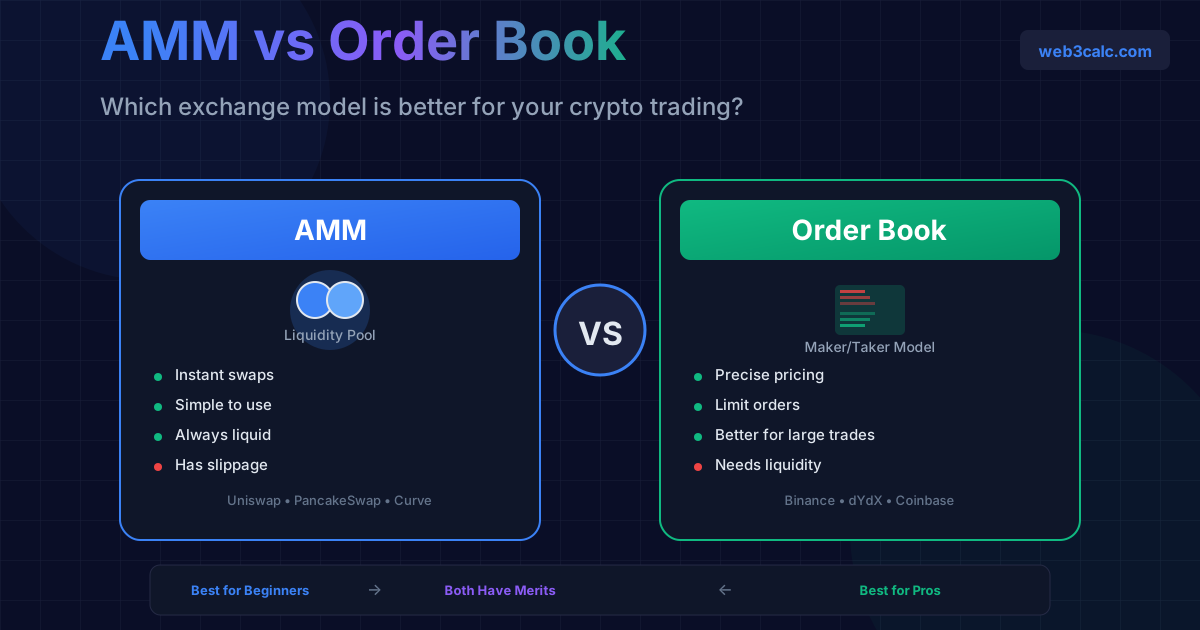
AMM vs Order Book: Which is Better for Crypto Trading?
Understand the key differences between Automated Market Makers (AMMs) and Order Book exchanges. Learn which model suits your trading style and why both matter in DeFi.
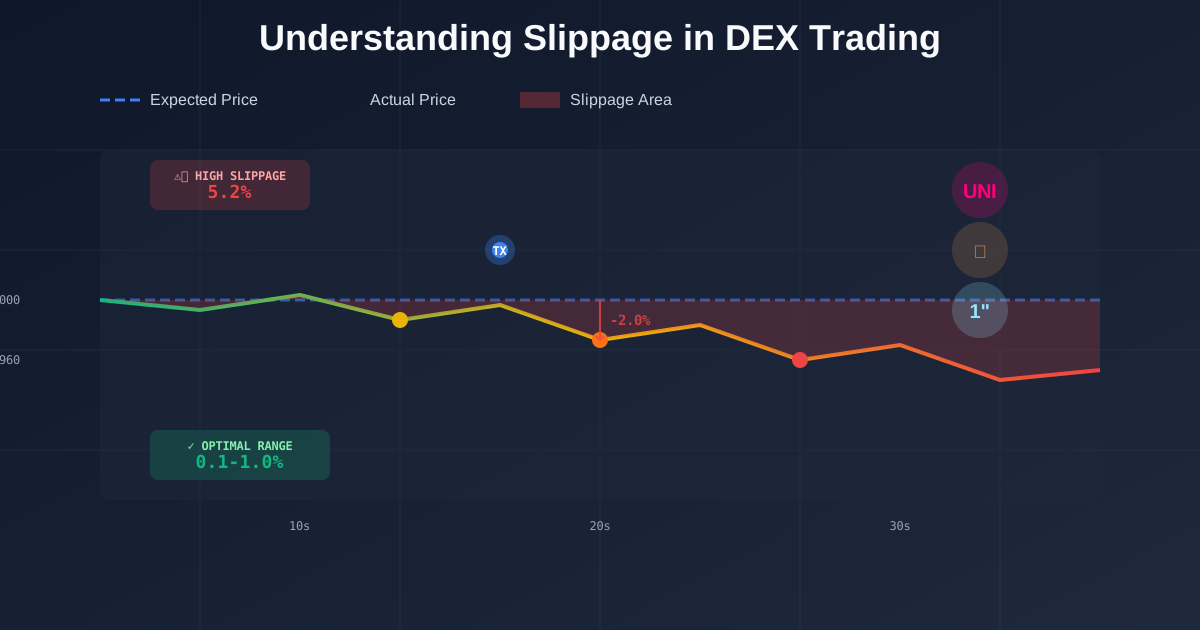
Understanding Slippage in DEX Trading: Complete Guide 2025
# Understanding Slippage in DEX Trading: Complete Guide 2025 If you've ever traded on a decentralized exchange (DEX) like Uniswap or PancakeSwap, you've likely encountered **slippage**—the differenc...
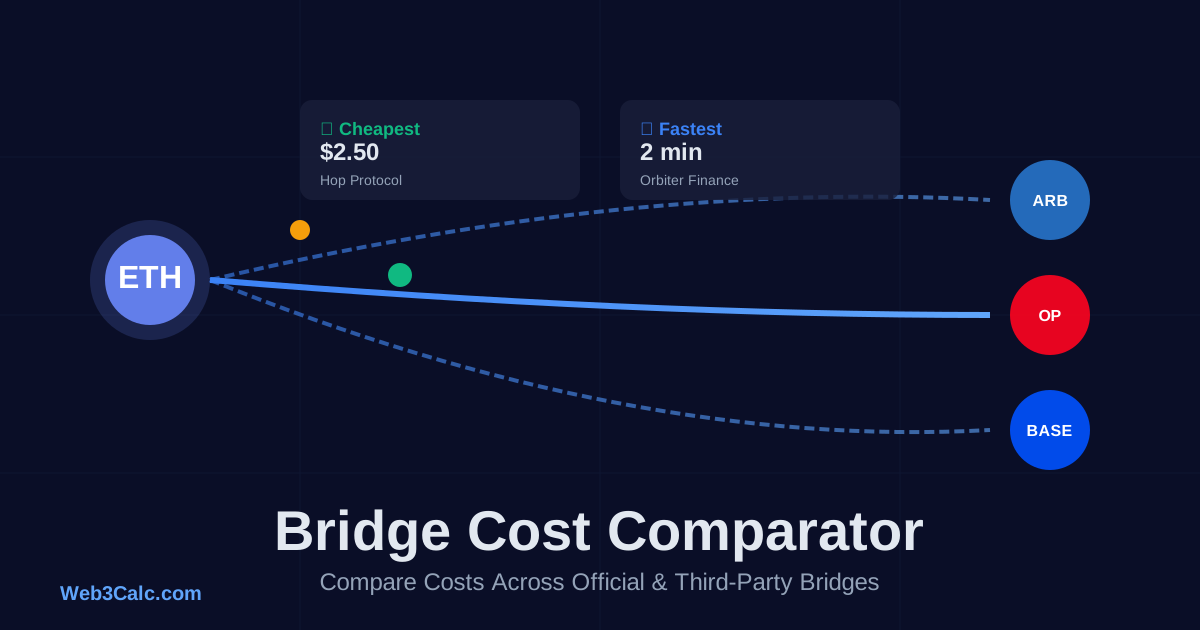
Complete Guide to Crypto Bridge Costs: Compare Fees & Find the Cheapest Route
Learn how to compare crypto bridge costs across official and third-party bridges. Compare Arbitrum, Optimism, Hop, Across, and more. Save money on your cross-chain transfers.