Complete Guide to MEV Protection: Defend Against Sandwich Attacks
Learn how to protect your DeFi trades from MEV bots, sandwich attacks, and frontrunning. Compare protection services and calculate potential losses.

Complete Guide to MEV Protection: Defend Against Sandwich Attacks
If you've ever executed a large DeFi trade and noticed you paid significantly more than expected, you may have been victimized by MEV bots. Maximal Extractable Value (MEV) attacks cost DeFi users an estimated $500 million+ per year, with individual traders losing anywhere from 0.5% to 5% of their trade value.
This comprehensive guide will teach you everything about MEV, how to calculate your risk exposure, and the best protection methods available in 2025.
What is MEV (Maximal Extractable Value)?
MEV refers to the maximum profit that can be extracted from block production beyond standard block rewards and gas fees. In simple terms, it's money that miners or validators can make by manipulating the order of transactions in a block.
The Public Mempool Problem
When you submit a transaction on Ethereum or most other blockchains, it first goes to a public "waiting room" called the mempool. Here's the problem:
- Your pending transaction is publicly visible
- MEV bots scan the mempool 24/7
- Bots identify profitable opportunities from your transaction
- They manipulate transaction ordering to extract value from you
This creates an adversarial environment where your trades can be exploited before they even execute.
Types of MEV Attacks
1. Sandwich Attacks 🥪
The most common and costly MEV attack. Here's how it works:
Step-by-step breakdown:
- You submit: Swap 10 ETH → USDC with 2% slippage
- Bot detects: Your pending transaction in mempool
- Frontrun: Bot buys USDC before your trade (pushing price up)
- Your trade: Executes at the worse price the bot created
- Backrun: Bot sells USDC immediately after (profiting from your trade)
Real example:
Your expected price: 1 ETH = $2,000 USDC
After bot frontrun: 1 ETH = $1,960 USDC
Your loss: $400 (2% of $20,000 trade)
Bot's profit: ~$350 (after gas costs)
Sandwich attacks are especially profitable on:
- Large trades (>$10k)
- High slippage tolerance settings
- Low liquidity pairs
- During high network congestion
2. Frontrunning ⚡
Bots copy your transaction and pay higher gas to get executed first:
- Arbitrage frontrunning: You spot a price difference, bot steals the opportunity
- Liquidation frontrunning: You try to liquidate a position, bot liquidates first
- NFT sniping: You bid on an NFT, bot bids higher with more gas
3. Backrunning 🔙
Less harmful to users but still profitable for bots:
- Bot executes right after your large trade
- Profits from the price movement you created
- You don't lose money directly, but the market moves against you faster
4. Time-Bandit Attacks ⏰
Advanced attack where miners reorganize blocks:
- Extremely rare and expensive
- Requires miner collusion
- Only profitable for multi-million dollar opportunities
How Much Are You Losing to MEV?
Use our MEV Protection Calculator to assess your risk, but here's a quick estimation:
Risk Factors That Increase MEV Exposure:
| Factor | Low Risk | Medium Risk | High Risk | Critical Risk | |--------|----------|-------------|-----------|---------------| | Trade Size | <$1,000 | $1k-$10k | $10k-$100k | >$100k | | Slippage | <0.5% | 0.5-1% | 1-3% | >3% | | DEX Liquidity | >$100M | $10M-$100M | $1M-$10M | <$1M | | Network Congestion | Low | Medium | High | Extreme |
Expected Loss Estimates:
Without Protection:
- Small trades (<$1k): 0.1-0.5% loss
- Medium trades ($1k-$10k): 0.5-2% loss
- Large trades ($10k-$100k): 2-5% loss
- Whale trades (>$100k): 5-10% loss
With Protection (Flashbots/CoW):
- All trade sizes: 0-0.1% additional cost
- Net savings: 1-9% depending on trade size
MEV Protection Methods Compared
1. Flashbots Protect (Private Transactions)
How it works:
- Your transaction bypasses public mempool
- Sent directly to participating validators
- No frontrunning possible
Pros:
- ✅ Free to use
- ✅ Works with any wallet/DEX
- ✅ 90%+ protection rate
- ✅ Gas refunds if transaction fails
Cons:
- ❌ Slightly slower confirmation (30-60 seconds)
- ❌ Only Ethereum mainnet
- ❌ Requires RPC configuration
Best for: Ethereum traders, all trade sizes
Setup:
// Add Flashbots RPC to MetaMask
Network Name: Ethereum (Flashbots)
RPC URL: https://rpc.flashbots.net
Chain ID: 1
2. Eden Network
How it works:
- Stake EDEN tokens for priority
- Private mempool with slot auctions
- Direct validator connections
Pros:
- ✅ Fast confirmations (<10 seconds)
- ✅ Priority ordering system
- ✅ Supports multiple chains
Cons:
- ❌ Requires staking EDEN tokens
- ❌ 0.1-0.3% additional cost
- ❌ Complex setup
Best for: Professional traders, high-frequency trading
3. MEV Blocker
How it works:
- Simple RPC endpoint
- Routes transactions to private relays
- Returns MEV profits to users
Pros:
- ✅ Easiest setup (just change RPC)
- ✅ Returns MEV profits to you
- ✅ Free to use
- ✅ No token required
Cons:
- ❌ Only Ethereum
- ❌ Rebates are small (<$1 usually)
- ❌ New protocol (less battle-tested)
Best for: Casual traders wanting easy protection
Setup:
RPC URL: https://rpc.mevblocker.io
4. CoW Swap (Intent-Based DEX)
How it works:
- Submit intent to trade, not transaction
- Solvers compete to fill your order
- Batch auctions prevent MEV
Pros:
- ✅ Built-in MEV protection
- ✅ Often better prices than regular DEXs
- ✅ Gasless approvals
- ✅ No failed transactions
Cons:
- ❌ Must use CoW Swap interface
- ❌ Longer settlement (2-5 minutes)
- ❌ Limited token pairs
- ❌ Only Ethereum & Gnosis Chain
Best for: Large swaps (>$10k), patient traders
5. 1inch Fusion Mode
How it works:
- Similar to CoW Swap (intent-based)
- Resolvers compete for your order
- Dutch auction mechanism
Pros:
- ✅ Integrated with 1inch aggregator
- ✅ Good for complex routes
- ✅ MEV-protected by design
Cons:
- ❌ Only on 1inch platform
- ❌ Variable execution time
- ❌ May not work for all tokens
Best for: Users already on 1inch
Comparison Table: All Protection Methods
| Method | Setup Difficulty | Cost | Protection Level | Speed | Chains | |--------|-----------------|------|------------------|-------|--------| | Flashbots Protect | Medium | Free | 90% | 30-60s | ETH | | Eden Network | Hard | 0.1-0.3% | 95% | <10s | Multi | | MEV Blocker | Easy | Free | 85% | 30-60s | ETH | | CoW Swap | Easy | Free | 98% | 2-5min | ETH, GNO | | 1inch Fusion | Easy | Free | 90% | 1-3min | Multi | | Lower Slippage | Easy | Free | 30% | Instant | All | | Split Trades | Medium | +Gas | 50% | Varies | All |
Step-by-Step: How to Enable MEV Protection
Option 1: Flashbots Protect (Recommended for Most Users)
- Open MetaMask settings
- Navigate to: Settings → Networks → Add Network
- Enter details:
- Network Name:
Ethereum Flashbots - RPC URL:
https://rpc.flashbots.net - Chain ID:
1 - Currency Symbol:
ETH - Block Explorer:
https://etherscan.io
- Network Name:
- Save and switch to this network before trading
- Trade normally on your preferred DEX
Option 2: CoW Swap (Easiest)
- Visit: swap.cow.fi
- Connect wallet
- Enter trade details (amount, tokens)
- Submit order (gasless signature)
- Wait 2-5 minutes for solvers to fill your order
Option 3: MEV Blocker (Fastest Setup)
- Open MetaMask
- Click network dropdown → Add Network
- Manual entry:
- RPC URL:
https://rpc.mevblocker.io - (Other settings same as Ethereum)
- RPC URL:
- Done! Trade as normal
Advanced Protection Strategies
For Whales (>$100k trades)
- Use OTC desks (avoid public DEXs entirely)
- Split into smaller chunks (<$50k each)
- Time trades during low congestion periods
- Use limit orders instead of market orders
- Consider CoW Swap for best execution
For Arbitrage Traders
- Never use public mempool (always use Flashbots/Eden)
- Compete on speed by running your own validator node
- Use flashbots bundles for atomic multi-step transactions
- Consider becoming a searcher (join the MEV supply chain)
For NFT Traders
- Use private minting services (e.g., Flashbots NFT)
- Set gas limits carefully (prevent gas wars)
- Use MEV-protected RPCs for all transactions
- Avoid reveal timing patterns that bots can exploit
For Liquidity Providers
- Add/remove liquidity during low activity hours
- Use zaps with MEV protection when entering positions
- Monitor for just-in-time (JIT) liquidity attacks
- Consider concentrated liquidity with protection
MEV Protection by Chain
Ethereum
- Best option: Flashbots Protect or CoW Swap
- MEV severity: Critical (most sophisticated bots)
- Estimated annual MEV: $300M+
BSC (Binance Smart Chain)
- Best option: BloXroute or lower slippage
- MEV severity: High
- Protection tools: Limited compared to Ethereum
Polygon
- Best option: Use low slippage + split trades
- MEV severity: Medium
- Native protection: Some validators offer private mempools
Arbitrum/Optimism
- Best option: Sequencer fairness (built-in)
- MEV severity: Low-Medium
- Note: L2s have some natural MEV protection due to sequencer design
Solana
- Best option: Jito MEV or stake-weighted QoS
- MEV severity: High (but different dynamics)
- Note: MEV works differently on Solana due to parallel execution
Common Mistakes to Avoid
❌ Mistake #1: High Slippage "Just to Be Safe"
Many users set 3-5% slippage thinking it prevents failed transactions. This actually invites MEV bots by giving them a larger profit window.
Solution: Use 0.5% slippage + private RPC. If transaction fails, you're protected from MEV.
❌ Mistake #2: Trusting "Fast" Modes on Wallets
Gas priority (fast/instant modes) doesn't protect against MEV—it just helps you get mined faster, which bots also see.
Solution: Private mempool > Gas priority
❌ Mistake #3: Only Protecting Large Trades
Even small trades ($500-1k) can lose $5-20 to MEV bots over time.
Solution: Set up MEV protection once, use it for all trades.
❌ Mistake #4: Using Multiple Hops
Each swap in a multi-hop route is an MEV opportunity.
Solution: Use aggregators with MEV protection (1inch Fusion, CoW Swap) for complex routes.
❌ Mistake #5: Ignoring Gas Prices
High gas = high network activity = more MEV bot activity.
Solution: Trade during low gas periods (weekends, late nights UTC) when possible.
Real User Stories
Case Study 1: $12,000 Sandwich Attack
Setup:
- User swapped $50,000 USDC → ETH on Uniswap
- Set 3% slippage tolerance
- Used public RPC endpoint
Result:
- Expected: 25 ETH at $2,000 each
- Received: 24.4 ETH at $2,049 each
- Lost: $12,000 to MEV bot
Prevention: Using Flashbots would have saved $11,950 (accounting for ~$50 in delayed execution risk)
Case Study 2: Protected $100k Trade
Setup:
- User swapped $100,000 ETH → USDC on CoW Swap
- Set 0.5% max slippage
- Used intent-based auction
Result:
- Expected: $100,000 USDC
- Received: $100,150 USDC
- Saved: ~$3,000 (avoided sandwich + got better price from solver competition)
Case Study 3: NFT Mint Frontrun
Setup:
- User minted NFT at 0.08 ETH floor
- Used MetaMask default RPC
- Set gas to "Fast"
Result:
- Transaction pending for 2 minutes
- Bot frontran with 2x gas price
- User's transaction failed
- Lost: ~$15 in wasted gas
Prevention: Flashbots NFT protection or private mint
Tools for Monitoring MEV
1. EigenPhi (eigenphi.io)
- Real-time MEV transaction monitoring
- Shows sandwich attacks as they happen
- Track MEV bot profits
2. MEV-Inspect (mev-inspect.com)
- Historical MEV data
- Research-grade analytics
- Open source
3. Zeromev (zeromev.org)
- Track your own MEV losses
- Compare protection methods
- Educational resources
4. Etherscan MEV Labels
- Shows MEV bot addresses
- Transaction patterns
- Free to use
FAQ
Is MEV protection really necessary for small trades?
Yes. Even $500 trades can lose $2-10 to MEV bots. Over time, this adds up. Setting up protection takes 5 minutes and works for all future trades.
Do I need to pay for MEV protection?
No. Flashbots, MEV Blocker, and CoW Swap are all free. Some premium services (Eden Network) charge fees but offer faster execution.
Will my transactions be slower with protection?
Slightly. Flashbots adds 30-60 seconds. CoW Swap takes 2-5 minutes. This is a worthwhile trade-off to save 1-5% on trade value.
Can MEV bots still attack me with protection?
With proper protection (Flashbots/CoW), your attack risk drops from 20-40% to <1%. No protection is 100%, but private mempools are highly effective.
Does MEV protection work on all chains?
No. It's most developed on Ethereum. BSC, Polygon, and Arbitrum have limited options. Always check chain-specific protection tools.
What about AMM LP (liquidity provider) MEV?
LPs face "just-in-time" (JIT) liquidity attacks and "loss-versus-rebalancing" (LVR). These require different protection:
- Use protocols with MEV revenue sharing (Rook)
- Provide liquidity on private DEXs
- Use automated position management (Arrakis, Gamma)
Can I become an MEV bot myself?
Yes, but it's highly technical and competitive. You need:
- Fast infrastructure (<10ms latency to validators)
- Deep blockchain knowledge
- Significant capital for gas wars
- Programming skills (Rust, Go, or Python)
Most individual traders are better off using protection services.
Conclusion
MEV attacks cost DeFi users hundreds of millions per year, but protection is simple and mostly free:
For most users:
- Set up Flashbots Protect RPC (5 minutes)
- Use it for all trades
- Save 1-5% on every transaction
For large traders (>$10k):
- Use CoW Swap for best execution
- Consider splitting trades
- Monitor MEV analytics tools
For all traders:
- Lower your slippage tolerance
- Avoid trading during high congestion
- Stay informed about new protection methods
Use our MEV Protection Calculator to estimate your risk and compare protection services for your specific trades.
Related Tools:
- Token Swap Aggregator - Find best rates with MEV protection
- Gas Fee Calculator - Optimize transaction costs
- Impermanent Loss Calculator - Understand LP risks
Further Reading:
Share this article:
Related Articles
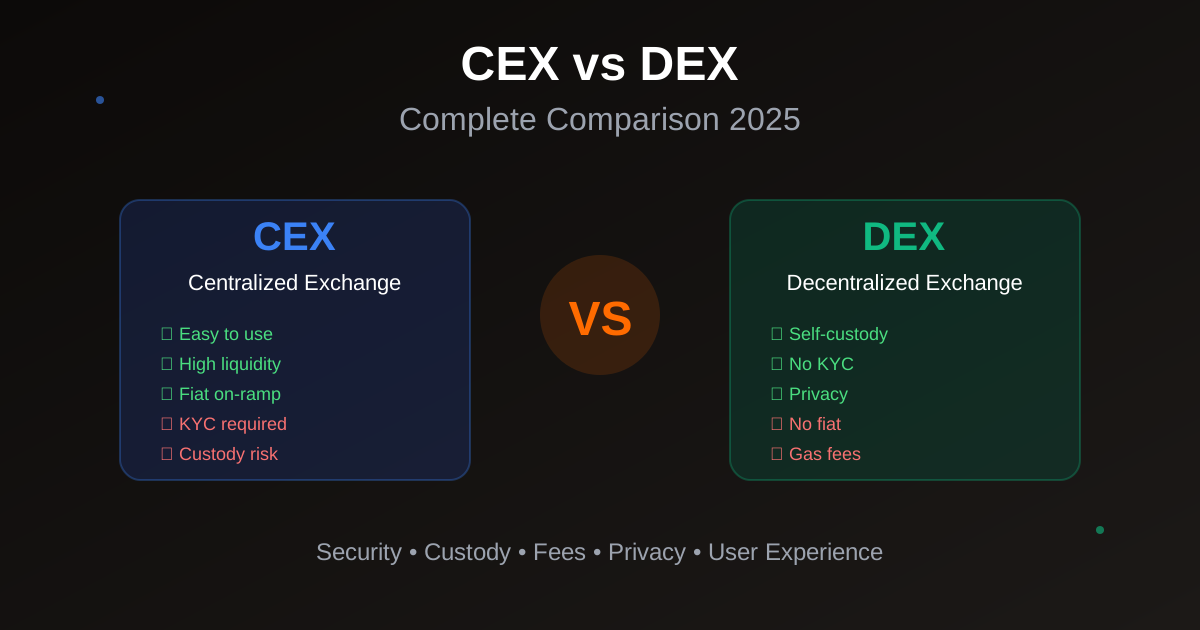
Centralized vs Decentralized Exchanges: Complete Comparison 2025
Comprehensive comparison of CEX vs DEX. Compare security, custody, fees, liquidity, user experience, regulations, privacy, and learn when to use centralized or decentralized exchanges.
Best DEX Platforms: Complete Comparison 2025
Compare the top 10 decentralized exchanges (DEX) for trading and liquidity provision. In-depth analysis of Uniswap, PancakeSwap, Curve, dYdX, and more with TVL, fees, and feature comparisons.
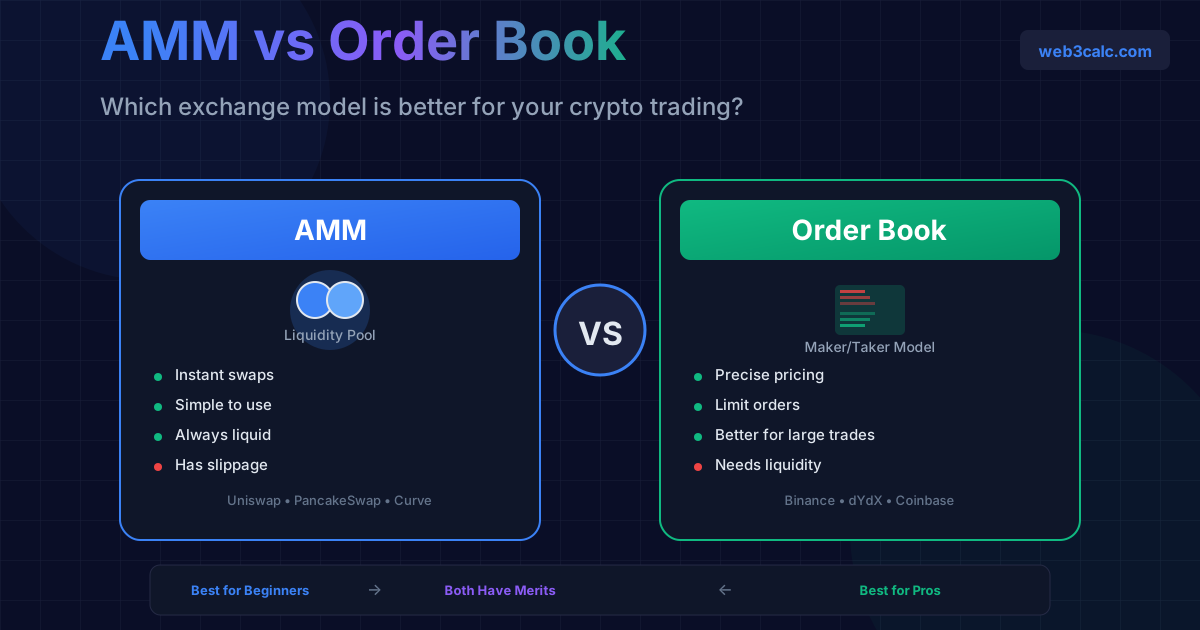
AMM vs Order Book: Which is Better for Crypto Trading?
Understand the key differences between Automated Market Makers (AMMs) and Order Book exchanges. Learn which model suits your trading style and why both matter in DeFi.