Centralized vs Decentralized Exchanges: Complete Comparison 2025
Comprehensive comparison of CEX vs DEX. Compare security, custody, fees, liquidity, user experience, regulations, privacy, and learn when to use centralized or decentralized exchanges.
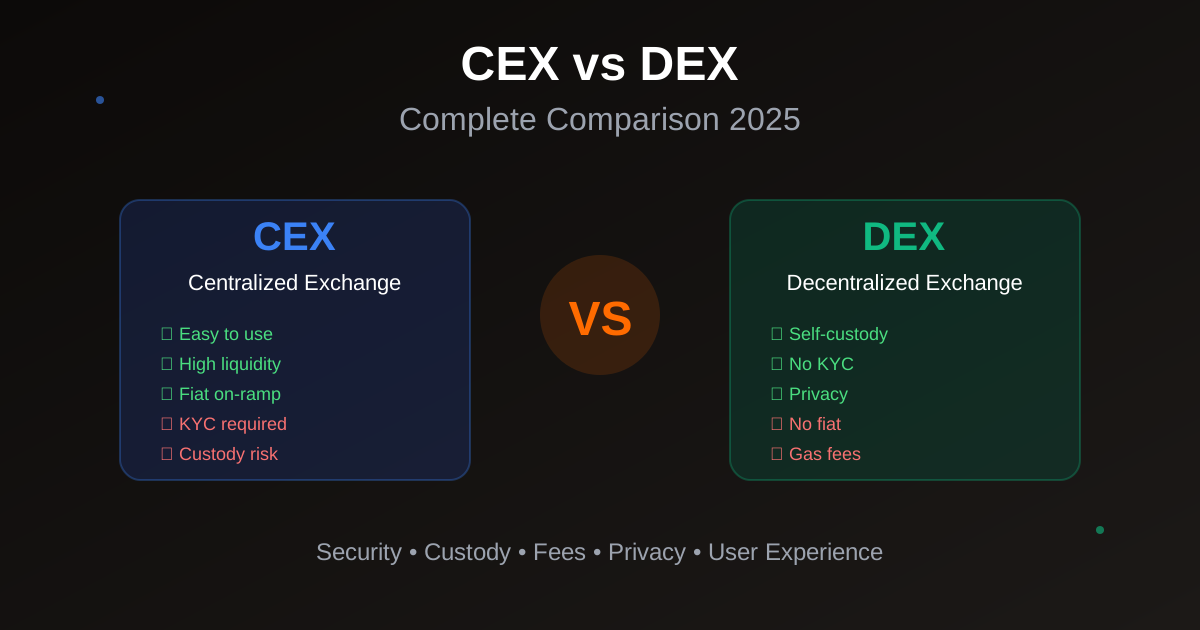
Centralized vs Decentralized Exchanges: Complete Comparison 2025
The choice between centralized exchanges (CEX) and decentralized exchanges (DEX) fundamentally shapes your crypto trading experience. Each offers distinct advantages and trade-offs in security, control, fees, and user experience.
This comprehensive guide compares CEX and DEX across every critical dimension to help you understand which exchange type suits your needs.
TL;DR - Quick Comparison
| Feature | Centralized Exchange (CEX) | Decentralized Exchange (DEX) | |---------|---------------------------|------------------------------| | Custody | Exchange holds your funds | You hold your funds | | KYC Required | Yes (usually) | No | | Trading Experience | Fast, familiar (order books) | On-chain, requires wallet | | Liquidity | Very high | Lower (but improving) | | Fees | 0.1-0.5% trading fee | 0.05-0.3% + gas fees | | Security Model | Trust the exchange | Trust smart contracts | | Asset Variety | Major cryptocurrencies | Long-tail tokens | | Fiat On/Off Ramp | Yes (easy) | Limited (requires bridges) | | Regulation | Heavily regulated | Varies by jurisdiction | | Privacy | Low (KYC required) | High (pseudonymous) | | Hacking Risk | Exchange can be hacked | Personal wallet responsibility | | Best For | Beginners, fiat trades, high volume | DeFi users, privacy-focused, self-custody |
What is a Centralized Exchange (CEX)?
Definition
A centralized exchange is a platform operated by a company that facilitates cryptocurrency trading. The exchange acts as an intermediary between buyers and sellers, holding customer funds in custody.
How CEX Works
- Registration: Create account with email and password
- KYC Verification: Submit identity documents
- Deposit: Send crypto or fiat to exchange wallet
- Trading: Place orders on order books
- Withdrawal: Request withdrawal to external wallet
Major Centralized Exchanges
Top CEX by Volume (2025):
- Binance - $50B daily volume
- Coinbase - $15B daily volume
- Kraken - $8B daily volume
- OKX - $12B daily volume
- Bybit - $10B daily volume
- KuCoin - $5B daily volume
- Bitfinex - $3B daily volume
- Gemini - $2B daily volume
CEX Architecture
Backend Components:
- Order matching engine
- Custody wallets (hot + cold storage)
- KYC/AML systems
- Trading interface
- Internal ledger (off-chain)
Key Characteristic: Trades happen off-chain on internal database, settled periodically on blockchain.
What is a Decentralized Exchange (DEX)?
Definition
A decentralized exchange is a peer-to-peer marketplace where trades execute via smart contracts without intermediaries. Users retain custody of their funds at all times.
How DEX Works
- Connect Wallet: Use MetaMask or similar
- No Registration: Anonymous, no KYC
- Trading: Approve tokens, execute swaps on-chain
- All On-Chain: Every transaction is blockchain transaction
- Self-Custody: You control private keys
Major Decentralized Exchanges
Top DEX by Volume (2025):
- Uniswap - $1.8B daily volume
- Curve - $800M daily volume
- PancakeSwap - $650M daily volume
- dYdX - $2.5B daily volume (derivatives)
- SushiSwap - $280M daily volume
- Balancer - $300M daily volume
- GMX - $450M daily volume
- Trader Joe - $180M daily volume
DEX Models
Automated Market Maker (AMM):
- Liquidity pools (e.g., Uniswap, PancakeSwap)
- Algorithmic pricing
- No order books
- Liquidity providers earn fees
Order Book DEX:
- Traditional order matching (e.g., dYdX, Serum)
- On-chain or hybrid
- More complex but familiar UX
Comprehensive Feature Comparison
1. Custody & Control
Centralized Exchanges: Custodial Model
How it works:
- Exchange controls private keys
- Your coins stored in exchange wallets
- You have account balance (IOU)
- Trust required
Analogy: Like a bank - you deposit money, they hold it, you can withdraw.
Advantages: ✅ No need to manage private keys ✅ Can recover account with password reset ✅ Exchange handles security ✅ Simple user experience ✅ Customer support available
Disadvantages: ❌ "Not your keys, not your coins" ❌ Exchange can freeze your account ❌ Exchange bankruptcy risk (Mt. Gox, FTX) ❌ Withdrawal limits may apply ❌ Dependence on third party
Historic Failures:
- Mt. Gox (2014): 850K BTC lost
- QuadrigaCX (2019): $190M inaccessible
- FTX (2022): $8B+ customer funds lost
- Celsius (2022): Bankruptcy, funds locked
Decentralized Exchanges: Self-Custody
How it works:
- You control private keys via wallet
- Funds never leave your wallet until trade
- Smart contract executes swap atomically
- No intermediary
Analogy: Like peer-to-peer cash exchange - direct ownership.
Advantages: ✅ Full control of funds ✅ No account freezing ✅ No withdrawal limits ✅ No exchange bankruptcy risk ✅ Permissionless access
Disadvantages: ❌ You're responsible for security ❌ Lost keys = lost funds forever ❌ No customer support for wallet issues ❌ Must understand wallets and gas ❌ Mistakes are irreversible
Key Principle: With great power comes great responsibility.
Recommendation by User Type
Choose CEX if:
- New to crypto
- Don't want key management responsibility
- Want account recovery options
- Need customer support
- Prefer familiar banking model
Choose DEX if:
- Experienced with crypto
- Value self-custody
- Understand wallet security
- Trust yourself more than exchanges
- Want maximum control
2. Privacy & KYC
Centralized Exchanges: Identity Required
KYC Requirements:
- Full name, date of birth
- Government-issued ID (passport, license)
- Proof of address (utility bill, bank statement)
- Selfie verification
- Source of funds (for large amounts)
Privacy Implications:
- Exchange knows your identity
- Links identity to all trades
- Must report to tax authorities
- Data breach risk
- Transaction monitoring
Verification Levels:
| Level | Requirements | Limits | |-------|-------------|--------| | Level 1 | Email only | $1K-5K withdrawal/day | | Level 2 | Basic KYC | $50K-100K/day | | Level 3 | Enhanced KYC | Unlimited |
Advantages: ✅ Regulatory compliance ✅ Fraud prevention ✅ Can link to bank accounts ✅ Dispute resolution
Disadvantages: ❌ No privacy ❌ Data breach exposure ❌ Government surveillance ❌ May be censored
Decentralized Exchanges: Pseudonymous
No KYC Required:
- Just connect wallet
- No personal information
- Wallet address only identifier
- Fully permissionless
Privacy Level:
- Pseudonymous (not anonymous)
- Transactions public on blockchain
- IP address may be logged by RPC
- Can use VPN/Tor for extra privacy
Advantages: ✅ Financial privacy ✅ No data collection ✅ No identity verification ✅ Censorship resistant ✅ Accessible globally
Disadvantages: ❌ No recourse for mistakes ❌ Can't easily link to fiat ❌ May face regulatory pressure ❌ On-chain analysis possible
Privacy Comparison
CEX Privacy Score: 2/10
- Full identity disclosure
- Transaction monitoring
- Data sharing with authorities
DEX Privacy Score: 7/10
- Pseudonymous access
- No identity collection
- On-chain transparency (pro and con)
3. Security Models
CEX Security: Trust the Exchange
Security Responsibilities:
Exchange must secure:
- Hot wallets (online, for withdrawals)
- Cold storage (offline, bulk funds)
- Database and servers
- API access
- Employee access
- DDoS protection
Multi-Layer Security:
- 2FA (Two-factor authentication)
- Withdrawal whitelist
- Email confirmations
- IP whitelist
- Anti-phishing codes
- Insurance funds (some exchanges)
Risk Factors:
External attacks:
- Hacking attempts (constant)
- Phishing users
- API exploits
- Social engineering
Internal threats:
- Rogue employees
- Poor key management
- Insolvency (FTX, Celsius)
- Fractional reserve
Major CEX Hacks:
| Exchange | Year | Amount Lost | Outcome | |----------|------|-------------|---------| | Mt. Gox | 2014 | 850K BTC ($450M) | Bankruptcy | | Bitfinex | 2016 | 120K BTC ($72M) | Recovered partially | | Coincheck | 2018 | $530M | Compensated users | | Binance | 2019 | $40M | Covered by SAFU fund | | KuCoin | 2020 | $280M | Recovered most funds |
CEX Security Score: 6/10
- Improving but not foolproof
- Single point of failure
- Depends on exchange practices
DEX Security: Trust Smart Contracts
Security Model:
- Smart contracts hold funds during swaps only
- Funds in your wallet rest of time
- Audited code (ideally)
- Immutable once deployed
Risk Factors:
Smart contract risks:
- Code bugs and vulnerabilities
- Economic exploits (flash loans)
- Oracle manipulation
- Front-running/MEV
User risks:
- Wallet compromise
- Phishing (fake sites)
- Malicious token approvals
- Transaction mistakes
Major DEX Exploits:
| Protocol | Year | Amount Lost | Cause | |----------|------|-------------|-------| | bZx | 2020 | $8M | Flash loan exploit | | Harvest Finance | 2020 | $24M | Flash loan attack | | PancakeBunny | 2021 | $200M | Flash loan exploit | | Curve (DNS) | 2023 | $570K | Front-end hijack | | Balancer V1 | 2020 | $500K | Smart contract bug |
DEX Security Score: 7/10
- No custody risk
- Smart contract risk exists
- User responsibility higher
Security Best Practices
For CEX: ✅ Enable 2FA (authenticator app) ✅ Use unique, strong password ✅ Whitelist withdrawal addresses ✅ Don't store large amounts long-term ✅ Verify URLs (bookmarks) ✅ Check for insurance (FDIC, SAFU)
For DEX: ✅ Use hardware wallet for large amounts ✅ Verify contract addresses ✅ Revoke unlimited approvals ✅ Start with small test transactions ✅ Use official frontends only ✅ Check audits before using new protocols
4. Trading Experience & Liquidity
CEX Trading: Order Books
Order Book Model:
- Limit orders (set your price)
- Market orders (instant execution)
- Stop-loss, take-profit orders
- Margin/leveraged trading
- Futures and options
Trading Features:
- Advanced charting (TradingView)
- Technical indicators
- API for trading bots
- Copy trading
- Mobile apps
Liquidity:
- Very high for major pairs
- Tight spreads (0.01-0.1%)
- Large orders possible
- Market makers provide liquidity
Example: BTC/USDT on Binance
- 24h Volume: $5B+
- Spread: 0.01% ($0.20 on $2K)
- Slippage: Minimal for $100K orders
- Depth: $50M+ within 1%
Speed:
- Instant execution (internal DB)
- No blockchain wait
- Can process 100K+ orders/second
DEX Trading: AMMs & Limited Order Books
AMM Model (Most Common):
- Swap tokens from liquidity pools
- Algorithmic pricing
- No order books
- Liquidity from LPs
Trading Experience:
- Simple swap interface
- Connect wallet first
- Approve tokens (gas cost)
- Set slippage tolerance
- Confirm transaction (wait for block)
Liquidity:
- Lower than major CEXs
- Varies by chain and pair
- Slippage on large orders
- Fragmented across chains
Example: ETH/USDC on Uniswap
- 24h Volume: $200M
- Pool TVL: $150M
- Slippage: 0.1% for $10K, 0.5% for $50K
- Fee: 0.05% or 0.3%
Speed:
- Depends on blockchain
- Ethereum: 12-15 seconds
- BSC: 3 seconds
- Arbitrum: <1 second
Liquidity Comparison
$10K Trade (BTC/USD):
- Binance CEX: 0.01% slippage, instant
- Uniswap DEX: 0.02-0.05% slippage + 0.3% fee, 15 seconds
$100K Trade (ETH/USD):
- Coinbase CEX: 0.02% slippage, instant
- Uniswap DEX: 0.08-0.15% slippage + fee, 15 seconds
$1M Trade:
- CEX: Still tight, 0.05-0.1% slippage
- DEX: 0.3-0.8% slippage, may need to split
Winner for Liquidity: CEX (especially for large trades)
5. Fees & Costs
CEX Fee Structure
Trading Fees (Maker/Taker):
| Exchange | Maker Fee | Taker Fee | Volume Discount? | |----------|-----------|-----------|-----------------| | Binance | 0.10% | 0.10% | Yes (to 0.02%) | | Coinbase | 0.40% | 0.60% | Yes | | Kraken | 0.16% | 0.26% | Yes | | OKX | 0.08% | 0.10% | Yes |
Additional Fees:
- Deposit: Usually free
- Withdrawal: $1-25 per crypto
- Fiat deposit: Free to 1-3%
- Fiat withdrawal: $5-25 or 1%
- Margin/leverage: Interest fees
Example: $10K Trade on Binance
- Trading fee: $10K × 0.1% = $10
- Withdrawal fee: $15 (BTC)
- Total: $25
DEX Fee Structure
Swap Fees:
- Protocol fee: 0.05-1% of trade
- Goes to liquidity providers
- No withdrawal fees (just gas)
Gas Fees:
- Varies by blockchain
- Per transaction cost
- Not related to trade size
Example: $10K Trade on Uniswap (Ethereum)
- Swap fee: $10K × 0.3% = $30
- Gas fee: $10-50 (depends on congestion)
- Total: $40-80
Example: $10K Trade on PancakeSwap (BSC)
- Swap fee: $10K × 0.25% = $25
- Gas fee: $0.50
- Total: $25.50
Cost Comparison by Trade Size
$1K Trade:
- CEX (Binance): $1 + $15 withdrawal = $16 (1.6%)
- DEX (Ethereum): $3 + $15 gas = $18 (1.8%)
- DEX (BSC): $2.5 + $0.50 gas = $3 (0.3%)
$10K Trade:
- CEX: $10 + $15 = $25 (0.25%)
- DEX (Ethereum): $30 + $20 = $50 (0.5%)
- DEX (BSC): $25 + $0.50 = $25.50 (0.26%)
$100K Trade:
- CEX: $100 + $15 = $115 (0.12%)
- DEX (Ethereum): $300 + $30 = $330 (0.33%)
- DEX (BSC): $250 + $0.50 = $250.50 (0.25%)
Winner: Depends on trade size and chain
- Small trades: BSC DEX
- Large trades: CEX
- Ethereum DEX: Most expensive
6. Asset Selection & Markets
CEX Asset Coverage
Typical CEX:
- 100-500 trading pairs
- Major cryptocurrencies (BTC, ETH, etc.)
- Top 100-500 by market cap
- Vetted/listed tokens only
- Fiat pairs (USD, EUR, etc.)
Trading Pairs:
- Crypto-to-fiat (BTC/USD, ETH/EUR)
- Crypto-to-crypto (ETH/BTC, ALT/ETH)
- Stablecoin pairs (ALT/USDT)
Derivatives:
- Futures contracts
- Options
- Margin trading (2-125x leverage)
- Perpetual swaps
Listing Process:
- Application required
- Listing fees ($50K-500K+)
- Compliance review
- Market making requirements
DEX Asset Coverage
Typical DEX:
- Thousands of tokens
- Any token can be traded
- Permissionless listing
- Long-tail assets
- New token launches
No Fiat Pairs:
- Only crypto-to-crypto
- Must use stablecoins (USDC, USDT)
- Need CEX or fiat on-ramp separately
Derivatives (Limited):
- Perpetuals on specialized DEXs (GMX, dYdX)
- Options (Dopex, Lyra)
- Less mature than CEX
Freedom:
- Anyone can create pool
- No permission needed
- No listing fees
- But: More scam tokens
Asset Selection Comparison
CEX Advantages: ✅ Fiat on/off ramps ✅ Vetted tokens (less scams) ✅ Major pairs with high liquidity ✅ Derivatives markets
DEX Advantages: ✅ Any token tradeable ✅ Early access to new tokens ✅ Long-tail asset coverage ✅ No permission needed
Use Both:
- CEX for major trading
- DEX for new/niche tokens
7. User Experience
CEX UX: Familiar & Polished
Onboarding:
- Simple registration
- Guided KYC process
- Tutorial for beginners
- Customer support
Trading Interface:
- Professional charts
- Order types
- One-click trading
- Mobile apps (iOS/Android)
- Notifications
Account Management:
- Easy deposits/withdrawals
- Transaction history
- Tax reports
- Portfolio tracking
- Referral programs
Learning Curve: Easy to moderate
- Familiar to stock trading
- Tutorials available
- Support when stuck
Best CEX Interfaces:
- Coinbase (beginner-friendly)
- Binance (feature-rich)
- Kraken (clean design)
DEX UX: Requires Crypto Knowledge
Onboarding:
- Wallet setup required
- Understand private keys
- Get crypto first (on CEX or P2P)
- Add network to wallet
- No tutorials (usually)
Trading Interface:
- Simple swap forms
- Limited charts (improving)
- Connect wallet button
- Approve → Swap two-step process
- No mobile app (web3 mobile wallets)
Account Management:
- No account (just wallet)
- Use blockchain explorers for history
- Track portfolio separately
- No built-in tax reports
- No customer support
Learning Curve: Moderate to steep
- Must understand wallets
- Gas fees confusing
- Mistakes costly
- No support to call
Best DEX Interfaces:
- Uniswap (cleanest)
- PancakeSwap (beginner-friendly)
- Camelot (modern)
UX Winner: CEX
Better for most users, especially beginners.
8. Regulation & Legal
CEX Regulation: Heavily Regulated
Licensing Requirements:
- Money transmitter licenses
- Banking partnerships
- Regulatory compliance
- Regular audits
Compliance Obligations:
- Know Your Customer (KYC)
- Anti-Money Laundering (AML)
- Transaction monitoring
- Suspicious activity reporting
- Travel Rule compliance
Geographic Restrictions:
- May not serve certain countries
- Restricted in some US states
- Compliance varies by jurisdiction
Regulatory Bodies:
- USA: SEC, CFTC, FinCEN
- Europe: MiCA framework
- UK: FCA
- Asia: Varies by country
Recent Regulatory Actions:
- Binance: $4B+ fines (2023)
- Coinbase: SEC lawsuit
- Kraken: SEC settlement
- Many exchanges geoblocking
Advantages of Regulation: ✅ Consumer protection ✅ Insurance (sometimes) ✅ Dispute resolution ✅ Legitimacy and trust ✅ Bank integrations
Disadvantages: ❌ Restrictions on who can use ❌ Asset delisting risk ❌ Costly compliance ❌ Privacy loss ❌ Censorship possible
DEX Regulation: Gray Area
Current Status:
- Most DEXs claim to be "just software"
- No KYC enforcement
- Operates permissionlessly
- Regulatory uncertainty
Increasing Pressure:
- SEC considers some DEX tokens securities
- Front-ends may implement restrictions
- Geoblocking certain regions
- Delisting of some assets
Recent Examples:
- Uniswap Labs: Delisted certain tokens
- dYdX: US geoblocking
- Tornado Cash: Sanctioned by OFAC
Advantages: ✅ Permissionless (for now) ✅ No KYC ✅ Censorship resistant (protocol level) ✅ Global access
Disadvantages: ❌ Regulatory uncertainty ❌ May face restrictions ❌ No legal recourse ❌ Future unclear
9. Fiat Integration
CEX: Easy Fiat On/Off Ramps
Deposit Methods:
- Bank transfer (ACH, SEPA, Wire)
- Credit/debit card
- PayPal, Apple Pay (some)
- Cash deposits (some regions)
Withdrawal Methods:
- Bank transfer
- PayPal
- Debit card
- Check (some exchanges)
Fees:
- Deposit: Free to 3%
- Withdrawal: $5-25 or 1%
- Credit card: 3-5%
Processing Time:
- Instant (credit card)
- 1-5 business days (bank transfer)
- Instant (crypto deposits)
Winner: CEX by far - essential for most users
DEX: No Direct Fiat
Must use workarounds:
- Buy crypto on CEX
- Withdraw to personal wallet
- Use wallet to connect to DEX
- Trade on DEX
Fiat → DEX Path:
- Coinbase: Buy ETH with USD
- Withdraw ETH to MetaMask
- Use MetaMask on Uniswap
- Total time: 30-60 minutes
Alternative: Fiat On-Ramps
- Moonpay, Wyre, Transak
- Higher fees (5-10%)
- Directly to wallet
- Still requires KYC
10. Use Case Analysis
When to Use CEX
Optimal scenarios:
✅ Buying crypto with fiat
- Easiest entry point
- Bank transfers
- Credit card purchases
✅ Beginners learning
- User-friendly
- Support available
- Familiar interface
✅ Trading major pairs
- Best liquidity
- Tight spreads
- Low fees
✅ Margin/futures trading
- Sophisticated derivatives
- High leverage
- Professional tools
✅ Large position sizes
- Deep liquidity needed
- Minimize slippage
- Institutional use
✅ Don't want custody responsibility
- Exchange manages keys
- Account recovery possible
- Password reset
✅ Need customer support
- Human assistance
- Dispute resolution
- Account issues
✅ Frequent fiat withdrawals
- Easy off-ramps
- Regular spending
- Converting to fiat
When to Use DEX
Optimal scenarios:
✅ Value self-custody
- Control your keys
- No trust required
- Sovereign finance
✅ Privacy concerned
- No KYC
- Pseudonymous
- Financial privacy
✅ Trading new/niche tokens
- Access to all tokens
- Early token launches
- Long-tail assets
✅ DeFi participation
- Yield farming
- Liquidity provision
- Staking
- Governance
✅ Living in restricted regions
- No geoblocking
- Permissionless access
- Global availability
✅ Don't trust centralized entities
- CEX bankruptcy risk
- No intermediaries
- Code is law
✅ Short-term trades only
- Trade and return to wallet
- No long-term custody
- Maximum security
✅ Experienced crypto user
- Comfortable with wallets
- Understand gas
- Know the risks
Risk Comparison
CEX Risks
Counterparty risk:
- Exchange insolvency
- Fractional reserve
- Withdrawal freezes
- Account closure
Security risks:
- Exchange hacks
- Internal fraud
- Database breaches
- API exploits
Regulatory risks:
- Asset delisting
- Service termination
- Account freezing
- Forced KYC
Operational risks:
- Downtime during volatility
- Maintenance windows
- Technical issues
- Customer support delays
DEX Risks
Smart contract risk:
- Code vulnerabilities
- Economic exploits
- Oracle manipulation
- Flash loan attacks
User error risk:
- Lost private keys
- Wrong address sends
- Malicious approvals
- Phishing sites
Market risks:
- Impermanent loss (LPs)
- MEV/front-running
- Sandwich attacks
- Rug pulls (new tokens)
Technical risks:
- Gas price volatility
- Network congestion
- Failed transactions
- Wallet compatibility
Risk Mitigation
For CEX:
- Don't keep large amounts on exchange
- Use hardware 2FA
- Whitelist addresses
- Research exchange reputation
- Diversify across exchanges
For DEX:
- Use hardware wallet
- Verify contracts
- Start with small amounts
- Revoke old approvals
- Use official frontends
Cost of Ownership Analysis
3-Month Trading Scenario
Profile: Active trader, $20K capital, 100 trades
CEX Costs:
- Trading fees: 100 × $20K × 0.1% = $2,000
- Withdrawals: 10 × $15 = $150
- Total: $2,150 (10.75% of capital)
DEX Costs (Ethereum):
- Trading fees: 100 × $20K × 0.3% = $6,000
- Gas fees: 100 × $20 = $2,000
- Total: $8,000 (40% of capital) ❌
DEX Costs (Arbitrum):
- Trading fees: 100 × $20K × 0.3% = $6,000
- Gas fees: 100 × $0.50 = $50
- Total: $6,050 (30% of capital)
DEX Costs (BSC):
- Trading fees: 100 × $20K × 0.25% = $5,000
- Gas fees: 100 × $0.40 = $40
- Total: $5,040 (25.2% of capital)
Winner for active trading: CEX
Long-Term Hold Scenario
Profile: Buy and hold, $50K investment, 1 year
CEX Costs:
- Initial buy: $50K × 0.1% = $50
- Holding: $0
- Withdrawal at end: $15
- Total: $65
Risks: Exchange failure, account freeze
DEX Costs:
- Initial buy: $50K × 0.3% = $150
- Gas (buy): $20
- Holding: $0 (in your wallet)
- Total: $170
Risks: Wallet security (your responsibility)
Winner: CEX slightly cheaper, but DEX much safer for long-term
The Hybrid Approach (Recommended)
Use Both Strategically
Most sophisticated users utilize both CEX and DEX:
CEX for:
- Fiat on/off ramps
- Major trading pairs
- Leveraged trading
- Large position entry/exit
DEX for:
- Long-term holdings (after buying on CEX)
- New token access
- DeFi participation
- Privacy-focused activities
Typical Workflow
-
Buy on CEX (Coinbase, Binance)
- Use fiat to buy crypto
- Take advantage of liquidity
- Lower trading fees
-
Withdraw to Personal Wallet
- Self-custody for security
- Use hardware wallet for large amounts
- You control private keys
-
Trade on DEX (Uniswap, PancakeSwap)
- Access niche tokens
- DeFi farming
- LP provision
-
Return to CEX for Fiat
- When cashing out
- Convert to fiat
- Withdraw to bank
Comparison Summary
CEX Strengths
✅ Easy fiat integration ✅ High liquidity ✅ User-friendly ✅ Customer support ✅ Advanced trading features ✅ Mobile apps
CEX Weaknesses
❌ Custody risk ❌ No privacy (KYC) ❌ Regulatory restrictions ❌ Account freezing possible ❌ Higher trust required
DEX Strengths
✅ Self-custody ✅ Privacy (no KYC) ✅ Permissionless ✅ All tokens accessible ✅ Censorship resistant ✅ DeFi integration
DEX Weaknesses
❌ No fiat integration ❌ Lower liquidity ❌ User responsibility ❌ Higher learning curve ❌ Gas fees ❌ No customer support
Future Trends
CEX Evolution
Improving:
- Better security practices
- Proof of reserves
- Insurance funds
- Self-custody options
Challenges:
- Increased regulation
- Compliance costs
- Competition from DEXs
DEX Evolution
Improving:
- Better UX/UI
- Lower gas fees (L2s)
- More liquidity
- Limit orders
- Better price oracles
Challenges:
- Regulatory pressure
- Front-end restrictions
- MEV/front-running
Convergence
Hybrid models emerging:
- CEX with self-custody wallets
- DEX with optional KYC
- CEX-DEX aggregators
- Best of both worlds
Tools & Resources
For CEX Users:
- CoinMarketCap - Exchange rankings
- CER.live - Exchange proof of reserves
- CryptoCompare - Exchange comparison
For DEX Users:
- Token Price Calculator - Compare prices across DEXs
- Impermanent Loss Calculator - For LPs
- Portfolio Tracker - Track DEX positions
- DeFi Llama - DEX volume and TVL
- Revoke.cash - Manage token approvals
Security Tools:
- Wallet Guard - Phishing protection
- Fire - Token approval manager
- Etherscan/BscScan - Verify contracts
Conclusion: Which Should You Use?
For Most Users: Start with CEX, Evolve to DEX
Recommended Path:
Stage 1: Beginner (0-6 months)
- Use CEX only
- Learn basics with small amounts
- Easy fiat on-ramp
- Customer support available
- Build confidence
Stage 2: Intermediate (6-18 months)
- Continue using CEX for major trading
- Experiment with DEX (small amounts)
- Set up personal wallet
- Learn DeFi basics
- Hybrid approach
Stage 3: Advanced (18+ months)
- Use DEX for most activities
- Self-custody primary
- CEX only for fiat on/off ramps
- Understand all risks
- Maximum control
Quick Decision Guide
Choose CEX if you:
- Are new to crypto
- Need fiat integration
- Want simplicity
- Need customer support
- Value convenience over control
Choose DEX if you:
- Experienced crypto user
- Value self-custody
- Want privacy
- Understand risks
- DeFi participant
Use Both if you:
- Want best of both worlds
- Strategic about trade-offs
- Have larger portfolio
- Active in DeFi
Frequently Asked Questions
Q: Is it safe to keep crypto on an exchange? For small amounts and short-term, yes. For large amounts or long-term, move to personal wallet.
Q: Can I get hacked using a DEX? DEX itself is safer, but your wallet can be compromised through phishing or malware.
Q: Which has lower fees? Depends on trade size and chain. Generally CEX for large trades, DEX on cheap chains (BSC) for small trades.
Q: Do I need KYC for DEX? No, DEXs don't require KYC. But you may need CEX (with KYC) to buy crypto initially.
Q: What if I lose my password on a CEX? You can reset it. But if you lose DEX wallet keys, funds are gone forever.
Q: Are DEXs legal? Currently yes, but regulations are evolving. Some jurisdictions may restrict access.
Q: Can CEX freeze my account? Yes, due to suspicious activity, regulations, or ToS violations.
Related Resources
- Best DEX Platforms Comparison
- Ethereum vs BSC vs Arbitrum
- Token Price Calculator
- Portfolio Tracker
- Wallet Security Checker
Information current as of December 2025. The crypto regulatory landscape evolves rapidly. Always verify current status.
Disclaimer: This article is educational only, not financial advice. Cryptocurrency trading involves risk of loss. Understand risks before trading on any platform.
Share this article:
Related Articles
Best DEX Platforms: Complete Comparison 2025
Compare the top 10 decentralized exchanges (DEX) for trading and liquidity provision. In-depth analysis of Uniswap, PancakeSwap, Curve, dYdX, and more with TVL, fees, and feature comparisons.
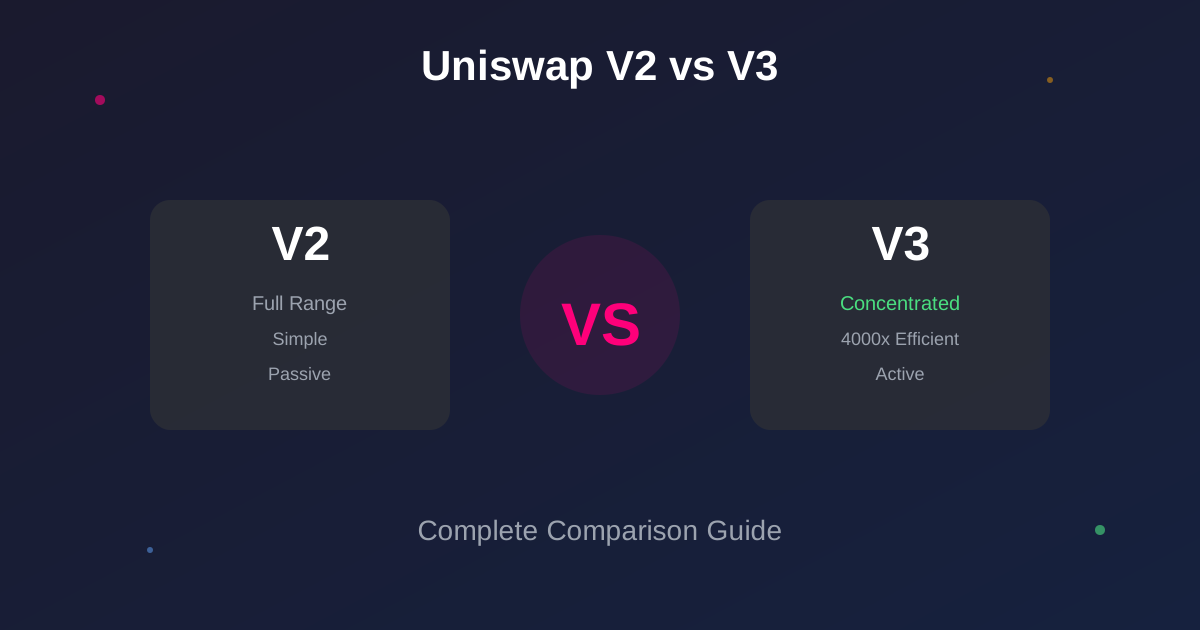
Uniswap V2 vs V3: Complete Comparison for Liquidity Providers
Comprehensive comparison of Uniswap V2 and V3 protocols. Learn the key differences in capital efficiency, impermanent loss, fees, and which version is best for your liquidity strategy.
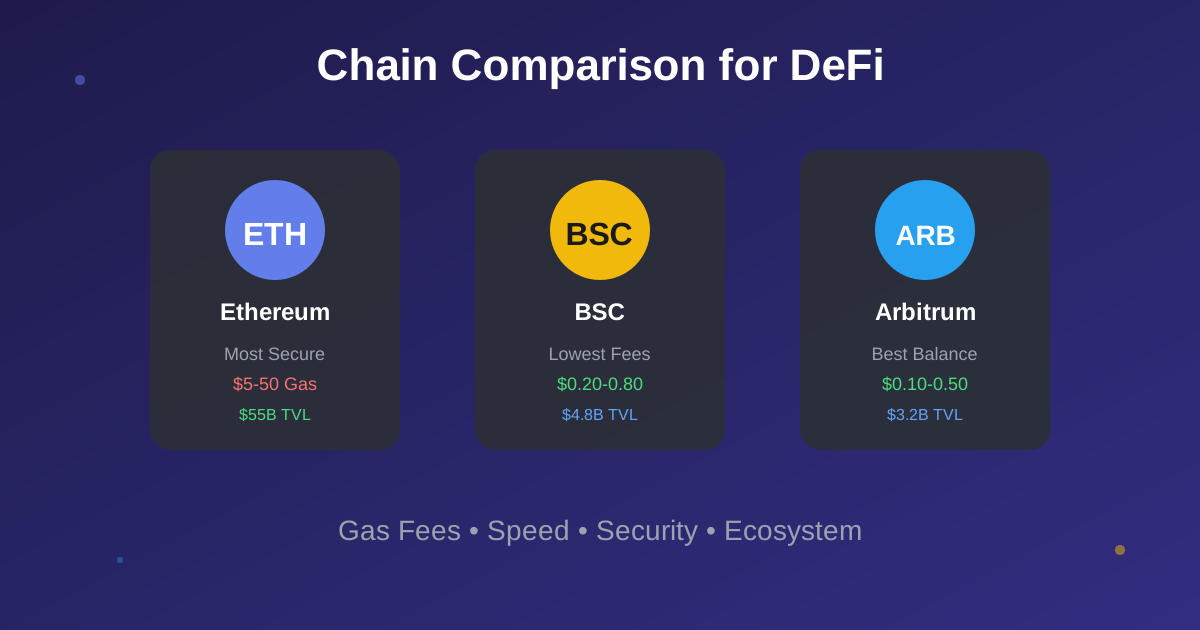
Ethereum vs BSC vs Arbitrum for DeFi: Complete Chain Comparison 2025
Compare Ethereum, Binance Smart Chain, and Arbitrum for DeFi. Detailed analysis of gas fees, speed, security, TVL, ecosystem, and which blockchain is best for your DeFi strategy.