Uniswap V3 Liquidity Mining Guide: Advanced ROI Simulator & Strategy Calculator
Uniswap V3 Liquidity Mining Guide: Advanced ROI Simulator & Strategy Calculator
Uniswap V3 revolutionized DeFi liquidity provision by introducing concentrated liquidity, allowing LPs to earn 4,000x more fees with the same capital compared to V2. However, this power comes with complexity: choosing the right price range, fee tier, and rebalancing strategy can mean the difference between 50% APR and -20% losses.
This comprehensive guide will teach you everything about Uniswap V3 liquidity mining, from basic concepts to advanced strategies used by professional market makers. We'll also show you how to use our free ROI simulator to optimize your positions before deploying capital.
What is Liquidity Mining in Uniswap V3?
Liquidity mining (or liquidity provision) is the act of depositing two tokens into a Uniswap pool to facilitate trading. In return, you earn a portion of trading fees proportional to your share of the pool.
Uniswap V2 vs V3: The Game Changer
Uniswap V2 spreads your liquidity across all possible prices from $0 to infinity. If you provide ETH/USDC liquidity:
- Your capital is divided across the entire price curve
- You earn fees on ALL trades, but very little per trade
- No management required ("set and forget")
- Capital efficiency: 1x
Uniswap V3 lets you concentrate liquidity within a specific price range:
- You choose a min and max price (e.g., $1,800 - $2,200 for ETH)
- Your capital only covers trades within this range
- You earn 10-100x more fees per trade within your range
- Capital efficiency: Up to 4,000x
Real-World Example
Scenario: You have $20,000 to provide liquidity for ETH/USDC
V2 Approach:
- Deposit 5 ETH ($10,000) + $10,000 USDC
- Your liquidity covers prices from $0 to ∞
- Pool has $100M total, your share: 0.02%
- Daily fees earned: ~$20 (0.02% of $100K daily volume)
- Fee APR: 36%
V3 Concentrated Approach (±10% range):
- Deposit 5 ETH ($10,000) + $10,000 USDC
- Your liquidity covers prices from $1,800 to $2,200 only
- Pool has $100M total, but only $10M in your range
- Your effective share in-range: 0.2% (10x higher!)
- Daily fees earned: ~$200 (0.2% of $100K daily volume)
- Fee APR: 365% 🚀
The catch? If ETH drops to $1,700 or rises to $2,300, you stop earning fees and face higher impermanent loss.
How Our Liquidity Mining ROI Simulator Works
Our calculator helps you simulate returns before deploying capital. Here's what it calculates:
1. Fee Earnings 💰
- Daily Fee Income: Based on pool volume, your TVL share, and fee tier
- Fee APR: Annualized fee return as a percentage of your capital
- Concentration Bonus: How much more you earn vs full-range positions
- Volume Share: Your effective share of trading volume in-range
2. Impermanent Loss ⚠️
- IL Amount: Dollar loss from price divergence vs HODLing
- IL Percentage: Loss as % of initial capital
- Out-of-Range Impact: Additional losses when price exits your range
- Final Position Value: What your LP tokens are worth after price movement
3. Rebalancing Costs 🔄
- Gas Costs: Total transaction fees for repositioning
- Number of Rebalances: Based on your strategy (never/daily/weekly/monthly)
- Slippage Impact: Additional costs from trades during rebalancing
- Cost as % of Capital: How much rebalancing eats into returns
4. Net ROI 📊
- Total Return: Fees - IL - Rebalancing Costs
- Net ROI %: Final return on investment percentage
- Break-Even Days: How long until fees offset impermanent loss
- Risk Score: Overall risk assessment of your strategy
5. Strategy Comparison 🎯
Compare your concentrated position against:
- Full Range V2-style: Passive, lower fees, lower IL
- Wide Range V3: ±50% range, balanced approach
- HODL: Simply holding tokens without LP
- Best Strategy: Algorithm picks optimal approach
Step-by-Step: Using the Calculator
Step 1: Configure Your Position
Token Pair:
- Enter your token symbols (e.g., ETH and USDC)
- Input how much of each token you want to provide
- Calculator automatically balances based on current price
Price Range:
- Current Price: Market price of Token0 in terms of Token1
- Min Price: Lower bound of your range
- Max Price: Upper bound of your range
Pro Tip: Start wide (±30-50%), then narrow as you gain experience.
Step 2: Select Fee Tier
Uniswap V3 offers 4 fee tiers:
0.01% - Stablecoin Pairs
- USDC/USDT, DAI/USDC, USDC/USDT
- Extremely tight ranges (±0.05% to ±1%)
- Highest volume, lowest volatility
- Requires daily rebalancing
- Best for: Automated strategies, large capital ($50K+)
0.05% - Correlated Assets
- WETH/stETH, wstETH/ETH, USDC/DAI
- Tight ranges (±2% to ±5%)
- Assets that usually trade at fixed ratios
- Occasional depegging risk
- Best for: Semi-active LPs, moderate capital ($10K-50K)
0.3% - Standard Pairs (Most Popular)
- ETH/USDC, WBTC/ETH, LINK/ETH
- Moderate ranges (±20% to ±50%)
- Highest liquidity and volume
- Good balance of fees and risk
- Best for: Most retail LPs, any capital ($1K+)
1.0% - Exotic Pairs
- New tokens, low-cap alts, exotic pairs
- Very wide ranges (±100% to ±200%)
- High volatility and IL risk
- Lower volume but higher fees
- Best for: Risk-tolerant LPs, small positions ($500-$5K)
Rule of Thumb: Higher volatility = higher fee tier needed to compensate for IL
Step 3: Input Pool Metrics
Pool TVL (Total Value Locked):
- Go to Uniswap Info
- Find your pool (e.g., ETH/USDC 0.3%)
- Note the total TVL (e.g., $50,000,000)
24h Trading Volume:
- Same page, note daily volume (e.g., $5,000,000)
- Higher volume = more fees earned
- Look for volume/TVL ratio > 0.1 (10% daily turnover)
Expected Price Change:
- Your prediction for price movement over holding period
- Positive % = price increase (bullish)
- Negative % = price decrease (bearish)
- Be realistic! Don't assume 100% gains unless you have strong conviction
Holding Period:
- How many days you plan to hold the position
- Longer periods = more fees but more IL risk
- Common periods: 7 days (weekly), 30 days (monthly), 90 days (quarterly)
Step 4: Configure Rebalancing
Rebalancing Frequency:
Never (Passive)
- Zero gas costs
- Lowest capital efficiency
- Best for: Very wide ranges (±50%), L1 mainnet (high gas), "set and forget" investors
Monthly
- ~1 rebalance per 30 days
- Moderate gas costs
- Good balance for most LPs
- Best for: ±20-30% ranges, active investors checking weekly
Weekly
- ~4 rebalances per month
- Higher gas costs but worth it on L2s
- Keeps position optimal
- Best for: ±10-20% ranges, dedicated LPs, L2 deployments
Daily (Advanced)
- 30 rebalances per month
- Only viable on L2s or with automation
- Maximum capital efficiency
- Best for: ±5-10% ranges, bots/automated strategies, pro market makers
Gas Cost Per Rebalance:
- Ethereum Mainnet: $50-200 (depending on gas prices)
- Arbitrum/Optimism: $2-10
- Base/Polygon: $0.50-$5
- Use L2s whenever possible to minimize costs!
Step 5: Analyze Results
Once calculated, you'll see:
📊 Summary Cards:
- Net Return: Your total profit/loss in USD
- Net ROI: Return as a percentage
- Total Fees: How much you earned from trading
- Impermanent Loss: Cost of price divergence
- Risk Level: Low/Medium/High/Very High assessment
📈 Detailed Breakdown:
- Fee earnings day-by-day
- IL progression over time
- Rebalancing cost timeline
- Break-even analysis
🎯 Strategy Comparison Table: See how your strategy stacks up against alternatives. The best strategy (highest net profit) is highlighted.
💡 Recommendations:
- Optimal price range suggestion
- Better fee tier recommendation
- Risk warnings if IL exceeds fees
- Tips for improving ROI
Advanced Liquidity Mining Strategies
Strategy 1: The Conservative (Wide Range, Passive)
Setup:
- Price range: ±50% from current price
- Fee tier: 0.3%
- Rebalancing: Never or monthly
- Target: 15-25% APR
Best For:
- First-time LPs
- Long-term holders wanting extra yield
- Mainnet deployments (high gas costs)
Example:
- ETH at $2,000
- Range: $1,000 - $3,000
- Very unlikely to go out of range
- Lower fees but much lower risk
Pros:
- Low management, low stress
- Minimal gas costs
- Still earns more than HODLing
Cons:
- 60-80% less fees than concentrated positions
- Capital inefficiency
Strategy 2: The Balanced (Moderate Range, Weekly Rebalancing)
Setup:
- Price range: ±25% from current price
- Fee tier: 0.3%
- Rebalancing: Weekly
- Target: 30-50% APR
Best For:
- Most retail LPs
- L2 deployments (cheap gas)
- Active investors checking positions regularly
Example:
- ETH at $2,000
- Range: $1,500 - $2,500
- Rebalance when price hits $1,550 or $2,450
- Good fees, manageable risk
Pros:
- 2-3x fees of passive strategy
- Still relatively low maintenance
- Good risk/reward balance
Cons:
- Requires weekly monitoring
- Some gas costs
- More IL than passive
Strategy 3: The Aggressive (Tight Range, Daily Rebalancing)
Setup:
- Price range: ±10% from current price
- Fee tier: 0.3%
- Rebalancing: Daily or automated
- Target: 60-150% APR
Best For:
- Professional LPs
- Automated bots
- Large capital ($50K+)
- L2 only (gas costs)
Example:
- ETH at $2,000
- Range: $1,800 - $2,200
- Rebalance every time price moves 5%
- Maximum fees, maximum management
Pros:
- 5-10x fees of passive strategy
- Extremely capital efficient
- Can generate 100%+ APR
Cons:
- Requires automation or daily attention
- High gas costs (even on L2)
- Extreme IL risk if price breaks range
- Stressful to manage
Strategy 4: The Multi-Position (Diversified Ranges)
Setup:
- Deploy 3 positions at different ranges:
- 40% capital in ±10% range (high fees)
- 40% capital in ±30% range (moderate)
- 20% capital in ±60% range (insurance)
- Rebalance only the tight position
- Target: 40-70% APR
Best For:
- Advanced LPs with $20K+ capital
- Risk-averse but yield-hungry investors
- Those who want optimization without stress
Example for ETH at $2,000:
- Position 1: $8K in $1,800-$2,200 (tight, rebalance weekly)
- Position 2: $8K in $1,400-$2,600 (moderate, rebalance monthly)
- Position 3: $4K in $800-$3,200 (wide, never rebalance)
Pros:
- Always earning fees (at least one position in range)
- Diversified risk
- Don't need to rebalance everything
Cons:
- More complexity to manage
- Multiple gas costs for initial setup
- Tracking 3 positions instead of 1
Strategy 5: The Stablecoin Farmer (0.01% Tier)
Setup:
- Pair: USDC/USDT or USDC/DAI
- Range: ±0.1% (e.g., $0.998 - $1.002)
- Fee tier: 0.01%
- Rebalancing: Daily or automated
- Target: 5-15% APR (stablecoin rates!)
Best For:
- Conservative investors
- Those wanting stablecoin yields
- Large capital ($100K+)
- L2 only
Example:
- $100K split $50K USDC + $50K USDT
- Range: $0.998 - $1.002
- Pool volume: $50M daily
- Your share: 0.2% of volume = $100K daily
- Fees: 0.01% × $100K = $10/day = $3,650/year
- APR: 3.65% plus occasional depeg profits
Pros:
- No IL risk (both stablecoins)
- Predictable returns
- Great for bear markets
Cons:
- Requires huge volume to be profitable
- Must be on L2 (mainnet gas kills returns)
- Lower % returns than volatile pairs
Impermanent Loss Deep Dive
IL is the silent killer of LP returns. Here's exactly how it works in V3:
IL Formula Simplified
For Uniswap V2 (full range):
IL % = (2 × √price_ratio) / (1 + price_ratio) - 1
For Uniswap V3 (concentrated): IL is amplified by your range width:
IL_V3 = IL_V2 × Concentration_Factor

Where Concentration_Factor = (max_price - min_price) / current_price
Real Examples
Scenario 1: ETH 2x (In-Range)
- Initial: $2,000
- Final: $4,000
- V2 IL: -5.7%
- V3 IL (±20% range): -11.4% (2x worse)
- V3 IL (±50% range): -6.8% (similar to V2)
Scenario 2: ETH 2x (Out-of-Range)
- Initial: $2,000, range $1,800-$2,200
- Final: $4,000 (way out of range)
- Your position converted to 100% USDC at $2,200
- IL: Massive - you missed 100% gain from $2,200 to $4,000
When Fees Offset IL
Break-Even Formula:
Fee APR needed = (IL % / days_held) × 365

Example:
- Expected IL: 10%
- Holding period: 30 days
- Required fee APR: (10% / 30) × 365 = 122% APR
Use our calculator to instantly see if your fees will beat IL!
IL Mitigation Tactics
1. Choose Correlated Pairs
- ETH/stETH: Highly correlated, low IL
- WBTC/renBTC: Both follow BTC price
- Stablecoin pairs: Near-zero IL
2. Hedge with Perpetuals
- Open short perpetual position = hedge IL on downside
- Example: Provide $20K ETH/USDC LP + short $10K ETH on GMX
- If ETH dumps, your short gains offset LP losses
3. Use Asymmetric Ranges
- Bullish? Set range with more upside ($2K to $3K vs $1.5K to $2K)
- Bearish? Set range with more downside
- Reduces IL in your expected direction
4. Active Rebalancing
- When price trends strongly, close position early
- Avoid the "out of range" death spiral
- Redeploy at new price level
Fee Tier Optimization
Choosing the wrong fee tier can cost you 50% of potential earnings. Here's the decision matrix:
Volume/TVL Ratio Method
Daily Volume / Pool TVL = Turnover Ratio

If ratio > 1.0 (100%): Use 0.01% or 0.05%
If ratio 0.1 - 1.0 (10-100%): Use 0.3%
If ratio < 0.1 (10%): Use 1.0%
Why?
- High turnover = lots of trades = lots of fees even at 0.01%
- Low turnover = few trades = need high fees per trade
Volatility-Based Method
Check 30-day price volatility:
- < 2% volatility: 0.01% tier (stablecoins)
- 2-10% volatility: 0.05% tier (correlated assets)
- 10-30% volatility: 0.3% tier (standard crypto)
- > 30% volatility: 1.0% tier (alts, new tokens)
Use our calculator to simulate all 4 tiers and see which maximizes ROI!
Gas Cost Optimization
Gas costs can destroy your returns if you're not careful:
Gas Cost Examples (December 2025)
Mainnet (50 gwei):
- Add liquidity: ~$80-150
- Remove liquidity: ~$60-120
- Rebalance (remove + add): ~$140-270
- Monthly rebalancing cost: $560-$1,080/month
Arbitrum:
- Add liquidity: ~$2-5
- Remove liquidity: ~$1-3
- Rebalance: ~$3-8
- Monthly rebalancing cost: $12-$32/month
Base/Optimism:
- Similar to Arbitrum, ~$2-8 per rebalance
Gas Efficiency Tips
1. Minimum Capital Requirements
To keep gas below 5% of fees:
Mainnet:
- Passive (monthly rebalancing): $20K minimum
- Active (weekly): $50K minimum
- Aggressive (daily): $200K+ minimum
L2 (Arbitrum/Base):
- Passive: $2K minimum
- Active: $5K minimum
- Aggressive: $10K minimum
Rule: If gas costs > 10% of fee income, you're too small for that strategy.
2. Batch Operations
- Don't rebalance one position at a time
- Wait until you have 3-5 positions needing rebalancing
- Do all at once to amortize gas overhead
3. Set Price Alerts
- Don't manually check every day
- Use tools like Revert Finance, DeBank, or Zapper
- Get notified only when action needed
4. Use Automation Protocols
- Gamma Strategies: Automated rebalancing, 10% performance fee
- Arrakis Finance: Active liquidity management, 20% fee
- Charm Finance: Algorithmic LPs, 15% fee
- Trade fee % for gas savings
Rebalancing Automation
DIY Automation (Advanced)
If you're technical, automate with:
-
Gelato Network:
- Set conditional orders: "If price > $2,200, rebalance"
- Pay per execution (~$5-10)
-
Chainlink Keepers:
- Monitor price on-chain
- Trigger rebalancing function automatically
-
Custom Bot:
- Use ethers.js to monitor Uniswap positions
- Execute rebalancing when conditions met
- Deploy on AWS/Heroku
Managed Services (Easy)
Let protocols do the work:
Gamma Strategies:
- Deposit your tokens, they manage everything
- Auto-rebalance when out of range
- Fee: 10% of earnings
- Best for: $5K-50K positions
Arrakis (formerly G-UNI):
- Professional market-making strategies
- Dynamic range adjustment
- Fee: 20% of earnings
- Best for: $10K-100K positions
Sommelier Finance:
- Cellar vaults with sophisticated strategies
- Combines LP + yield farming + rebalancing
- Fee: 15% management + 10% performance
- Best for: $20K+ positions
Cost Comparison
Manual (Weekly rebalancing on Arbitrum):
- Time: 30 min/week
- Cost: $15/month gas
- Total cost: $180/year + your time
Gamma Automated:
- Time: 0 min/week
- Cost: 10% of earnings (e.g., $500 on $5,000 annual fees)
- Total cost: $500/year
Break-even: If your time is worth $10/hour, automation saves money at ~26 hours/year (30 min/week).
Common Mistakes to Avoid
Mistake #1: Ranges Too Tight
❌ Don't: Set ±5% range without daily monitoring ✅ Do: Start with ±30%, narrow as you learn
Mistake #2: Ignoring Out-of-Range Risk
❌ Don't: Assume price stays in range forever ✅ Do: Set alerts at 80% of range boundaries
Mistake #3: Wrong Fee Tier
❌ Don't: Use 0.3% for stablecoin pairs ✅ Do: Match fee tier to volatility (use our calculator!)
Mistake #4: Deploying on Mainnet
❌ Don't: Provide liquidity on Ethereum L1 with <$50K ✅ Do: Use Arbitrum, Base, or Optimism for better gas efficiency
Mistake #5: No IL Calculation
❌ Don't: Blindly provide liquidity without simulating returns ✅ Do: Use our calculator to ensure fees beat IL
Mistake #6: Emotional Rebalancing
❌ Don't: Panic-rebalance every small price movement ✅ Do: Stick to your strategy, rebalance on schedule
Mistake #7: Putting All Capital in One Pool
❌ Don't: YOLO 100% into one pair ✅ Do: Diversify across 3-5 pools
Mistake #8: Forgetting About Taxes
❌ Don't: Rebalance daily on mainnet (every trade is taxable!) ✅ Do: Consider tax implications, track all trades
Real-World Case Studies
Case Study 1: Conservative LP on ETH/USDC
Profile: First-time LP, $10K capital, risk-averse
Setup:
- Pair: ETH/USDC on Arbitrum
- Capital: 2.5 ETH ($5,000) + $5,000 USDC
- Fee tier: 0.3%
- Range: $1,400 - $2,600 (±30%)
- Strategy: Monthly rebalancing
Results (90 days):
- Fee earnings: $486 (APR: 19.4%)
- Impermanent loss: -$127 (ETH up 15%)
- Gas costs: -$24 (3 rebalances)
- Net return: $335 (13.4% in 90 days = 53.6% APR)
Takeaway: Conservative approach still beat HODLing (15% ETH gain + 0% USDC = 7.5% average) by 6%.
Case Study 2: Aggressive LP on USDC/USDT
Profile: Experienced LP, $100K capital, stablecoin farmer
Setup:
- Pair: USDC/USDT on Arbitrum
- Capital: $50K USDC + $50K USDT
- Fee tier: 0.01%
- Range: $0.998 - $1.002 (±0.2%)
- Strategy: Automated rebalancing (Arrakis)
Results (90 days):
- Fee earnings: $1,247 (5% APR)
- Impermanent loss: $0 (stablecoins!)
- Protocol fees: -$125 (10% to Arrakis)
- Net return: $1,122 (4.5% in 90 days = 18% APR)
Takeaway: Low risk, consistent returns. Better than USDC/USDT lending (3-8% APR).
Case Study 3: Pro LP on WBTC/ETH
Profile: Pro market maker, $250K capital, active management
Setup:
- Pair: WBTC/ETH on Mainnet (high volume)
- Capital: 7.5 WBTC ($150K) + 50 ETH ($100K)
- Fee tier: 0.3%
- Range: 0.045 - 0.055 WBTC/ETH (±10%)
- Strategy: Daily bot rebalancing
Results (90 days):
- Fee earnings: $15,680 (25% APR)
- Impermanent loss: -$3,240 (WBTC outperformed ETH)
- Gas costs: -$2,700 (90 rebalances on L1!)
- Net return: $9,740 (15.6% in 90 days = 62.4% APR)
Takeaway: High returns but high maintenance. Would've been 72% APR on L2 (saving $2,400 gas).
Tools & Resources
Position Management
- Revert Finance: Best LP dashboard, set alerts, track IL
- DeBank: Portfolio tracking across chains
- Zapper: Quick add/remove liquidity
- APY Vision: IL tracking and analytics
Analytics
- Uniswap Info: Pool metrics, volume, TVL
- Dune Analytics: Custom LP queries
- DeFi Llama: Cross-protocol comparison
Automation
- Gamma Strategies: Automated rebalancing
- Arrakis Finance: Professional management
- Sommelier: Cellar vaults
Calculators
- Web3Calc (this tool!): ROI simulator, strategy comparison
- Daily DEFI: IL calculator
- Uniswap Calculator: Official V3 tool
Frequently Asked Questions
Q1: What's the minimum capital to start?
A:
- Mainnet: $20K+ (gas costs prohibitive below this)
- L2s (Arbitrum, Base): $1K-2K minimum
- Stablecoin pairs: $5K+ (need volume to earn)
Q2: Can I lose all my money?
A:
- No, you can't lose MORE than HODLing
- Worst case: token goes to zero (same as holding)
- IL reduces gains, doesn't create new losses
- Biggest risk: smart contract hacks (use audited protocols)
Q3: How much APR should I target?
A:
- Stablecoin pairs: 5-15% APR realistic
- ETH/USDC: 20-50% APR
- Volatile pairs: 50-150% APR (but higher risk)
- If someone promises 500%+, it's probably unsustainable
Q4: When should I rebalance?
A:
- Never: Wide ranges (±50%), mainnet deployments
- Monthly: Moderate ranges (±25-30%), most LPs
- Weekly: Tight ranges (±10-20%), L2 only
- Daily: Very tight ranges (±5-10%), pros/bots only
Q5: What if price goes out of my range?
A:
- You stop earning fees
- Your position converts to one asset (the "loser")
- You can withdraw, take the loss, redeploy elsewhere
- Or wait for price to return (may never happen)
Q6: Is V3 better than V2?
A:
- For active LPs: Yes, 10-100x more capital efficient
- For passive LPs: No, V2 "set and forget" is easier
- Most people: V3 with wide ranges (±30-50%) is best of both
Q7: Should I use Ethereum or L2?
A:
- Ethereum: Only if $50K+ capital
- L2 (Arbitrum, Base, Optimism): Everyone else
- Gas savings on L2 add 5-10% to APR
Q8: How do I handle taxes?
A:
- Every rebalancing = taxable event
- Use CoinTracker or Koinly to track
- Consider tax-loss harvesting
- HODLing in LP may be better if in high tax bracket
Q9: What's the best pair for beginners?
A:
- ETH/USDC 0.3%: Most liquid, good balance
- Range: ±30-40% from current price
- Rebalance: Monthly
- Chain: Arbitrum or Base
- Capital: $2K-5K to start
Q10: Can I automate this?
A:
- Yes: Use Gamma, Arrakis, or Sommelier
- Cost: 10-20% of earnings
- Break-even: Worth it if you value your time >$10/hour
- DIY: Build bot with ethers.js if technical
Conclusion
Uniswap V3 liquidity mining is one of the most profitable yet complex strategies in DeFi. Success requires:
✅ Understanding the mechanics: Concentrated liquidity, IL, fee tiers ✅ Choosing the right strategy: Match range/rebalancing to your risk tolerance ✅ Using our calculator: Simulate before deploying real capital ✅ Optimizing gas costs: Deploy on L2s whenever possible ✅ Managing IL: Ensure fees always exceed potential losses ✅ Staying disciplined: Stick to your strategy, don't panic rebalance
Your Action Plan
- Educate yourself: Read this guide, understand IL and fee mechanics
- Use our simulator: Test different ranges, fee tiers, strategies
- Start small: Deploy $1K-2K on Arbitrum to learn
- Monitor daily: Use Revert Finance, set price alerts
- Scale gradually: Once profitable, add more capital
- Automate eventually: After 3-6 months, consider Gamma/Arrakis
Remember: The best LP strategy is the one you'll actually maintain. Don't pick aggressive daily rebalancing if you'll forget to monitor. Start conservative, scale complexity as you gain experience.
Ready to optimize your liquidity mining?
👉 Use Our Free ROI Simulator to simulate your strategy before deploying capital!
Disclaimer: This guide is for educational purposes only. DeFi involves significant risk including impermanent loss, smart contract risk, and market volatility. Always do your own research and never invest more than you can afford to lose.
Share this article:
Related Articles
Portfolio Rebalancing Calculator Guide: Optimize Your Crypto Asset Allocation
# Portfolio Rebalancing Calculator Guide: Optimize Your Crypto Asset Allocation Portfolio rebalancing is one of the most important yet often overlooked aspects of crypto investing. As market prices...
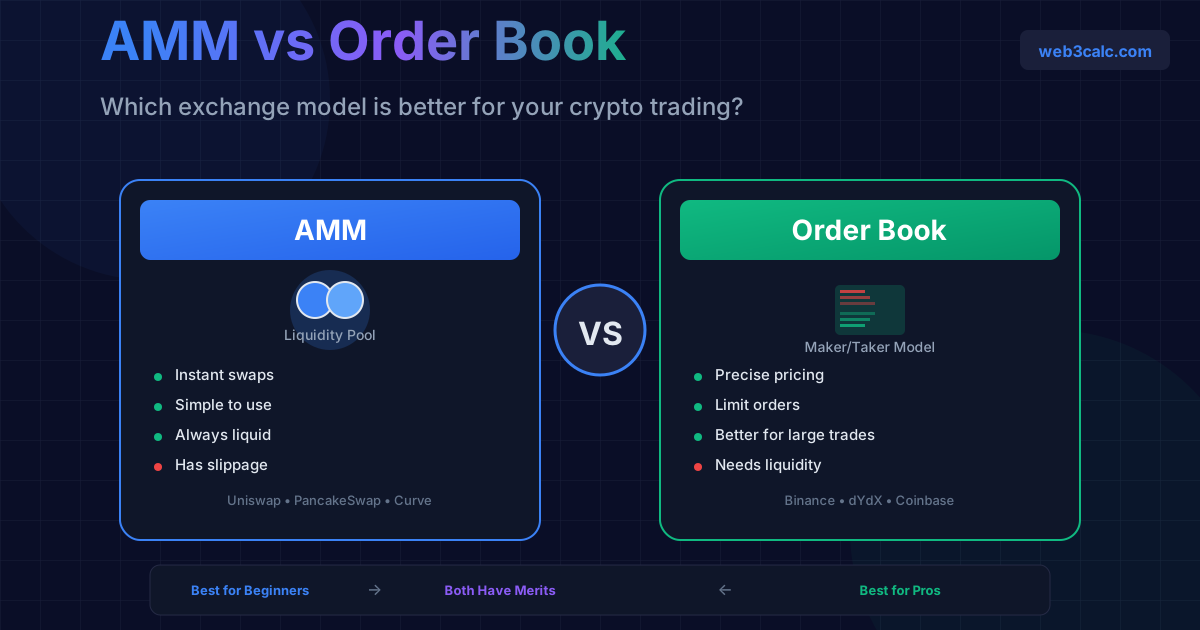
AMM vs Order Book: Which is Better for Crypto Trading?
Understand the key differences between Automated Market Makers (AMMs) and Order Book exchanges. Learn which model suits your trading style and why both matter in DeFi.
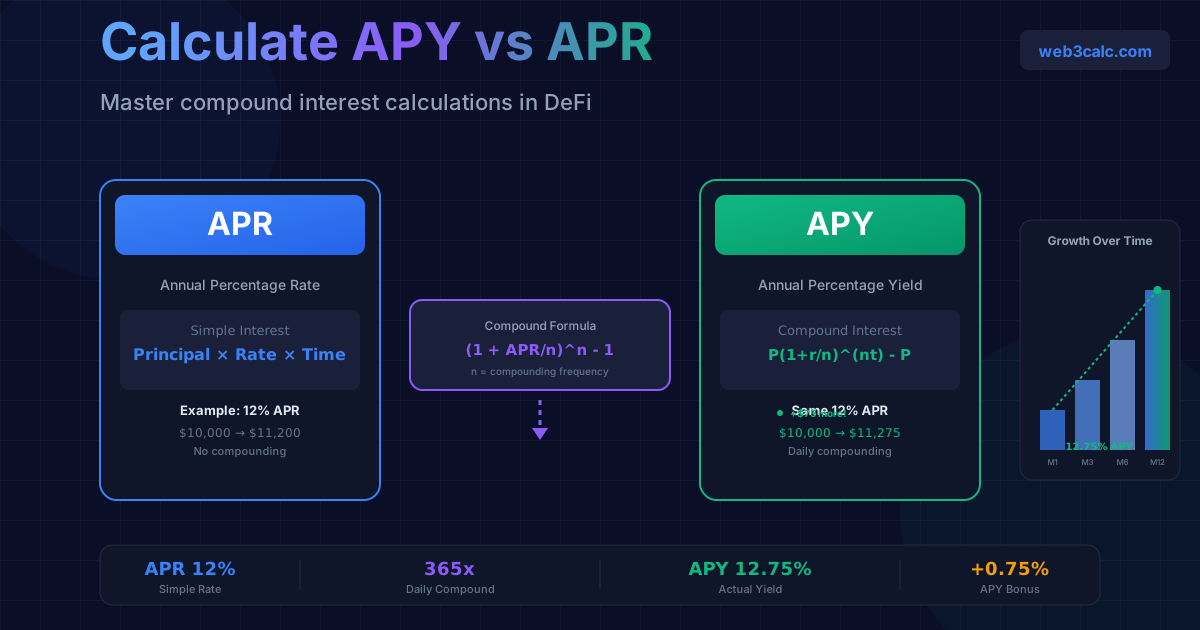
How to Calculate APY vs APR in DeFi: Complete Guide with Examples
Master the difference between APY and APR in DeFi. Learn calculation formulas, understand compound interest, and discover how to maximize your crypto yields.