Yield Farming Optimizer Guide: Maximize DeFi Returns in 2024
Complete guide to yield farming across 50+ protocols. Learn to calculate returns, compare APYs, manage risk, and optimize your DeFi strategy with auto-compounding.
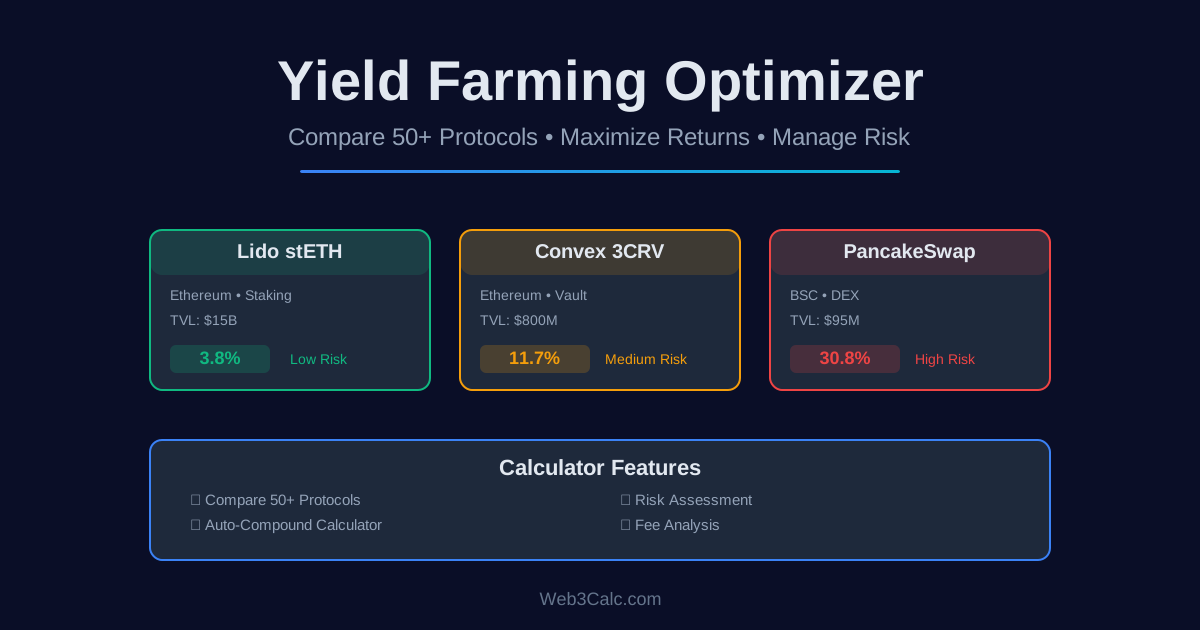
Yield Farming Optimizer Guide: Maximize DeFi Returns in 2024
Yield farming has evolved from a niche DeFi activity into a sophisticated investment strategy. With protocols offering anywhere from 3% to 300%+ APY, knowing how to evaluate, compare, and optimize yields is critical for maximizing returns while managing risk.
This comprehensive guide will teach you how to use our Yield Farming Optimizer to find the best opportunities across 50+ protocols, understand the risks, and build a sustainable farming strategy.
What is Yield Farming?
Yield farming (also called liquidity mining) is the practice of putting your cryptocurrency to work to generate returns. Unlike holding assets idle in a wallet, yield farming deploys capital into DeFi protocols where it earns interest, trading fees, or reward tokens.
How Yield Farming Works
When you yield farm, you're typically doing one of these:
- Providing Liquidity to DEXs: Deposit token pairs into AMMs like Uniswap or Curve, earn trading fees
- Lending Assets: Supply tokens to lending protocols like Aave, earn interest from borrowers
- Staking in Vaults: Deposit into auto-compounding vaults like Yearn or Beefy
- Liquidity Mining: Earn governance tokens as rewards for providing liquidity
Yield Sources Explained
Your returns come from multiple sources:
- Base APY: Trading fees (DEX pools) or interest (lending protocols)
- Reward APY: Bonus tokens distributed by the protocol
- Auto-compounding: Interest earned on your interest
- Token Appreciation: Reward tokens increasing in value
Example: A Curve pool might offer 3% from trading fees + 5% in CRV rewards = 8% total APY before compounding.
Using the Yield Farming Optimizer
Our calculator helps you compare 50+ protocols across Ethereum, BSC, Arbitrum, Avalanche, and more. Here's how to use it effectively:
Step 1: Enter Your Investment Details
Start by inputting:
- Initial Investment: Amount in USD you plan to deploy
- Time Horizon: How long you'll farm (days)
- Risk Tolerance: Conservative, Moderate, or Aggressive
💡 Tip: Start with smaller amounts ($1,000-$5,000) when testing new protocols. Scale up once comfortable.
Step 2: Select a Protocol
Browse protocols grouped by blockchain. Each shows:
- APY: Total yield (base + rewards)
- Type: DEX, Lending, Vault, or Staking
- TVL: Total Value Locked (higher = more liquidity)
- Audit Status: Security assessment
Key metrics to check:
- TVL > $50M = good liquidity
- Contract age > 180 days = battle-tested
- Audit status = security verified
Step 3: Configure Compounding
Choose compound frequency:
- 0 = No compounding: Simple interest only
- 12 = Monthly: Good balance for most users
- 52 = Weekly: Higher returns, more gas costs
- 365 = Daily: Maximum returns (use auto-compound vaults)
Gas price matters: Ethereum mainnet costs $10-30 per transaction. Compounding weekly would cost $520-1,560/year. L2s (Arbitrum, Optimism) cost $1-5, making frequent compounding viable.
Step 4: Review Results
The calculator shows:
Return Breakdown:
- Final value after all fees
- Total profit vs initial investment
- Compound bonus (extra earnings from compounding)
- Effective APY (accounting for fees and compounding)
Cost Analysis:
- Deposit, withdrawal, and performance fees
- Gas costs for manual compounding
- Net return after all expenses
Risk Assessment:
- Risk level (Low/Medium/High/Critical)
- Specific risk factors for this protocol
- Personalized recommendations
Step 5: Compare Protocols
Click "Compare Protocols" to see side-by-side analysis of 6 top protocols across different risk levels. This shows:
- Estimated returns for your timeframe
- Net APY after fees
- Risk-adjusted returns
- Specific recommendations
Understanding APY vs APR
This is critical: APY ≠ APR.
- APR (Annual Percentage Rate): Simple interest, no compounding
- APY (Annual Percentage Yield): Includes compounding effect
The Compounding Effect
With a 20% APR:
- No compounding: $10,000 → $12,000 (20% return)
- Monthly compounding: $10,000 → $12,194 (21.94% APY)
- Daily compounding: $10,000 → $12,214 (22.14% APY)
The more frequently you compound, the higher your APY. This is why auto-compound vaults (Convex, Beefy, Yearn) often outperform manual farming even with performance fees.
Use our APY/APR Calculator to convert between formats and visualize compounding impact.
Protocol Comparison: Top Yield Farms
Here's a breakdown of major protocols across risk levels:
Conservative (3-8% APY) - Low Risk
Best for: Capital preservation with modest returns
Lido stETH (Ethereum)
- APY: 3.8%
- Risk: Very Low
- Strategy: Liquid staking, no IL risk
- Pros: Safest option, $15B TVL, liquid derivative
- Cons: Lower yields
Curve 3pool (Ethereum)
- APY: 8.0% (3.2% fees + 4.8% CRV)
- Risk: Low
- Strategy: Stablecoin pool (DAI/USDC/USDT)
- Pros: No impermanent loss, huge liquidity
- Cons: Requires claiming/compounding CRV rewards
Yearn USDC Vault (Ethereum)
- APY: 5.2%
- Risk: Low
- Strategy: Auto-compound across multiple protocols
- Pros: Set-and-forget, 20% performance fee only on profits
- Cons: Lower yields than direct farming
Moderate (8-20% APY) - Medium Risk
Best for: Balanced risk/reward
Convex 3CRV (Ethereum)
- APY: 11.7% (3.2% base + 8.5% rewards)
- Risk: Medium
- Strategy: Boosted Curve farming with CVX rewards
- Pros: Auto-compound, higher yields than Curve
- Cons: 16% performance fee, exposure to CVX token
Aura wstETH/ETH (Ethereum)
- APY: 18.1% (5.8% base + 12.3% rewards)
- Risk: Medium
- Strategy: Boosted Balancer pool
- Pros: Correlated assets (minimal IL), auto-compound
- Cons: Multiple reward tokens, 17% performance fee
GMX GLP (Arbitrum)
- APY: 23.7% (18.5% fees + 5.2% rewards)
- Risk: Medium
- Strategy: Index pool earning perpetual trading fees
- Pros: Real yield, auto-compound, L2 efficiency
- Cons: Exposure to basket of assets, 0.3% exit fee
Aggressive (20-50%+ APY) - High Risk
Best for: Risk-tolerant users chasing high yields
PancakeSwap V3 BNB/BUSD (BSC)
- APY: 30.8% (22.5% fees + 8.3% CAKE)
- Risk: High
- Strategy: Concentrated liquidity AMM
- Pros: Very high yields, active BSC ecosystem
- Cons: High impermanent loss risk, requires active management
Trader Joe AVAX/USDC (Avalanche)
- APY: 31.2% (18.7% fees + 12.5% JOE)
- Risk: High
- Strategy: AMM liquidity provision
- Pros: Strong yields, growing Avalanche DeFi
- Cons: AVAX price volatility, moderate IL risk
Warning: APYs above 50% are often unsustainable. They typically rely on:
- High token emissions (inflation)
- Temporary incentive programs
- Low liquidity (risky to enter/exit)
- New protocols (unproven security)
Always check if the high APY is sustainable long-term.
Risk Management Strategies
Yield farming carries significant risks. Here's how to protect yourself:
1. Diversify Across Protocols
Don't put all capital in one protocol. Even audited protocols can be exploited.
Example allocation for $50,000:
- 40% in low-risk (Lido, Curve, Yearn) = $20,000
- 40% in medium-risk (Convex, Aura, GMX) = $20,000
- 20% in high-risk (new opportunities) = $10,000
This balances upside potential with downside protection.
2. Check Audit Status
Never farm in unaudited protocols. Look for audits from:
- Trail of Bits
- ConsenSys Diligence
- OpenZeppelin
- Certora
- Quantstamp
Even audited protocols can have bugs, but it significantly reduces risk.
3. Understand Impermanent Loss
LP positions suffer IL when token prices diverge. Example:
You provide $10,000 in ETH/USDC at ETH = $2,000:
- If ETH → $4,000: IL = ~5.7% (but offset by fees)
- If ETH → $1,000: IL = ~5.7%
Strategies to minimize IL:
- Use stablecoin pools (Curve 3pool, no IL)
- Use correlated pairs (ETH/stETH, minimal divergence)
- Calculate whether fees exceed IL
Use our Impermanent Loss Calculator before entering LP positions.
4. Monitor TVL Trends
Declining TVL is a red flag:
- Users are exiting → possible security concerns
- Lower liquidity → higher price impact
- Rewards may dry up
Green flags:
- Growing or stable TVL
- TVL > $50M (good liquidity)
- TVL growth matches market (not just incentives)
5. Be Wary of Unsustainable Yields
If APY > 100%, ask:
- Where are these rewards coming from?
- What's the token emission rate?
- Is this a temporary incentive program?
- Will yields collapse when incentives end?
Example: Many "vampire attacks" (forks with high incentives) start at 500%+ APY but crash to 10% within weeks as rewards dump.
6. Calculate Break-Even Time
If you're manually compounding, calculate when returns cover gas costs:
At $15 gas per transaction, compounding weekly costs $780/year.
- On $10,000 at 10% APY = $1,000 profit → gas = 78% of profit ❌
- On $50,000 at 10% APY = $5,000 profit → gas = 15.6% of profit ✓
Rule of thumb: Manual compounding on Ethereum makes sense for positions > $25,000. Otherwise, use auto-compound vaults.
Auto-Compound Vaults Explained
Auto-compound vaults (Convex, Beefy, Yearn, Harvest) handle compounding for you. Here's when to use them:
How They Work
- You deposit into the vault
- Vault farms the underlying protocol (e.g., Curve)
- Rewards are auto-claimed and reinvested
- Vault charges performance fee (typically 5-20% of profits)
- You earn vault tokens representing your share
Manual vs Auto-Compound
Manual Farming:
- ✅ No performance fees
- ✅ Full control
- ❌ Requires active management
- ❌ High gas costs on Ethereum
- Best for: Large positions, cheap chains
Auto-Compound Vaults:
- ✅ Fully passive
- ✅ Compound daily (or multiple times per day)
- ✅ Gas costs socialized across all users
- ❌ Performance fee (5-20%)
- Best for: Small-medium positions, Ethereum mainnet
Top Auto-Compound Protocols
Convex Finance (Ethereum)
- Specializes in Curve pools
- 16% performance fee on CRV rewards
- Boosted CRV earnings + CVX rewards
- $3B+ TVL, excellent track record
Beefy Finance (Multi-chain)
- Covers 20+ chains
- 4.5% performance fee (lowest)
- Wide range of strategies
- Great for L2s and alt chains
Yearn Finance (Ethereum, Arbitrum, Optimism)
- 20% performance fee
- Complex multi-protocol strategies
- Very conservative (blue-chip protocols only)
- Best for long-term holders
Aura Finance (Ethereum)
- Specializes in Balancer pools
- 17% performance fee
- Similar model to Convex
- Growing rapidly
Example Strategies by Capital Size
Small Portfolio ($1,000 - $10,000)
Goal: Grow capital, learn DeFi
Strategy:
- 50% Beefy auto-compound on Arbitrum (low gas)
- 30% GMX GLP (real yield, auto-compound)
- 20% experimental (try new protocols with small amounts)
Why this works:
- Low gas chains make small positions viable
- Auto-compound handles complexity
- Diverse exposure to different yield types
Medium Portfolio ($10,000 - $100,000)
Goal: Balance growth and safety
Strategy:
- 30% Lido stETH (safe base)
- 30% Convex or Aura (medium risk, auto-compound)
- 25% Manual Curve farming (save on fees)
- 15% Higher-risk opportunities
Why this works:
- Strong safety net with stETH
- Auto-compound where it makes sense
- Large enough to justify manual farming
- Room for opportunistic plays
Large Portfolio ($100,000+)
Goal: Optimize returns, minimize costs
Strategy:
- 40% Mix of Lido stETH + Curve stablecoin pools
- 30% Manual Curve farming (compound monthly)
- 20% Convex/Aura (set and forget)
- 10% Calculated high-risk opportunities
Why this works:
- Position size justifies manual compounding
- Heavily weighted to safety
- Performance fees become significant (worth avoiding)
- Enough capital to access best opportunities
Common Mistakes to Avoid
1. Chasing APY Without Considering Risk
A 200% APY means nothing if the protocol gets hacked or the reward token crashes.
Solution: Use risk-adjusted returns. Our calculator weights returns by risk score.
2. Ignoring Gas Costs
Example: Farmer compounds $5,000 weekly at $20 gas
- Cost: $1,040/year
- 10% APY profit: $500
- Net result: -$540 loss
Solution: Use auto-compound vaults or compound less frequently.
3. Not Understanding Impermanent Loss
Farmer provides $10,000 in ETH/ALT pair. ALT crashes 80%.
- IL: ~40% loss
- Fees earned: 5%
- Net: -35% despite "earning yield"
Solution: Calculate IL before entering. Use stablecoin or correlated-asset pools.
4. Farming in Unaudited Protocols
Real examples:
- $10M+ drained from Meerkat Finance (no audit)
- $3M+ from Uranium Finance (no audit)
- Countless rug pulls on BSC
Solution: Only farm in audited protocols, especially for large positions.
5. Putting 100% in One Protocol
Even safe protocols can have issues:
- Terra/Anchor was considered "safe" → $40B wiped out
- Celsius offered "low risk" → bankruptcy
Solution: Diversify across 3-5+ protocols.
6. Not Monitoring Positions
APYs change daily. Today's best farm might be tomorrow's underperformer.
Solution: Review positions weekly. Rebalance monthly.
Advanced Optimization Techniques
1. Yield Aggregator Layering
Stack yield strategies:
- Stake ETH → get stETH (3.8% APY)
- Provide stETH/ETH to Curve → get stETH/ETH LP (4.5% APY)
- Stake LP in Convex → get boosted rewards (12% total APY)
Result: 12% APY on ETH (vs 3.8% basic staking).
2. Cross-Chain Yield Arbitrage
Same protocol, different chains, different APYs:
- Curve 2pool on Ethereum: 5% APY
- Curve 2pool on Arbitrum: 8% APY + lower gas
- Bridge to Arbitrum for extra 3% (mind bridge risks)
3. Liquidity Mining Cycles
Farm new protocols during launch incentives:
- Week 1-4: Ultra-high APY (often 100-500%)
- Exit before incentives end
- Move to next new protocol
Risks: Requires active monitoring, high reward token volatility, smart contract risks.
4. Delta-Neutral Farming
Eliminate price risk:
- Provide $10,000 USDC/ETH LP on Uniswap
- Short $5,000 worth of ETH on dYdX
- Farm yields while hedged against ETH price
Advanced strategy requiring margin and careful position management.
Tools to Track Yield Farms
Use these resources alongside our calculator:
APY Aggregators:
- DeFi Llama: Real-time APYs across 1,000+ protocols
- Vfat Tools: Detailed yield farm analytics
- APY.vision: Impermanent loss tracking
Portfolio Trackers:
- Zapper: Multi-protocol dashboard
- DeBank: Net worth tracking
- Zerion: Mobile-friendly portfolio view
Risk Analysis:
- DeFi Safety: Protocol security scores
- Rugdoc: Rug pull risk assessment
- Token Sniffer: Contract security scanner
Tax Implications
Important: Yield farming creates taxable events in most jurisdictions.
Taxable Events
- Claiming rewards: Ordinary income at fair market value
- Compounding: Claim + reinvest = 2 taxable events
- Withdrawing: Capital gains/losses on principal
Example: You farm 100 CURVE tokens worth $200. That's $200 taxable income. If you later sell at $150, that's a $50 capital loss.
Tracking Tools
- CoinTracker: Auto-import DeFi transactions
- Koinly: Supports 20,000+ protocols
- TokenTax: DeFi-specific tax software
Recommendation: Use our Crypto Tax Calculator to estimate obligations before tax season.
Frequently Asked Questions
What's a good APY for yield farming?
Sustainable yields:
- Stablecoins: 3-8% APY
- ETH/BTC: 4-12% APY
- Alt chains: 10-25% APY
Anything above 50% is likely temporary or high-risk.
How much should I start with?
Start with $500-$2,000 to learn. Once comfortable, scale to $10,000+.
Don't farm with:
- Emergency funds
- Money you need within 6 months
- Money you can't afford to lose
Is yield farming safe?
No DeFi activity is completely safe. Risks include:
- Smart contract bugs
- Protocol exploits
- Impermanent loss
- Token price crashes
- Rug pulls
Mitigate by using audited protocols, diversifying, and starting small.
What's the best protocol for beginners?
Conservative beginners:
- Lido stETH (simplest, lowest risk)
- Curve 3pool (stablecoins, no IL)
- Yearn USDC Vault (auto-compound, hands-off)
Moderate beginners:
- Convex (automated Curve farming)
- GMX GLP (real yield, auto-compound)
- Beefy on Arbitrum (low gas, many options)
Should I use leverage?
No, not as a beginner. Leverage amplifies both gains AND losses. It adds:
- Liquidation risk
- Funding rate costs
- Complexity
Master basic farming first. Leverage is for advanced users only.
How often should I compound?
Depends on position size and chain:
Ethereum mainnet:
- < $10,000: Use auto-compound vaults
- $10,000-$50,000: Compound monthly
-
$50,000: Compound weekly
L2s / Alt chains (low gas):
- Any size: Compound weekly or use auto-compound
Use our calculator's "Break-Even Days" metric to find your optimal frequency.
Conclusion
Yield farming can generate significant returns, but success requires:
- Proper evaluation: Use tools like our Yield Farming Optimizer to compare protocols objectively
- Risk management: Diversify, check audits, understand IL
- Cost optimization: Factor in gas costs and performance fees
- Realistic expectations: 5-20% APY is sustainable, 100%+ rarely is
- Continuous learning: DeFi evolves rapidly, stay updated
Start small, learn the mechanics, and scale up as you gain confidence. The best yield farm is the one that matches your risk tolerance, time commitment, and capital size.
Ready to Optimize Your Yields?
Use our Yield Farming Optimizer to:
- ✅ Compare 50+ protocols across 5+ chains
- ✅ Calculate auto-compound returns
- ✅ Assess risk factors automatically
- ✅ Get personalized strategy recommendations
- ✅ See break-even analysis for gas costs
Start optimizing your DeFi returns today →
Related Tools:
- Impermanent Loss Calculator: Understand IL before providing liquidity
- APY/APR Calculator: Convert between interest rate formats
- Staking Rewards Calculator: Calculate ETH, SOL, and other staking yields
- Gas Fee Calculator: Estimate transaction costs for manual compounding
Disclaimer: This guide is for educational purposes only. Yield farming involves significant risks including total loss of capital. Always do your own research and never invest more than you can afford to lose. Past performance does not guarantee future results.
Share this article:
Related Articles
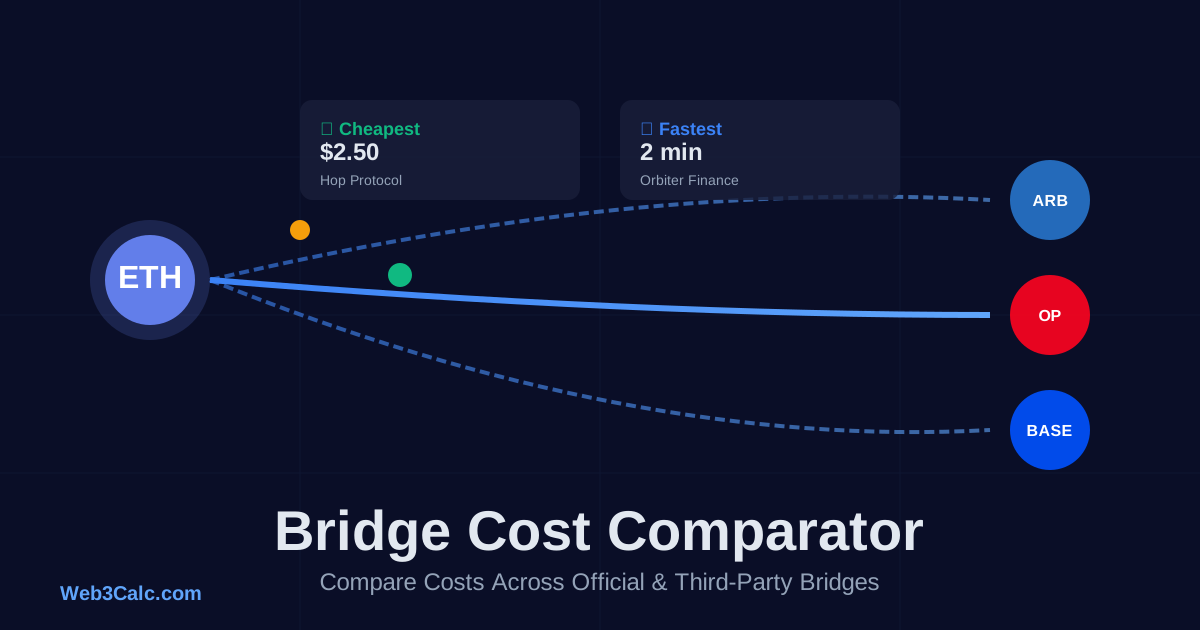
Complete Guide to Crypto Bridge Costs: Compare Fees & Find the Cheapest Route
Learn how to compare crypto bridge costs across official and third-party bridges. Compare Arbitrum, Optimism, Hop, Across, and more. Save money on your cross-chain transfers.
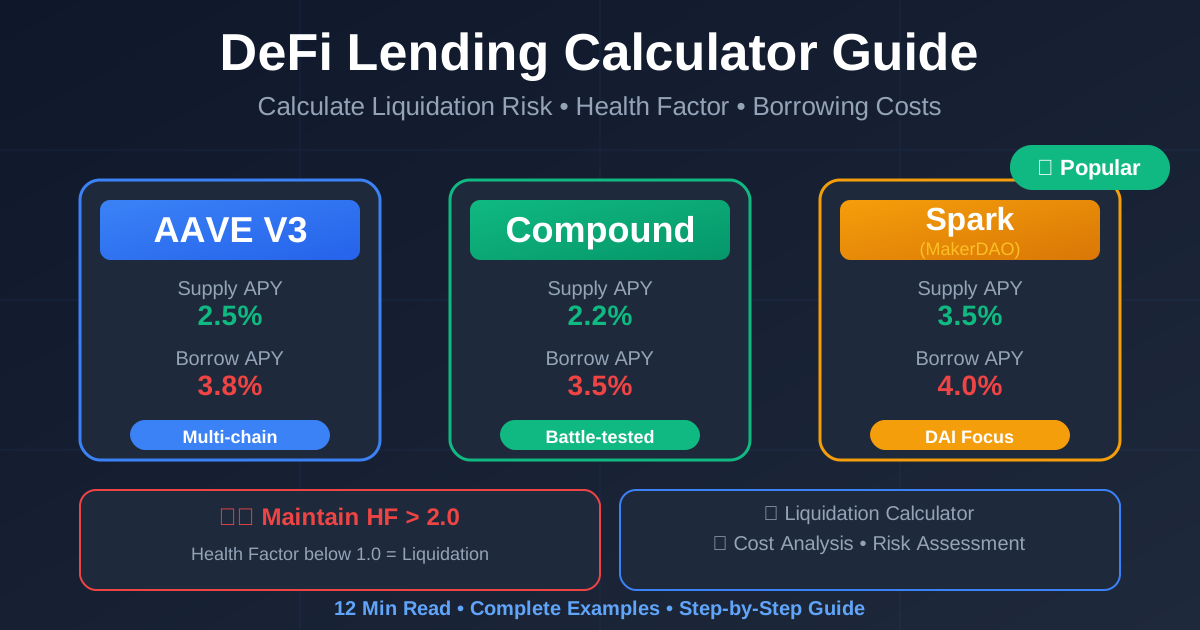
DeFi Lending Guide: How to Calculate Liquidation Risk & Optimize Borrowing Positions
Complete guide to DeFi lending on Aave, Compound, and MakerDAO. Learn to calculate health factors, liquidation prices, and optimize your borrowing positions safely.
Uniswap V3 Liquidity Mining Guide: Advanced ROI Simulator & Strategy Calculator
# Uniswap V3 Liquidity Mining Guide: Advanced ROI Simulator & Strategy Calculator Uniswap V3 revolutionized DeFi liquidity provision by introducing concentrated liquidity, allowing LPs to earn 4,000...