What is Total Value Locked (TVL)? Complete Guide to DeFi's Most Important Metric
Learn everything about Total Value Locked (TVL) in DeFi. Understand how TVL works, why it matters, and how to use it to evaluate DeFi protocols safely.
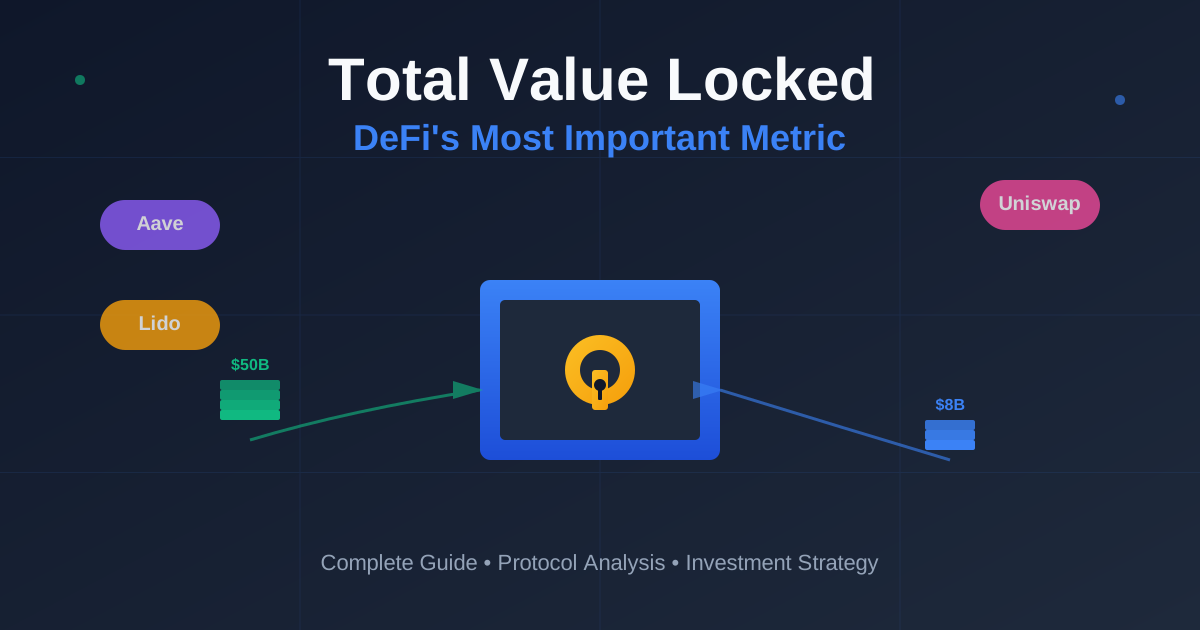
What is Total Value Locked (TVL)? Complete Guide to DeFi's Most Important Metric
Total Value Locked (TVL) is the most widely cited metric in DeFi, but what does it really mean? If you're evaluating protocols, comparing platforms, or trying to assess risk, understanding TVL is essential. This comprehensive guide breaks down everything you need to know about TVL in 2025.
What is Total Value Locked (TVL)?
Total Value Locked (TVL) represents the total dollar value of all assets deposited and locked in a DeFi protocol or platform. Think of it as the "size" or "popularity" indicator of a DeFi project.
Simple Analogy
TVL is like the total deposits in a traditional bank:
- High TVL = Many users trust the protocol (like a major bank)
- Low TVL = Fewer users or newer protocol (like a small credit union)
- Growing TVL = Increasing adoption and confidence
- Declining TVL = Users withdrawing, potential concerns
TVL Formula
TVL = Sum of all assets deposited × Current market price

Example:
Protocol has:
- 1,000 ETH @ $2,000 = $2,000,000
- 500,000 USDC @ $1 = $500,000
- 200 WBTC @ $40,000 = $8,000,000

Total TVL = $10,500,000
Why TVL Matters in DeFi
1. Liquidity Indicator
Higher TVL generally means:
- ✅ More liquidity for trades
- ✅ Lower slippage
- ✅ Better user experience
- ✅ More stable pricing
Example:
- Uniswap V3 (High TVL): $3.5B - Trade $100K with 0.1% slippage
- New DEX (Low TVL): $500K - Trade $100K with 15%+ slippage
2. Security Proxy
TVL can indicate security confidence:
- Protocols with billions locked → Users trust the smart contracts
- Sudden TVL drops → Potential security concerns
- Steady TVL growth → Strong fundamentals
Real Case Study:
Aave TVL History:
2020: $50M (early adopter phase)
2021: $15B (DeFi summer boom)
2022: $5B (bear market correction)
2023-2025: $8-12B (mature, stable)

Interpretation: Sustained high TVL = battle-tested security
3. Revenue Potential
More TVL = More fees generated:
- Lending protocols earn interest on higher amounts
- DEXs generate more trading fees
- Yield farms distribute more rewards
Example Calculation:
Protocol A: $1B TVL, 0.3% trading fee
Daily volume: $50M
Daily fees: $50M × 0.3% = $150,000

Protocol B: $10M TVL, 0.3% trading fee
Daily volume: $500K
Daily fees: $500K × 0.3% = $1,500

Protocol A generates 100x more fees
4. Network Effects
High TVL attracts more users, creating a virtuous cycle:
High TVL → Better liquidity → More users → Higher TVL → ...
How is TVL Calculated?
Basic TVL Calculation
- Identify all assets locked in the protocol
- Get current market prices for each asset
- Multiply quantity × price for each asset
- Sum all values = Total TVL
Advanced Considerations
Double-Counting Issue
Problem: Some protocols count the same assets multiple times.
Example:
User deposits 100 USDC to Aave
Aave counts: +100 USDC TVL

User receives 100 aUSDC (Aave receipt token)
User deposits aUSDC to Curve
Curve counts: +100 aUSDC TVL

Same $100 counted twice across ecosystem!
Solution: Platforms like DeFiLlama use "adjusted TVL" to remove double-counting.
Cross-Chain TVL
Multi-chain protocols require aggregation:
Uniswap Total TVL:
- Ethereum: $2.5B
- Polygon: $150M
- Arbitrum: $400M
- Optimism: $250M
- Base: $200M
Total: $3.5B
LP Token Valuation
Liquidity provider tokens are valued by their underlying assets:
ETH/USDC LP Token:
Contains: 10 ETH + 20,000 USDC
Value: (10 × $2,000) + $20,000 = $40,000
Top DeFi Protocols by TVL (December 2025)
1. Lido Finance - $25B+
- Category: Liquid Staking
- Why High TVL: Ethereum staking dominance
- Key Metric: 30% of all staked ETH
2. MakerDAO - $8B+
- Category: Decentralized Stablecoin
- Why High TVL: DAI backing collateral
- Key Metric: Oldest, most trusted
3. Aave - $7B+
- Category: Lending/Borrowing
- Why High TVL: Multi-chain, audited, reliable
- Key Metric: #1 lending protocol
4. Uniswap - $3.5B+
- Category: Decentralized Exchange
- Why High TVL: Most liquid DEX
- Key Metric: 60% DEX market share
5. Curve Finance - $3B+
- Category: Stablecoin DEX
- Why High TVL: Best stablecoin swaps
- Key Metric: <0.01% slippage on stables
6. Convex Finance - $2.5B+
- Category: Yield Optimizer
- Why High TVL: Curve LP boosting
- Key Metric: Controls 50%+ of Curve voting power
7. JustLend (Tron) - $2B+
- Category: Lending
- Why High TVL: Tron ecosystem leader
- Key Metric: Integrated with TRON stablecoins
8. Rocket Pool - $2B+
- Category: Decentralized ETH Staking
- Why High TVL: True decentralization
- Key Metric: No minimum stake via rETH
9. PancakeSwap - $1.8B+
- Category: DEX (BSC)
- Why High TVL: BNB Chain dominance
- Key Metric: Lowest fees on BSC
10. Compound - $1.5B+
- Category: Lending
- Why High TVL: Pioneer, trusted, audited
- Key Metric: First major lending protocol
TVL by Blockchain (2025)
Ethereum: $50B+ (60% market share)
- Strengths: Security, network effects, developer ecosystem
- Top Protocols: Lido, Aave, MakerDAO, Uniswap
- Trend: Gradual decline as L2s grow
Tron: $8B+ (10%)
- Strengths: Stablecoin dominance (USDT)
- Top Protocols: JustLend, SunSwap
- Trend: Stable, strong in Asian markets
BSC (Binance Smart Chain): $4B+ (5%)
- Strengths: Low fees, Binance backing
- Top Protocols: PancakeSwap, Venus
- Trend: Declining but still relevant
Arbitrum: $2.5B+ (3%)
- Strengths: Ethereum scaling, low fees
- Top Protocols: GMX, Uniswap V3, Aave
- Trend: Rapidly growing
Solana: $2B+ (2.5%)
- Strengths: Speed, low fees
- Top Protocols: Marinade Finance, Raydium
- Trend: Recovery after FTX collapse
Polygon: $1.5B+ (2%)
- Strengths: Ethereum compatibility
- Top Protocols: Aave, Uniswap V3
- Trend: Competition from other L2s
Other Chains: $15B+ (18%)
- Optimism, Base, Avalanche, Fantom, etc.
How to Use TVL for Investment Decisions
TVL as a Safety Indicator
Rule of Thumb:
- >$1B TVL = Likely safe, battle-tested
- $100M-$1B = Medium risk, evaluate carefully
- $10M-$100M = Higher risk, proceed with caution
- <$10M = Very high risk, could be experimental
Example Risk Assessment:
Protocol X: $5M TVL, launched 2 months ago
- Red flag: Low TVL for age
- Could be: Legitimate new project OR potential rug pull
- Action: Wait for TVL growth or thorough audit

Protocol Y: $500M TVL, running 2+ years
- Green flag: Sustained high TVL
- Indicates: Community trust, working product
- Action: Reasonable to use, still do due diligence
TVL Trends Matter More Than Absolute Numbers
Analyze TVL Direction:
📈 Growing TVL (Bullish)
Month 1: $50M
Month 2: $75M (+50%)
Month 3: $120M (+60%)

Signal: Strong adoption, positive momentum
📉 Declining TVL (Bearish)
Month 1: $500M
Month 2: $400M (-20%)
Month 3: $280M (-30%)

Signal: Users losing confidence, investigate why
➡️ Stable TVL (Neutral/Mature)
Month 1: $2B
Month 2: $1.95B (-2.5%)
Month 3: $2.05B (+5%)

Signal: Mature protocol, stable user base
TVL vs Market Cap Analysis
Key Ratio: TVL / Market Cap
High ratio = Good value:
Protocol A:
TVL: $500M
Market Cap: $100M
Ratio: 5.0 (Undervalued?)

Protocol B:
TVL: $500M
Market Cap: $2B
Ratio: 0.25 (Overvalued?)
Interpretation:
- Ratio >1: TVL exceeds market cap (often undervalued)
- Ratio <1: Market cap exceeds TVL (growth expectations priced in)
- Ratio <0.1: Potentially overvalued
TVL Per User
Indicates capital efficiency:
Protocol X: $1B TVL, 100K users = $10K/user
Protocol Y: $1B TVL, 1M users = $1K/user

Protocol X has higher capital concentration
(Could mean whales OR fewer but larger users)
Common TVL Misconceptions
Myth 1: "Higher TVL Always Means Better"
Reality: Not necessarily.
Counterexample:
Curve Finance: $3B TVL, specialized stablecoin swaps
Uniswap: $3.5B TVL, general-purpose DEX

Both excellent, different use cases
TVL alone doesn't determine which is "better"
Myth 2: "TVL = Revenue"
Reality: TVL indicates potential, not actual revenue.
Example:
Aave: $7B TVL
Revenue: ~$200M/year (2.8% of TVL)

Higher TVL ≠ proportionally higher revenue
Depends on utilization rate, fees, etc.
Myth 3: "TVL Cannot Be Manipulated"
Reality: TVL can be temporarily inflated.
Manipulation Tactics:
- Flash loan attacks to temporarily boost TVL
- Team depositing own tokens
- Wash trading between wallets
- Incentive farming with mercenary capital
How to Detect:
- Check TVL consistency over time
- Look at unique wallet addresses
- Analyze token distribution
- Monitor withdrawal patterns
Myth 4: "All TVL Tracking Sites Show Same Numbers"
Reality: Different methodologies = different numbers.
Example:
DeFiLlama: $50B total TVL (removes double-counting)
Other sites: $65B total TVL (includes some double-counting)
Difference: Methodology varies
Best Practice: Use DeFiLlama for accurate, standardized data.
TVL Tracking Tools
1. DeFiLlama (Most Accurate)
- URL: defillama.com
- Pros: No double-counting, open-source, multi-chain
- Best For: Comprehensive DeFi analysis
2. DeBank
- URL: debank.com
- Pros: User-friendly, portfolio tracking
- Best For: Personal holdings + protocol research
3. DappRadar
- URL: dappradar.com
- Pros: Includes NFTs, gaming
- Best For: Broader Web3 ecosystem view
4. Token Terminal
- URL: tokenterminal.com
- Pros: Revenue metrics, fundamentals
- Best For: Investment analysis
5. DeFi Pulse (Historical)
- URL: defipulse.com
- Note: Less updated now, use DeFiLlama instead
Real-World TVL Case Studies
Case Study 1: Lido's TVL Dominance
Timeline:
2020: Launch with $0 TVL
2021: $1B TVL (Ethereum 2.0 staking begins)
2022: $15B TVL peak (pre-Merge)
2023: $8B TVL (post-Merge adjustment)
2025: $25B+ TVL (liquid staking adoption)
Lessons:
- First-mover advantage in liquid staking
- Network effects compound rapidly
- Regulatory clarity helps TVL growth
Case Study 2: Terra/Luna Collapse
What Happened:
2021: $1B TVL (Anchor Protocol launch)
Early 2022: $30B TVL peak
May 2022: $0 TVL (death spiral)
Warning Signs Ignored:
- Unsustainable 20% APY on stablecoins
- TVL grew too fast (ponzinomic red flag)
- Majority of TVL in one protocol (Anchor)
Lesson: Extremely high TVL + unsustainable yields = danger
Case Study 3: Uniswap V3 Migration
V2 → V3 TVL Shift:
2021 Pre-V3: V2 had $8B TVL
2021 Post-V3 Launch: V2 $5B, V3 $2B
2022: V2 $3B, V3 $4B
2025: V2 $500M, V3 $3B

Total TVL declined but concentrated liquidity improved efficiency
Lesson: TVL decline ≠ failure if capital efficiency improves
Advanced TVL Metrics
1. TVL Volatility
Measures stability:
Stable Protocol: ±5% monthly TVL change
Volatile Protocol: ±30% monthly TVL change

Lower volatility = More predictable, mature protocol
2. TVL to Volume Ratio (DEXs)
Capital efficiency indicator:
Uniswap V3: $3.5B TVL, $1B daily volume
Ratio: 0.35 (efficient, concentrated liquidity)

Older AMM: $1B TVL, $50M daily volume
Ratio: 0.05 (less efficient, spread liquidity)
3. Sticky TVL vs Mercenary Capital
Sticky TVL: Users stay regardless of incentives Mercenary TVL: Users chase highest yields
How to Identify:
Check TVL when incentives end:
- Drops <20%: Mostly sticky
- Drops 50%+: Mostly mercenary
4. TVL Concentration
Risk indicator:
Protocol TVL: $1B
Top 10 wallets: $800M (80% concentration)
Red flag: High centralization risk

Better distribution:
Top 10 wallets: $200M (20% concentration)
How to Safely Farm High TVL Protocols
Step 1: Verify TVL Authenticity
Checklist:
- [ ] Cross-reference on multiple tracking sites
- [ ] Check TVL growth is organic (not overnight spike)
- [ ] Verify unique wallet addresses
- [ ] Look for smart contract audits
Step 2: Assess TVL Sustainability
Questions to Ask:
- Is TVL incentive-dependent?
- What happens when rewards end?
- Is the protocol generating real revenue?
- Are yields sustainable long-term?
Step 3: Diversify Across TVL Tiers
Sample Allocation:
60% in top 5 protocols (>$5B TVL)
- Lower risk, stable returns

30% in mid-tier ($500M-$5B TVL)
- Moderate risk, good returns

10% in emerging (<$500M TVL)
- Higher risk, potential high returns
Step 4: Monitor TVL Changes
Set Alerts:
- 20% daily TVL drop = Warning signal
- 50% monthly TVL decline = Exit consideration
- Sudden spike = Potential manipulation
TVL and Protocol Security
The TVL Security Paradox
Question: Does high TVL mean secure?
Answer: Correlation, not causation.
Why High TVL ≠ Guaranteed Safety:
- Smart contract bugs can exist regardless of TVL
- Economic exploits (oracle manipulation) still possible
- Governance attacks on high TVL protocols
- Bridge hacks affect TVL instantly
Better Security Indicators:
- Multiple audits by top firms
- Bug bounty programs
- Time-tested (1+ year)
- No major exploits history
- Active developer community
Major Protocol Hacks Despite High TVL
Poly Network (2021): $600M exploit, $8B TVL
Ronin Bridge (2022): $625M hack, $1B TVL
Wormhole (2022): $320M exploit, $5B cross-chain TVL

Lesson: High TVL attacked = bigger target
The Future of TVL as a Metric
Emerging TVL Variants
1. Productive TVL Only counts assets actively generating yield:
Total TVL: $1B
Idle assets: $200M
Productive TVL: $800M (better metric)
2. Real TVL Adjusted for:
- Double counting
- Mercenary capital
- Team-controlled liquidity
3. Risk-Adjusted TVL Weights TVL by protocol risk:
High-risk protocol: $100M TVL × 0.5 = $50M weighted
Low-risk protocol: $100M TVL × 1.0 = $100M weighted
TVL in Ethereum's Future
Post-Merge Trends:
- More ETH staked = Lower DeFi TVL
- Layer 2 TVL growing faster
- Cross-chain TVL becoming standard
2026 Predictions:
Ethereum L1 TVL: $40B (down from $50B)
Layer 2 Combined TVL: $30B (up from $10B)
Reason: Users migrating to L2s for lower fees
Practical Examples: Using TVL
Example 1: Choosing a Lending Protocol
Scenario: You want to lend $10,000 USDC
Option A - Aave:
TVL: $7B
Rate: 4% APY
Your deposit: 0.00014% of pool
Risk: Very low (established, audited)
Option B - New Protocol:
TVL: $50M
Rate: 15% APY
Your deposit: 0.02% of pool
Risk: Higher (newer, less tested)
Decision Framework:
- Aave: Safer, lower return, sleep well
- New Protocol: 3.75x higher yield, but 140x more risky
- Compromise: Split 80% Aave, 20% New Protocol
Example 2: Evaluating a New DEX
Metrics:
DEX Launch: Week 1
TVL: $5M
Daily Volume: $500K
Token Price: $2
Market Cap: $50M

Analysis:
- TVL/Market Cap: 0.1 (Fair for new project)
- Volume/TVL: 0.1 (10% daily, very high)
- Wait for TVL to reach $50M before larger deposits
Example 3: Yield Farming Decision
Protocol Incentive Program:
Base APY: 5%
Token Rewards: 45% APY
Total: 50% APY

Current TVL: $100M
After rewards end: TVL drops to $30M (projected)

Conclusion: 70% of TVL is mercenary capital
Strategy: Farm early, exit before rewards end
Tools to Calculate Your Impact on TVL
Your Deposit's TVL Contribution
Use our Portfolio Tracker to:
- Calculate your total DeFi TVL contribution
- Track TVL across multiple protocols
- Monitor your portfolio's impact
Formula:
Your TVL Contribution = Σ(deposits across all protocols)

Example:
Aave: $5,000
Uniswap: $10,000 (LP value)
Curve: $3,000
Your Total: $18,000 TVL contribution
Common Questions About TVL
Q1: Can TVL Go Negative?
A: No, but it can go to zero (protocol death).
Q2: Does Staked ETH Count in TVL?
A: Yes, liquid staking protocols (Lido, Rocket Pool) count staked ETH in TVL.
Q3: Is High TVL Proof of No Rug Pull?
A: No. Exit scams can happen even with high TVL if developers control smart contracts.
Prevention:
- Check if contracts are upgradeable
- Verify timelock on admin functions
- Look for multisig wallets (not single EOA)
Q4: Why Did My Protocol's TVL Drop Overnight?
Common Causes:
- Major user withdrew (whale exit)
- Token price crashed (TVL = quantity × price)
- Exploit or hack
- Incentive program ended
- Better opportunities elsewhere
Q5: Can I Manipulate TVL for Profit?
A: Attempting to manipulate TVL is:
- Often unprofitable (gas fees, risks)
- Potentially illegal (market manipulation)
- Easily detected by analytics tools
- Not recommended
Key Takeaways
✅ TVL shows total assets locked in a protocol
- Higher TVL = more liquidity, lower slippage
- But not the only safety indicator
✅ Use TVL trends, not just absolute numbers
- Growing TVL = positive momentum
- Declining TVL = investigate why
✅ Combine TVL with other metrics
- Audits, time-tested, revenue, user count
- TVL alone is insufficient for decisions
✅ Watch for TVL manipulation
- Sudden spikes = suspicious
- Organic growth = trustworthy
✅ Track TVL on DeFiLlama
- Most accurate, no double-counting
- Open-source, community-verified
✅ Diversify across TVL tiers
- Don't put everything in one protocol
- Balance safety and returns
Conclusion
Total Value Locked (TVL) is DeFi's most important metric, but it's not a magic bullet for safety or investment decisions. Use TVL as one component of your due diligence:
Good TVL Usage:
- Comparing similar protocols
- Tracking adoption trends
- Assessing liquidity depth
- Monitoring protocol health
Bad TVL Usage:
- Only metric for safety
- Ignoring TVL manipulation signs
- Not checking underlying fundamentals
- Chasing highest TVL blindly
Final Advice: High TVL + Multiple audits + Long track record + Organic growth + Real revenue = Likely safe protocol to use.
Ready to Track DeFi TVL?
Use our free tools to monitor and analyze protocols:
- Portfolio Tracker - Track your TVL contribution
- APY/APR Calculator - Compare protocol yields
- Impermanent Loss Calculator - Evaluate LP risks
- Staking Rewards Calculator - Calculate staking returns
Disclaimer: This article is for educational purposes only. TVL data can change rapidly. Always verify current numbers on DeFiLlama or official protocol dashboards before making investment decisions. Cryptocurrency investments carry significant risk.
Last updated: December 9, 2025
Share this article:
Related Articles
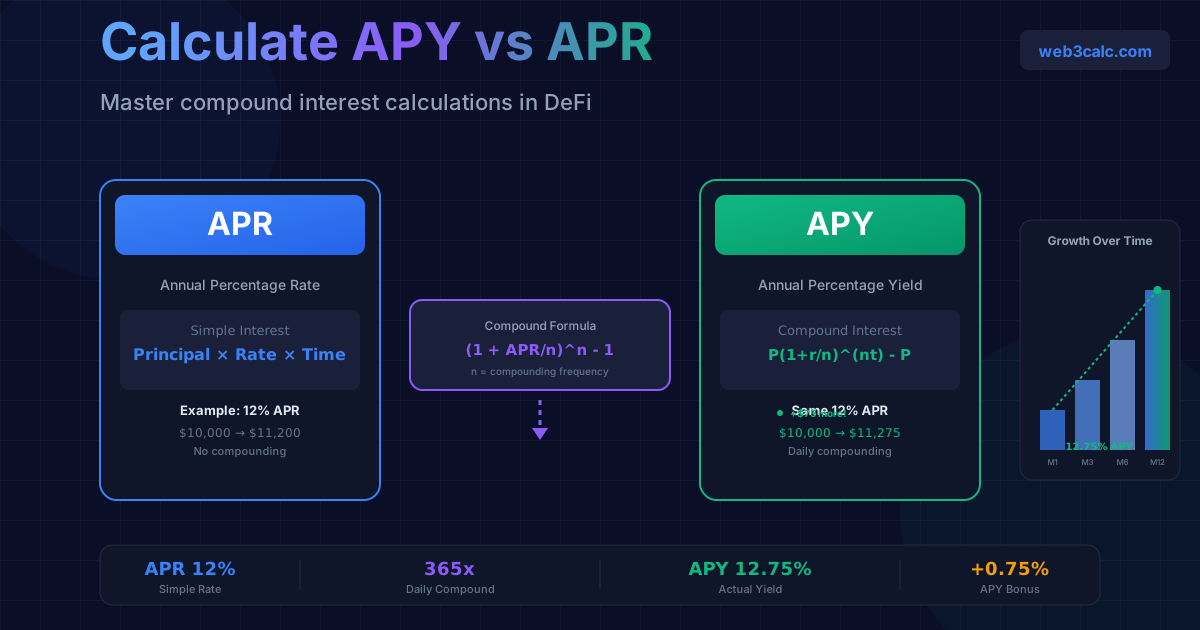
How to Calculate APY vs APR in DeFi: Complete Guide with Examples
Master the difference between APY and APR in DeFi. Learn calculation formulas, understand compound interest, and discover how to maximize your crypto yields.
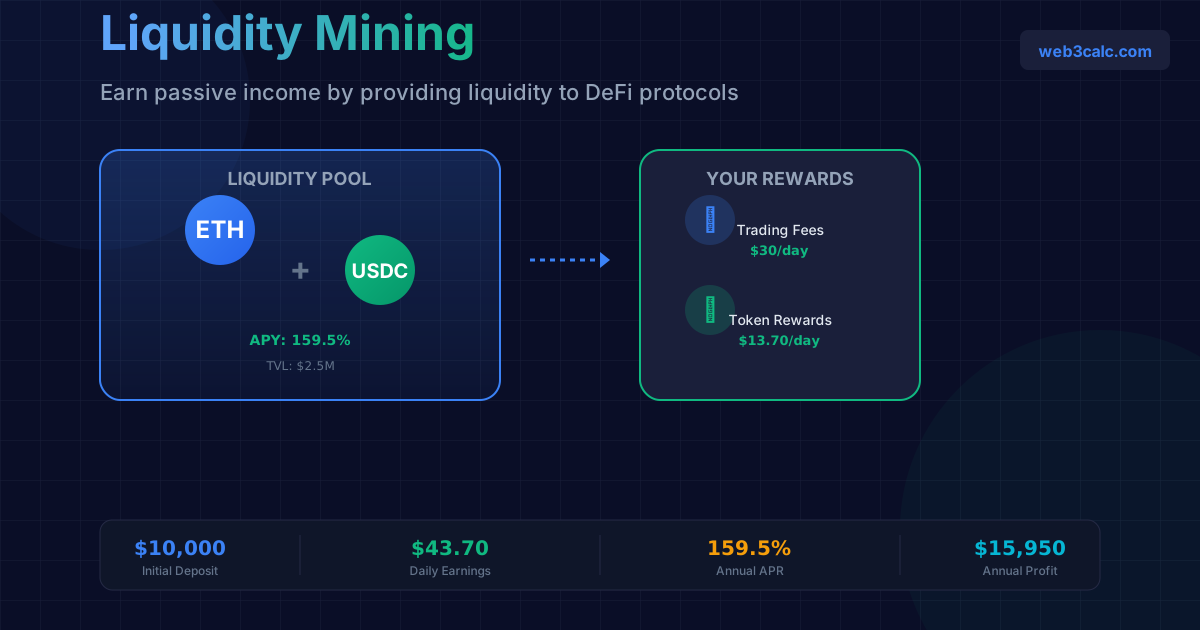
What is Liquidity Mining? Complete Guide to Earning Passive Income in DeFi
Discover how liquidity mining works, learn strategies to maximize your returns, and understand the risks involved in providing liquidity to DeFi protocols.
Yield Farming Strategies for Beginners: Maximize Your DeFi Returns in 2025
Discover proven yield farming strategies for beginners. Learn how to earn passive income through DeFi protocols, minimize risks, and optimize your returns.