What is Liquidity Mining? Complete Guide to Earning Passive Income in DeFi
Discover how liquidity mining works, learn strategies to maximize your returns, and understand the risks involved in providing liquidity to DeFi protocols.
What is Liquidity Mining? Complete Guide to Earning Passive Income in DeFi
Liquidity mining has become one of the most popular ways to earn passive income in the decentralized finance (DeFi) ecosystem. But what exactly is it, and how can you participate safely? This comprehensive guide will walk you through everything you need to know.
What is Liquidity Mining?
Liquidity mining, also known as yield farming, is the process of providing liquidity to decentralized exchanges (DEXs) or lending protocols in exchange for rewards. These rewards typically come in the form of:
- Trading fees from the liquidity pool
- Token rewards from the protocol (governance tokens)
- Additional incentives from liquidity mining programs
Think of it as earning interest in a traditional bank, but instead of depositing your money in a centralized institution, you're locking your crypto assets in a decentralized protocol that enables trading and lending.
How Does Liquidity Mining Work?
The Basic Process
- Deposit Tokens: You provide a pair of tokens (e.g., ETH and USDC) to a liquidity pool
- Receive LP Tokens: You get liquidity provider (LP) tokens representing your share of the pool
- Earn Rewards: You earn trading fees and additional token rewards
- Withdraw Anytime: You can remove your liquidity whenever you want (subject to smart contract rules)
Example Scenario
Let's say you want to participate in liquidity mining on Uniswap:
- You deposit $10,000 worth of ETH-USDC (50/50 ratio)
- You receive UNI-V2 LP tokens representing your share
- Every trade that uses your liquidity generates a 0.3% fee
- If the pool does $1M daily volume and you own 1% of the pool, you earn $30/day
- That's approximately $10,950/year in fees alone (109.5% APR!)
Types of Liquidity Mining
1. DEX Liquidity Pools
Platforms: Uniswap, SushiSwap, PancakeSwap, Curve
How it works: Provide token pairs to enable trading on decentralized exchanges
Rewards:
- Trading fees (0.05% to 1% per swap)
- Platform tokens (e.g., SUSHI, CAKE)
Best for: High-volume trading pairs
2. Lending Protocols
Platforms: Aave, Compound, Venus
How it works: Supply tokens that others can borrow
Rewards:
- Interest from borrowers
- Protocol governance tokens
Best for: Stablecoin lending with lower risk
3. Stablecoin Pools
Platforms: Curve Finance, Balancer
How it works: Provide liquidity to low-volatility stablecoin pairs
Rewards:
- Reduced impermanent loss risk
- Consistent fee income
- Often boosted by protocol incentives
Best for: Risk-averse liquidity providers
4. Concentrated Liquidity (V3)
Platforms: Uniswap V3, Trader Joe
How it works: Provide liquidity within specific price ranges
Rewards:
- Higher capital efficiency
- More fees per dollar invested
- Requires active management
Best for: Active traders and sophisticated LPs
Key Metrics to Understand
Annual Percentage Rate (APR)
APR shows the yearly return without compounding:
- Example: 100% APR means you double your money in one year
- Fixed rate that doesn't change with compounding
Annual Percentage Yield (APY)
APY includes compound interest:
- Example: 100% APY with daily compounding yields ~171% actual return
- Variable rate that increases with more frequent compounding
Total Value Locked (TVL)
The total amount of assets locked in a protocol:
- Higher TVL = more competition for rewards
- Lower TVL = potentially higher APY but higher risk
Trading Volume
Daily/weekly trading volume affects your fee earnings:
- High volume = more fee income for LPs
- Low volume = mostly relying on token rewards
Calculating Your Returns
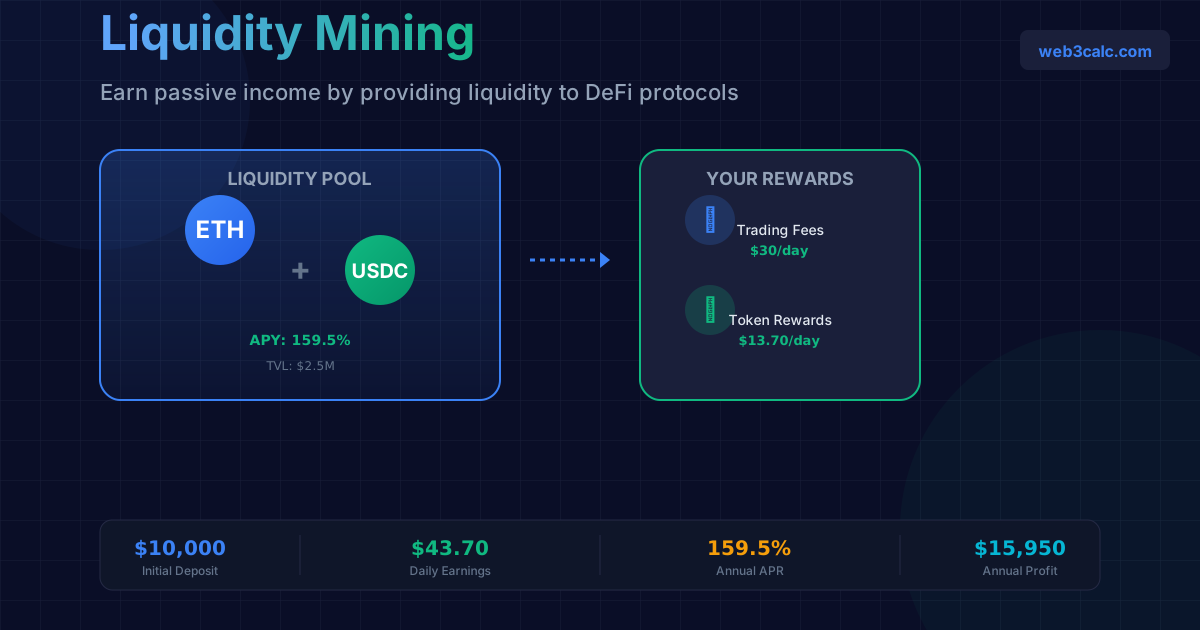
Let's break down a real example using our Impermanent Loss Calculator:
Initial Investment:
- $5,000 in ETH + $5,000 in USDC
- Total: $10,000
Pool Parameters:
- Trading fee: 0.3%
- Daily volume: $2,000,000
- Your pool share: 0.5%
- Additional token rewards: 50% APR
Daily Earnings:
- Fee income: ($2M × 0.3%) × 0.5% = $30/day
- Token rewards: ($10,000 × 50% APR) / 365 = $13.70/day
- Total daily: $43.70
Annual Return:
- Fee APR: 109.5%
- Token APR: 50%
- Combined APR: 159.5%
- Potential annual profit: $15,950 on $10,000
Note: This doesn't account for impermanent loss or token price changes.
Risks of Liquidity Mining
1. Impermanent Loss
The biggest risk for liquidity providers. When token prices diverge from your entry price, you can lose money compared to just holding.
Example:
- You deposit when ETH = $2,000
- ETH rises to $4,000
- Your position rebalances automatically
- You end up with less ETH than if you'd just held
Solution: Use our Impermanent Loss Calculator before entering any position.
2. Smart Contract Risk
DeFi protocols can have bugs or vulnerabilities:
- Hacks can drain liquidity pools
- Always check if the protocol is audited
- Diversify across multiple platforms
3. Rug Pulls
Malicious developers can:
- Drain liquidity pools
- Mint unlimited tokens
- Lock your funds
Red flags:
- Anonymous teams
- No audit reports
- Unrealistic APY (>1000%)
- New, unproven protocols
4. Token Price Volatility
Reward tokens can lose value quickly:
- High inflation rates dilute value
- Market dumps after farming programs end
- Token utility determines long-term value
5. Gas Fees
On Ethereum mainnet:
- Depositing can cost $50-200 in gas
- Harvesting rewards: $20-100
- Withdrawing: $50-200
Solution: Consider Layer 2s like Arbitrum, Optimism, or alternative chains like BSC, Polygon.
Liquidity Mining Strategies
Strategy 1: Stablecoin-Only Pools (Low Risk)
Pairs: USDC/USDT, DAI/USDC, USDT/DAI
Pros:
- Minimal impermanent loss
- Predictable returns
- Lower volatility
Cons:
- Lower APY (typically 5-20%)
- Still subject to stablecoin depeg risk
Best for: Conservative investors
Strategy 2: Blue-Chip Pairs (Medium Risk)
Pairs: ETH/USDC, WBTC/ETH, ETH/USDT
Pros:
- Higher volume = more fees
- More established protocols
- Moderate impermanent loss
Cons:
- Price volatility
- Moderate IL risk
Best for: Balanced risk/reward seekers
Strategy 3: High-Yield Farming (High Risk)
Pairs: New token/ETH, Meme coins, Low-cap altcoins
Pros:
- Extremely high APY (100%+)
- Early adopter advantages
- Potential token appreciation
Cons:
- Very high impermanent loss risk
- Rug pull danger
- Token price can crash
Best for: Risk-tolerant, experienced DeFi users
Strategy 4: Concentrated Liquidity (V3)
Platforms: Uniswap V3
Pros:
- 10x-100x capital efficiency
- More fees per dollar
- Flexibility in range selection
Cons:
- Requires active management
- Higher IL risk if price exits range
- More complex
Best for: Active traders
Step-by-Step: Your First Liquidity Mining
Step 1: Choose Your Platform
Popular options:
- Uniswap (Ethereum) - Most liquid, highest fees
- PancakeSwap (BSC) - Low gas fees, high APY
- Curve Finance - Best for stablecoins
- Trader Joe (Avalanche) - Lower fees, innovative features
Step 2: Prepare Your Tokens
You need:
- Equal value of both tokens (e.g., $500 ETH + $500 USDC)
- Extra ETH/BNB/AVAX for gas fees
- Tokens approved for the DEX contract
Step 3: Add Liquidity
- Connect your wallet (MetaMask, Trust Wallet)
- Navigate to "Liquidity" or "Pool" section
- Select your token pair
- Enter the amount (the interface auto-balances)
- Approve the transaction (2 txs: approval + deposit)
- Receive LP tokens
Step 4: Stake LP Tokens (If Required)
Some platforms require staking LP tokens for additional rewards:
- Go to "Farms" or "Staking" section
- Find your LP token pair
- Stake your LP tokens
- Start earning extra rewards
Step 5: Monitor & Harvest
- Check your position daily/weekly
- Harvest rewards periodically
- Reinvest (compound) or take profits
- Rebalance if needed
Step 6: Exit Strategy
When to withdraw:
- APY drops significantly
- Impermanent loss exceeds fee income
- You need the capital
- Better opportunities emerge
Top Liquidity Mining Platforms in 2025
Ethereum Mainnet
Uniswap V3
- TVL: $4B+
- Pros: Highest liquidity, trusted protocol
- Cons: High gas fees
- Best pairs: ETH/USDC, WBTC/ETH
Curve Finance
- TVL: $2B+
- Pros: Optimized for stablecoins, low IL
- Cons: Complex interface
- Best pairs: 3pool (DAI/USDC/USDT)
Layer 2 Solutions
Uniswap (Arbitrum)
- Lower gas fees
- Same interface as mainnet
- Growing liquidity
Velodrome (Optimism)
- High APY for specific pairs
- Vote-escrowed tokenomics
- Lower fees than Ethereum
Alternative Chains
PancakeSwap (BSC)
- TVL: $1.5B+
- Very low fees (<$0.50)
- High APY on farms
- Good for smaller positions
Trader Joe (Avalanche)
- Innovative liquidity book feature
- Competitive APY
- Fast finality
Tools for Liquidity Miners
Essential Tools
-
Web3Calc Impermanent Loss Calculator
- Calculate potential IL before entering
- Compare different price scenarios
- Factor in trading fees
-
DeFi Llama
- Compare APY across protocols
- Track TVL changes
- Find new opportunities
-
APY.vision
- Track LP position performance
- See realized vs unrealized IL
- Portfolio analytics
-
Zapper / DeBank
- Portfolio tracking
- One-click liquidity provision
- Multi-chain support
Advanced Tips
1. Compound Your Rewards
Reinvest your rewards to benefit from compound interest:
- Harvest rewards regularly
- Add them back to the pool
- APY becomes significantly higher over time
2. Use Multiple Chains
Diversify across:
- Ethereum (high security, high fees)
- L2s (moderate security, low fees)
- Alt chains (lower security, lowest fees)
3. Monitor Impermanent Loss
Set price alerts:
- If price moves >20%, check IL
- Use our calculator to see if fees offset IL
- Consider exiting if IL > accumulated fees
4. Tax Implications
Keep records:
- Every deposit is a taxable event
- Harvesting rewards = taxable income
- IL can sometimes be claimed as a loss
Consult a crypto tax professional!
5. Start Small
Best practice:
- Start with $100-500
- Learn the mechanics
- Understand the risks
- Scale up gradually
Common Mistakes to Avoid
❌ Chasing High APY
A 10,000% APY usually means:
- Unsustainable token emissions
- Likely rug pull
- Token will dump quickly
❌ Ignoring Gas Fees
$100 investment with $200 in gas fees = bad math
❌ Not Calculating Impermanent Loss
Always use our IL Calculator first!
❌ Providing Liquidity to Unknown Tokens
Stick to established tokens when starting:
- ETH, WBTC, USDC, USDT, DAI
- Major altcoins (LINK, UNI, AAVE)
- Avoid meme coins until experienced
❌ Never Harvesting Rewards
Token prices can crash - take profits regularly!
❌ Forgetting About Your Position
Set calendar reminders:
- Check weekly for volatile pairs
- Monthly for stable pairs
- Rebalance when needed
Liquidity Mining vs Traditional Finance
| Feature | Liquidity Mining | Traditional Savings | |---------|------------------|-------------------| | Returns | 5% - 300% APY | 0.5% - 5% APY | | Access | Permissionless | KYC required | | Risks | High (IL, smart contracts) | Low (FDIC insured) | | Transparency | Full (blockchain) | Limited | | Control | Full custody | Bank custody | | Fees | Gas fees | No fees |
Is Liquidity Mining Right for You?
✅ Yes, if you:
- Understand DeFi and smart contract risks
- Can afford to lose your investment
- Have time to monitor positions
- Are comfortable with volatility
- Want higher returns than traditional finance
❌ No, if you:
- Need guaranteed returns
- Can't afford losses
- Don't understand impermanent loss
- Want completely passive income
- Are risk-averse
Conclusion
Liquidity mining offers exciting opportunities to earn passive income in DeFi, but it's not without risks. The key to success is:
- Start small and learn the mechanics
- Use proper tools like our Impermanent Loss Calculator
- Understand the risks, especially impermanent loss
- Diversify across pools and protocols
- Monitor actively and adjust as needed
Remember: past performance doesn't guarantee future returns. Always do your own research, never invest more than you can afford to lose, and stay informed about the latest DeFi developments.
Ready to Start Liquidity Mining?
Use our free tools to make better decisions:
- Impermanent Loss Calculator - Calculate potential IL before entering pools
- Multi-chain Token Price - Track token prices across chains
- ENS Checker - Verify your Web3 identity
Disclaimer: This article is for educational purposes only and does not constitute financial advice. Cryptocurrency investments carry significant risk. Always do your own research and consult with financial professionals before making investment decisions.
Share this article:
Related Articles
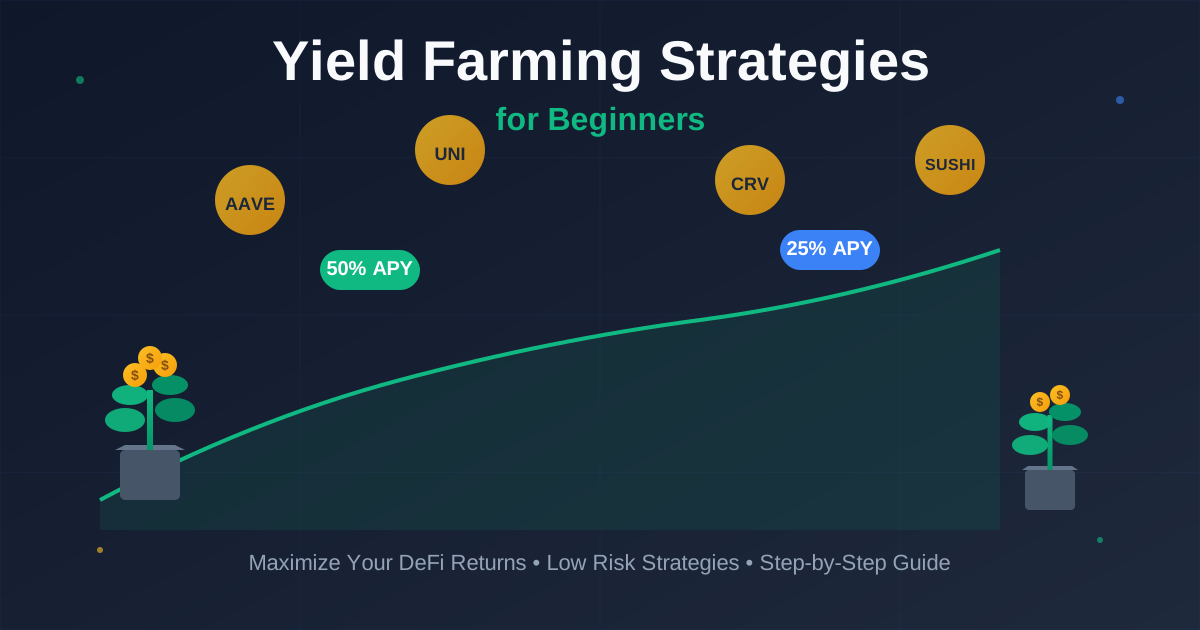
Yield Farming Strategies for Beginners: Maximize Your DeFi Returns in 2025
Discover proven yield farming strategies for beginners. Learn how to earn passive income through DeFi protocols, minimize risks, and optimize your returns.
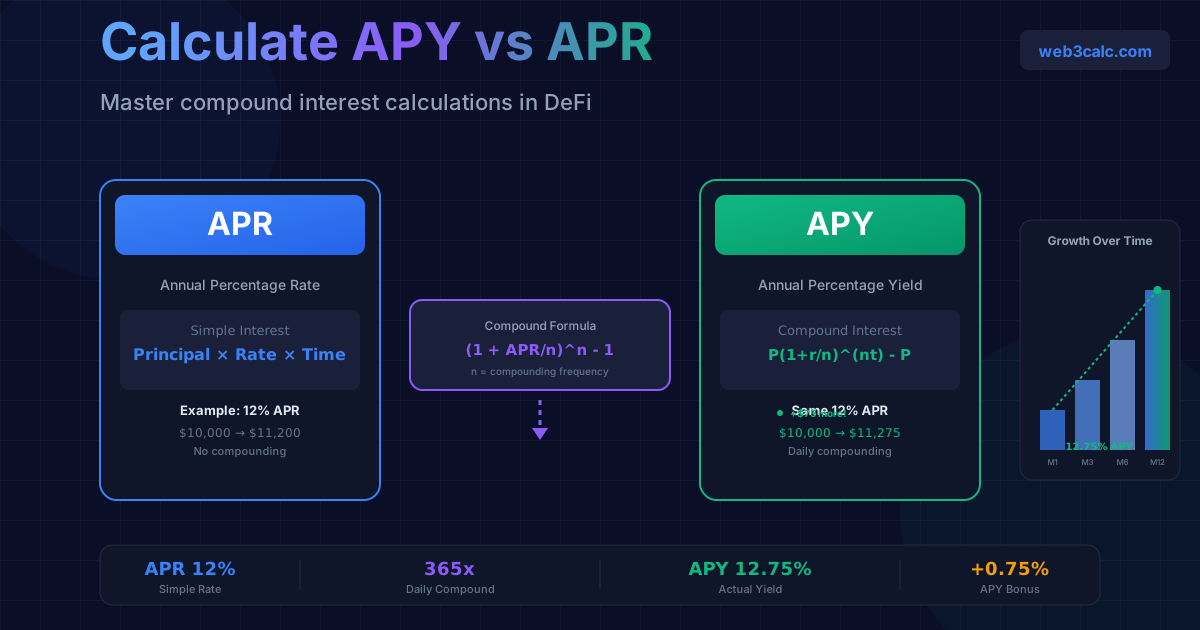
How to Calculate APY vs APR in DeFi: Complete Guide with Examples
Master the difference between APY and APR in DeFi. Learn calculation formulas, understand compound interest, and discover how to maximize your crypto yields.
What is Total Value Locked (TVL)? Complete Guide to DeFi's Most Important Metric
Learn everything about Total Value Locked (TVL) in DeFi. Understand how TVL works, why it matters, and how to use it to evaluate DeFi protocols safely.