Uniswap V2 vs V3: Complete Comparison for Liquidity Providers
Comprehensive comparison of Uniswap V2 and V3 protocols. Learn the key differences in capital efficiency, impermanent loss, fees, and which version is best for your liquidity strategy.
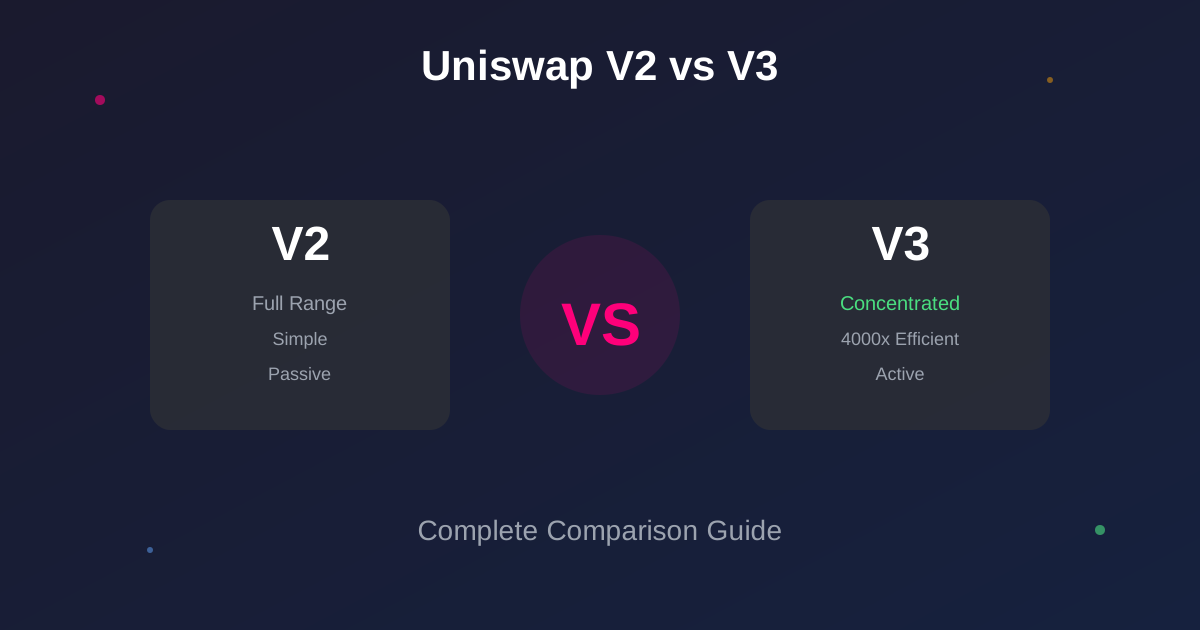
Uniswap V2 vs V3: Complete Comparison for Liquidity Providers
Uniswap is the largest decentralized exchange on Ethereum, with over $5 billion in total value locked. While Uniswap V2 pioneered the automated market maker (AMM) model, V3 introduced revolutionary concentrated liquidity features. But which version should you use as a liquidity provider?
This comprehensive guide compares Uniswap V2 and V3 across all key dimensions to help you make an informed decision.
TL;DR - Quick Comparison
| Feature | Uniswap V2 | Uniswap V3 | |---------|-----------|-----------| | Liquidity Range | Full range (0 to ∞) | Concentrated (custom ranges) | | Capital Efficiency | Low | Up to 4000x higher | | Fee Tiers | Fixed 0.3% | 0.01%, 0.05%, 0.3%, 1% | | Impermanent Loss Risk | Moderate | Higher (in range) | | Management Required | Passive | Active monitoring needed | | Gas Costs | Lower | Higher | | Best For | Set-and-forget LPs | Active traders, market makers | | APY Potential | 5-30% typically | 20-200%+ for active LPs |
Understanding the Core Difference: Full Range vs Concentrated Liquidity
Uniswap V2: Full Range Liquidity
In Uniswap V2, when you provide liquidity, your capital is distributed across the entire price curve from $0 to infinity.
Example: If you deposit 1 ETH + 2,000 USDC when ETH = $2,000:
- Your liquidity is active regardless of ETH price
- You earn 0.3% fee on all trades
- Your position is always "in range"
- Capital efficiency is spread thin
Visual representation:
Price Range: [━━━━━━━━━━━━━━━━━━━━━━]
Your Liquidity: ████████████████████████
Active Range: ████████████████████████ (100%)
Uniswap V3: Concentrated Liquidity
V3 lets you concentrate your liquidity within a specific price range you choose.
Example: Same 1 ETH + 2,000 USDC, but you set range $1,800 - $2,200:
- Your liquidity only active within this range
- You earn fees ONLY when price is in range
- Can achieve up to 4000x capital efficiency
- Requires active management
Visual representation:
Price Range: [━━━━━━━━━━━━━━━━━━━━━━]
Your Liquidity:      ████████
Active Range:        ████████ (20% of curve)
                     ↑
                Current Price
Capital Efficiency: The Game-Changer
V2 Capital Efficiency
With V2's full-range approach:
- Only ~20-30% of your capital is typically utilized
- Most liquidity sits idle at extreme prices
- Lower fee earnings per dollar invested
Example calculation:
- Deposit: $10,000 in ETH/USDC pool
- Daily volume: $1,000,000
- Your share: 0.1% of pool
- Daily fees: $1,000,000 × 0.3% × 0.1% = $3/day
- Annual APY: ~11%
V3 Capital Efficiency
With concentrated liquidity:
- 100% of your capital can be utilized if price stays in range
- Much higher fee earnings per dollar
- Can provide same liquidity with less capital
Example with same setup but tight range:
- Deposit: $10,000 in narrow range
- Effective liquidity: $50,000 (5x multiplier)
- Your effective share: 0.5% of pool
- Daily fees: $1,000,000 × 0.3% × 0.5% = $15/day
- Annual APY: ~55% (5x better!)
Efficiency Multiplier by Range Width
| Price Range Width | Efficiency Multiplier | Risk Level | |-------------------|----------------------|------------| | ±2% (very tight) | 100-200x | Extreme | | ±5% (tight) | 20-40x | High | | ±10% (moderate) | 10-20x | Moderate | | ±25% (wide) | 3-5x | Low | | ±50% (very wide) | 1.5-2x | Very Low | | Full range (V2 equivalent) | 1x | Lowest |
Fee Structure Comparison
Uniswap V2: One Size Fits All
- Single fee tier: 0.3% per swap
- Distribution: 100% to liquidity providers
- No flexibility: Same rate for all pairs
Pros:
- Simple and predictable
- Good middle ground for most pairs
Cons:
- Not optimal for stablecoins (too high)
- Not ideal for exotic pairs (too low)
Uniswap V3: Multiple Fee Tiers
V3 introduced four fee tiers to match different pool characteristics:
0.01% tier:
- Best for: Stablecoin pairs (USDC/USDT, DAI/USDC)
- Volatility: Extremely low
- Volume: Very high
- Strategy: Tight ranges (±0.5%)
0.05% tier:
- Best for: Correlated pairs (WETH/stETH, WBTC/renBTC)
- Volatility: Low
- Volume: High
- Strategy: Narrow ranges (±2-5%)
0.3% tier:
- Best for: Standard pairs (ETH/USDC, ETH/DAI)
- Volatility: Moderate
- Volume: Medium-high
- Strategy: Moderate ranges (±10-20%)
1% tier:
- Best for: Exotic/volatile pairs (new tokens, low-cap)
- Volatility: High
- Volume: Lower
- Strategy: Wide ranges (±30-50%)
Fee Earnings Comparison Example
ETH/USDC pair with $1M daily volume:
Uniswap V2 scenario:
- Fee tier: 0.3%
- Total fees: $3,000/day
- Your share (1% of pool): $30/day
Uniswap V3 scenario (optimal):
- Fee tier: 0.3%
- Total fees: $3,000/day
- Your concentrated position: Equivalent to 8% of pool
- Your earnings: $240/day (8x better!)
But this assumes price stays in your range 100% of the time.
Impermanent Loss: The Trade-off
V2 Impermanent Loss
In V2, impermanent loss is predictable and follows a standard curve:
IL by price change:
- 1.25x change: 0.6% loss
- 1.5x change: 2.0% loss
- 2x change: 5.7% loss
- 3x change: 13.4% loss
- 4x change: 20.0% loss
Characteristics:
- Gradual and predictable
- Occurs across entire price range
- Partially offset by fees over time
V3 Impermanent Loss
V3 IL is more complex due to concentrated ranges:
Within your range:
- IL behaves similarly to V2
- But concentrated, so potentially higher magnitude
- Higher fees help offset losses
Outside your range:
- Position becomes 100% one token
- All price movement is impermanent loss
- No fees earned to offset losses
- Must manually rebalance
Example scenario:
You provide liquidity ETH/USDC with range $1,800-$2,200 at current price $2,000.
If ETH rises to $2,500:
- Your position exits range at $2,200
- You now hold 100% USDC
- You missed ETH gains from $2,200 to $2,500
- This is additional IL compared to V2
If ETH falls to $1,500:
- Your position exits range at $1,800
- You now hold 100% ETH
- You're exposed to full downside
- No fees earned below $1,800
IL Risk Management
V2 approach:
- Set and forget
- Earn fees on all trades
- Accept moderate IL
V3 approach:
- Choose wider ranges for less IL risk
- Monitor and rebalance regularly
- Use multiple positions at different ranges
- Accept higher IL for higher fees
Gas Costs: An Important Factor
V2 Gas Efficiency
Operations and typical gas costs:
- Add liquidity: ~120,000 gas (~$25 at 50 gwei)
- Remove liquidity: ~100,000 gas (~$20 at 50 gwei)
- Collect fees: Free (included in removal)
Total for round trip: ~$45
V3 Gas Costs
Operations are more expensive:
- Add liquidity: ~180,000 gas (~$35 at 50 gwei)
- Remove liquidity: ~140,000 gas (~$28 at 50 gwei)
- Collect fees: ~80,000 gas (~$16 at 50 gwei)
- Rebalance (remove + add): ~$79
Total for round trip + one fee collection: ~$79
For active management (monthly rebalancing):
- Initial deposit: $35
- 4 rebalances per month: $316
- Monthly fee collections: $64
- Total monthly gas: ~$415
This means V3 strategies only make sense for larger positions (>$10,000).
Active vs Passive Management
V2: The Passive Approach
Time commitment: 5 minutes per month
- Add liquidity once
- Check performance occasionally
- Remove when desired
Best for:
- Busy professionals
- Long-term holders
- Risk-averse investors
- Smaller positions (<$5,000)
V3: The Active Approach
Time commitment: 2-5 hours per week
- Research optimal ranges
- Monitor price movements
- Rebalance positions
- Optimize fee tier selection
- Track multiple positions
Best for:
- Active traders
- Larger positions (>$10,000)
- Professional market makers
- Those seeking maximum returns
Real-World Performance Comparison
Case Study 1: Stablecoin Pair (USDC/USDT)
V2 performance (6 months):
- Capital: $10,000
- APY: 3-5%
- Total return: $150-250
- Management time: 30 minutes
V3 performance (0.01% tier, ±0.1% range):
- Capital: $10,000
- APY: 25-40%
- Total return: $1,250-2,000
- Gas costs: -$150
- Management time: 6 hours
- Net advantage: +$950 to $1,600
Winner: V3 (clear advantage for stablecoins)
Case Study 2: ETH/USDC Pair
V2 performance (6 months):
- Capital: $10,000
- APY: 15-25%
- Total return: $750-1,250
- Management time: 30 minutes
V3 performance (0.3% tier, ±15% range):
- Capital: $10,000
- APY: 35-65%
- Total return: $1,750-3,250
- Gas costs: -$250
- Out-of-range time: 25%
- Management time: 15 hours
- Net advantage: +$750 to $1,750
Winner: V3 (better for active managers)
Case Study 3: Small Position ($2,000)
V2 performance (3 months):
- Capital: $2,000
- Total return: $80
- Gas costs: -$45
- Net: $35
V3 performance (active strategy):
- Capital: $2,000
- Total return: $240
- Gas costs: -$200
- Net: $40
Winner: V2 (gas costs eat V3 profits on small positions)
Strategy Recommendations by Persona
1. Passive Investor (Beginner)
Profile:
- First-time LP
- Limited time
- Risk-averse
- Position: $1,000-$5,000
Recommendation: Uniswap V2
- Full-range liquidity
- Set and forget
- Lower gas costs
- Less complexity
Expected APY: 10-20%
2. Semi-Active Trader (Intermediate)
Profile:
- Some DeFi experience
- Can monitor weekly
- Moderate risk tolerance
- Position: $5,000-$20,000
Recommendation: Uniswap V3 (wide ranges)
- ±20-30% ranges
- Monthly rebalancing
- 0.3% or 1% tier
- Balance efficiency and safety
Expected APY: 25-40%
3. Active Market Maker (Advanced)
Profile:
- Professional trader
- Daily monitoring
- High risk tolerance
- Position: $20,000+
Recommendation: Uniswap V3 (tight ranges)
- ±5-10% ranges
- Multiple positions
- Active rebalancing
- Optimize fee tiers
Expected APY: 50-150%+
4. Stablecoin Farmer
Profile:
- Any experience level
- Seeking low risk
- Position: Any size >$3,000
Recommendation: Uniswap V3 (0.01% tier)
- ±0.5-1% ranges
- Monthly rebalancing
- Very low IL risk
- Maximize volume capture
Expected APY: 20-50%
Advanced V3 Strategies
Strategy 1: The Ladder Approach
Deploy multiple positions at different ranges:
Example with $30,000:
- Position 1: $10,000 at ±5% (tight)
- Position 2: $10,000 at ±15% (medium)
- Position 3: $10,000 at ±30% (wide)
Benefits:
- Always some position earning fees
- Diversified risk
- Captures different volatility scenarios
Strategy 2: The Range Order
Use V3 like a limit order by placing liquidity entirely above or below current price:
Example - Buying ETH dip:
- Current ETH price: $2,000
- Place liquidity at $1,600-$1,800
- When price drops, you buy ETH with your USDC
- Earn fees during the process
Strategy 3: Just-in-Time Liquidity
For advanced users with bots:
- Add liquidity right before large swaps
- Remove immediately after
- Minimize IL exposure
- Maximize fee capture
Note: Requires technical expertise and infrastructure
Tools and Analytics
Essential Tools for V3 LPs
Position Managers:
- Uniswap official interface
- Revert Finance (advanced analytics)
- DeBank (portfolio tracking)
- APY.vision (performance tracking)
Impermanent Loss Calculators:
- Web3Calc IL Calculator - Calculate IL for both V2 and V3
- DeFi Lab IL Calculator
- Daily DeFi IL tool
Range Optimization:
- Uniswap V3 Calculator
- Liquidity.vision
- Chainvine analytics
Gas Tracking:
- Etherscan Gas Tracker
- blocknative Gas Estimator
Common Mistakes to Avoid
V2 Mistakes
❌ Providing liquidity to low-volume pairs
- Result: Fees don't offset IL
- Solution: Focus on major pairs
❌ Ignoring impermanent loss
- Result: Negative returns despite fees
- Solution: Use IL calculator before depositing
❌ Small positions
- Result: Gas costs eat profits
- Solution: Deposit >$2,000 minimum
V3 Mistakes
❌ Setting ranges too tight
- Result: Constantly out of range
- Solution: Start with ±20% ranges
❌ Ignoring gas costs
- Result: Rebalancing eats profits
- Solution: Rebalance only when necessary
❌ Using V3 for small positions
- Result: Gas costs >returns
- Solution: Use V2 or increase position size
❌ Not monitoring positions
- Result: Missed rebalancing opportunities
- Solution: Set price alerts
❌ Wrong fee tier selection
- Result: Lower earnings
- Solution: Research pair volatility first
Migration Guide: V2 to V3
Should You Migrate?
Migrate if:
- Position >$10,000
- You can actively manage
- Pair has high volatility
- You understand concentrated liquidity
Stay on V2 if:
- Position <$5,000
- You prefer passive approach
- You're new to DeFi
- Pair has moderate volume
Migration Steps
-
Analyze current V2 position
- Calculate your current APY
- Check historical price range
- Estimate IL
-
Calculate V3 potential
- Use IL calculator for V3
- Estimate efficiency multiplier
- Factor in gas costs
-
Plan your range
- Check 90-day price history
- Set conservative ranges first
- Consider multiple positions
-
Execute migration
- Remove V2 liquidity
- Wait for optimal price
- Add V3 liquidity in chosen range
- Set price alerts
-
Monitor and adjust
- Check position daily first week
- Rebalance when out of range
- Optimize based on performance
Future Outlook
Uniswap V2
- Still widely used
- Supported by many protocols
- Lower gas costs advantage
- Will remain relevant for small LPs
Uniswap V3
- Becoming dominant for large pairs
- Superior capital efficiency
- More tools and integrations developing
- Professional LPs migrating to V3
Uniswap V4 (Coming 2024)
Expected features:
- Custom hooks for liquidity
- Even lower gas costs
- More customization options
- Easier position management
Conclusion: Which Should You Choose?
Choose Uniswap V2 if:
✅ You're new to DeFi and liquidity providing ✅ Your position is <$5,000 ✅ You want passive income ✅ You prefer simplicity ✅ You provide liquidity to moderate-volume pairs ✅ You can't actively monitor positions
Expected returns: 10-25% APY with minimal effort
Choose Uniswap V3 if:
✅ You have >$10,000 to deploy ✅ You can actively manage positions ✅ You understand concentrated liquidity ✅ You're providing liquidity to high-volume pairs ✅ You're comfortable with higher risk ✅ You want maximum capital efficiency
Expected returns: 30-150%+ APY with active management
Hybrid Approach
Many LPs use both:
- V2 for core passive positions
- V3 for active trading strategies
- Diversification across protocols
Next Steps
-
Calculate your potential returns:
- Use our Impermanent Loss Calculator for both V2 and V3
- Compare scenarios with different ranges
- Factor in gas costs
-
Start small:
- Test with $1,000-2,000 first
- Learn the interface
- Understand the risks
-
Educate yourself:
- Read Understanding Impermanent Loss
- Join Uniswap Discord
- Follow experienced LPs on Twitter
-
Track your performance:
- Use portfolio trackers
- Calculate actual vs expected returns
- Adjust strategy based on results
Frequently Asked Questions
Q: Can I use both V2 and V3 simultaneously? Yes! Many LPs split capital between both to diversify their strategy.
Q: What happens to my V2 liquidity? V2 pools still function normally. Your V2 positions are not affected by V3 launch.
Q: Is V3 always better? No. For small positions and passive strategies, V2 often performs better due to lower gas costs and less management overhead.
Q: How often should I rebalance V3 positions? Depends on your range width and volatility. Tight ranges may need weekly rebalancing, wide ranges monthly or less.
Q: What's the minimum position size for V3? Recommended >$10,000 for active strategies due to gas costs. Stablecoin pairs can work with >$5,000.
Calculate Your Impermanent Loss
Ready to start providing liquidity? Use our free tools:
- Impermanent Loss Calculator - Calculate IL for V2 and V3
- APY/APR Calculator - Compare different pool returns
- Liquidity Pool Returns Calculator - Track your LP positions
This comparison is based on data as of December 2025. DeFi protocols evolve rapidly, so always do your own research before providing liquidity.
Disclaimer: Providing liquidity involves risk, including impermanent loss. This article is for educational purposes only and not financial advice. Always understand the risks before investing.
Share this article:
Related Articles
Best DEX Platforms: Complete Comparison 2025
Compare the top 10 decentralized exchanges (DEX) for trading and liquidity provision. In-depth analysis of Uniswap, PancakeSwap, Curve, dYdX, and more with TVL, fees, and feature comparisons.
Centralized vs Decentralized Exchanges: Complete Comparison 2025
Comprehensive comparison of CEX vs DEX. Compare security, custody, fees, liquidity, user experience, regulations, privacy, and learn when to use centralized or decentralized exchanges.
Top Impermanent Loss Calculators Compared: Which is Best in 2025?
Compare the best impermanent loss calculators available. Detailed review of features, accuracy, ease of use, and recommendations to help you choose the right IL calculator for your needs.