Node Profitability Calculator - Should You Run Your Own Validator?
Calculate validator node profitability for Ethereum, Solana, and other PoS networks. Complete guide covering hardware costs, staking rewards, slashing risks, and when to run your own node vs liquid staking.
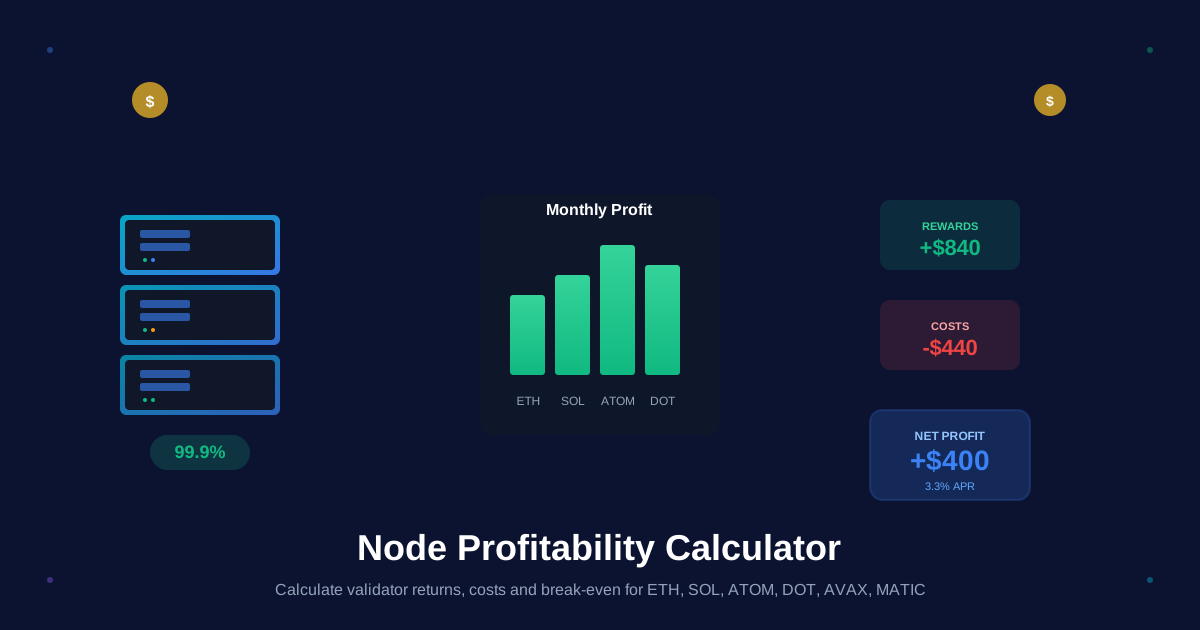
Running a validator node can be one of the most profitable activities in crypto - but is it right for you? This guide will help you calculate if validator node operation makes financial sense compared to liquid staking alternatives.
What is Validator Node Profitability?
Validator node profitability measures the net income from operating a blockchain validator after accounting for:
- Staking rewards: Block rewards and transaction fees earned
- Hardware costs: Initial server setup and depreciation
- Operating expenses: Electricity, internet, maintenance
- Slashing risks: Penalties for downtime or misbehavior
- Uptime requirements: Network penalties for offline periods
Our Node Profitability Calculator helps you model all these factors for Ethereum, Solana, Cosmos, Polkadot, Avalanche, and Polygon validators.
Why Calculate Node Profitability?
1. Break-Even Analysis
Understand how long it takes to recover your hardware investment:
- $2,000 Ethereum validator: ~18 months at 4.2% APR
- $3,500 Solana validator: ~24 months at 7.1% APR
- $1,500 Cosmos validator: ~8 months at 18.5% APR
2. Risk Assessment
Quantify slashing and downtime penalties:
- Ethereum: Slashing can cost 0.5-50 ETH depending on severity
- Solana: Miss rewards during downtime, no slashing
- Cosmos: 0.01% slash for double-signing, 5% for extended downtime
3. Liquid Staking Comparison
Calculate if running your own node beats delegating to Lido or Rocket Pool:
Own Node: 4.2% APR - $150/month costs - slashing risk
Liquid Staking: 3.8% APR - 0% costs - no slashing risk
4. Operating Cost Optimization
Identify cost-saving opportunities:
- Server location with cheap electricity
- Energy-efficient hardware
- Remote monitoring to reduce maintenance
- Redundant internet to maximize uptime
How to Use the Node Profitability Calculator
Step 1: Select Your Network
The calculator supports 6 major Proof-of-Stake networks:
Ethereum (ETH)
- Minimum stake: 32 ETH
- Expected APR: 4.2%
- Hardware cost: ~$2,000
- Electricity: 300W (~$40/month)
Solana (SOL)
- Minimum stake: 5,000 SOL (plus voting costs)
- Expected APR: 7.1%
- Hardware cost: ~$3,500 (higher specs required)
- Electricity: 400W (~$50/month)
Cosmos Hub (ATOM)
- Minimum stake: 1 ATOM (delegated voting power matters)
- Expected APR: 18.5%
- Hardware cost: ~$1,500
- Electricity: 200W (~$25/month)
Polkadot (DOT)
- Minimum stake: 350 DOT
- Expected APR: 10.5%
- Hardware cost: ~$2,500
- Electricity: 250W (~$35/month)
Avalanche (AVAX)
- Minimum stake: 2,000 AVAX
- Expected APR: 8.8%
- Hardware cost: ~$2,000
- Electricity: 300W (~$40/month)
Polygon (MATIC)
- Minimum stake: 1 MATIC (delegated, or ~10,000 for full validator)
- Expected APR: 5.3%
- Hardware cost: ~$1,200
- Electricity: 150W (~$20/month)
Step 2: Enter Staking Details
Token Amount
- Your staked amount (e.g., 32 ETH, 5000 SOL)
- More stake = more rewards, but higher capital requirement
Current Token Price
- Use real-time market price
- Calculator shows how price changes affect profitability
Expected APR
- Network average staking APR
- Check Staking Rewards for current rates
- Consider MEV/tips for Ethereum (adds ~0.5-1% extra)
Step 3: Input Hardware Costs
Initial Hardware Investment Typical costs by network:
- Budget setup ($1,000-1,500): Cosmos, Polygon
- Mid-range ($2,000-2,500): Ethereum, Avalanche
- High-spec ($3,000-4,000): Solana, Polkadot
Hardware Lifespan
- Average server lifespan: 3-5 years
- SSD degradation: Replace every 2-3 years
- Calculator spreads costs over useful life
Step 4: Operating Expenses
Electricity Cost
- Ethereum validator: ~300W = $40/month at $0.12/kWh
- Solana validator: ~400W = $50/month
- Tip: Countries with cheap electricity (Iceland, Paraguay) can save $200-400/year
Internet Cost
- Minimum requirement: 100 Mbps up/down, unlimited data
- Cost: $50-100/month in most countries
- Redundancy: Some validators run dual ISPs for 99.9% uptime
Maintenance
- Self-managed: ~5 hours/month at $50/hour = $250/month
- Managed hosting: $100-300/month
- Remote monitoring tools: $20-50/month
Step 5: Performance & Risk Inputs
Expected Uptime
- 99.9% uptime: Industry standard, few penalties
- 99%: Moderate penalties, reduced rewards
- 95%: Significant reward loss, possible slashing
Network penalties vary:
- Ethereum: Linear reward reduction for offline validators
- Solana: Miss block rewards during downtime
- Cosmos: 0.01% slash after 5% downtime in 10,000 blocks
Slashing Risk Input your estimated annual slashing probability:
- Conservative (0.5%): Well-configured, monitored setup
- Moderate (1%): Standard home validator
- High (2-5%): Experimental setups, poor security
Slashing severity:
- Ethereum: 0.5 ETH (minor) to 16+ ETH (mass slashing event)
- Polkadot: 0.01% to 100% of stake depending on offense
- Cosmos: 0.01% (downtime) to 5% (double-signing)
Understanding the Results
Monthly Profit Breakdown
The calculator shows your net monthly profit after all costs:
Monthly Staking Rewards:    $840
Hardware Depreciation:      -$55
Electricity Cost:           -$40
Internet Cost:              -$60
Maintenance:                -$250
Expected Slashing Loss:     -$35
─────────────────────────────────
Net Monthly Profit:         $400
Annual Metrics
Gross Annual Rewards
- Total rewards before any expenses
- Based on staking amount × APR
Total Annual Costs
- Hardware depreciation over lifespan
- Operating costs (electricity, internet)
- Maintenance and monitoring
Net Annual Profit
- Gross rewards - total costs - expected slashing
- Your actual take-home earnings
Effective APR
- Net profit as % of staked capital
- Accounts for all costs and risks
- Compare this to liquid staking APR
Break-Even Period
- Months to recover initial hardware investment
- Only counts net monthly profit
- Lower is better for capital efficiency
Risk Assessment
The calculator evaluates your setup's risk level:
🟢 Low Risk (Effective APR > 3%)
- Profitable after all costs
- Good uptime and security practices
- Comparable to liquid staking alternatives
🟡 Medium Risk (Effective APR 1-3%)
- Marginal profitability
- Consider optimization or liquid staking
- Monitor costs closely
🔴 High Risk (Effective APR < 1%)
- Barely profitable or losing money
- High costs or poor performance
- Liquid staking likely better option
Liquid Staking Comparison
The calculator compares running your own node to using liquid staking:
Liquid Staking Benefits:
- ✅ No hardware costs
- ✅ No operational headaches
- ✅ No slashing risk
- ✅ Liquid tokens (stETH, rETH, stSOL)
- ✅ No minimum downtime
Liquid Staking Drawbacks:
- ❌ Lower APR (protocol takes 5-10% fee)
- ❌ Smart contract risk
- ❌ Less control over validator selection
- ❌ Token depeg risk
Example Comparison (32 ETH):
Own Node:
+ Gross APR: 4.2%
- Costs: 0.6% (electricity, internet, maintenance)
- Risk: 0.3% (expected slashing)
= Net APR: 3.3%

Lido stETH:
+ Gross APR: 4.2%
- Protocol fee: 0.4%
= Net APR: 3.8%

Verdict: Liquid staking wins by 0.5% APR with zero hassle
6 Real-World Node Profitability Scenarios
Scenario 1: Home Ethereum Validator (Profitable)
Setup:
- 32 ETH staked @ $2,500/ETH = $80,000
- Expected APR: 4.2% + 0.8% MEV tips = 5.0%
- Hardware: $2,000 NUC with 2TB SSD (5-year lifespan)
- Operating costs: $130/month (electricity $40, internet $60, maintenance $30)
Annual Results:
Gross rewards:        $4,000 (5.0% of $80,000)
Hardware depreciation: -$400/year
Operating costs:      -$1,560/year
Expected slashing:    -$200/year (0.5% probability)
─────────────────────────────────
Net annual profit:    $1,840
Effective APR:        2.3%
Break-even:          13 months
Verdict: ✅ Worth it - Beats Lido's 3.8% APR after ~18 months when hardware is depreciated.
Scenario 2: High-Cost Solana Validator (Marginal)
Setup:
- 5,000 SOL staked @ $100/SOL = $500,000
- Expected APR: 7.1%
- Hardware: $3,500 high-spec server (3-year lifespan)
- Operating costs: $340/month (electricity $50, internet $80, hosting $100, maintenance $110)
Annual Results:
Gross rewards:        $35,500 (7.1% of $500,000)
Hardware depreciation: -$1,167/year
Operating costs:      -$4,080/year
Expected slashing:    $0 (Solana has no slashing)
Vote transaction fees: -$5,000/year
─────────────────────────────────
Net annual profit:    $25,253
Effective APR:        5.1%
Break-even:          16 months
Verdict: 🟡 Marginal - Significant costs reduce APR from 7.1% to 5.1%. Liquid staking via Marinade (6.5% APR) might be better unless you value decentralization highly.
Scenario 3: Low-Cost Cosmos Validator (Highly Profitable)
Setup:
- 10,000 ATOM staked @ $10/ATOM = $100,000
- Expected APR: 18.5%
- Hardware: $1,500 budget server (4-year lifespan)
- Operating costs: $95/month (electricity $25, internet $50, maintenance $20)
Annual Results:
Gross rewards:        $18,500 (18.5% of $100,000)
Hardware depreciation: -$375/year
Operating costs:      -$1,140/year
Expected slashing:    -$100/year (1% probability of 1% slash)
─────────────────────────────────
Net annual profit:    $16,885
Effective APR:        16.9%
Break-even:          5 months
Verdict: ✅ Excellent - Low costs + high staking APR = very profitable. Pays off hardware in 5 months.
Scenario 4: Polkadot Validator with High Uptime (Good)
Setup:
- 350 DOT staked @ $7/DOT = $2,450 (minimum)
- Expected APR: 10.5%
- Hardware: $2,500 dedicated server (4-year lifespan)
- Operating costs: $145/month (electricity $35, internet $60, monitoring $50)
- 99.9% uptime (excellent)
Annual Results:
Gross rewards:        $257 (10.5% of $2,450)
Hardware depreciation: -$625/year
Operating costs:      -$1,740/year
Expected slashing:    -$12/year (0.5% probability)
─────────────────────────────────
Net annual profit:    -$2,120
Effective APR:        -86.5%
Break-even:          Never (not profitable)
Verdict: ❌ Unprofitable - Minimum stake is too low to cover costs. Need ~5,000 DOT ($35,000) to break even. Use liquid staking instead.
Scenario 5: Professional Multi-Node Operation (Scalable)
Setup:
- 320 ETH across 10 validators = $800,000
- Expected APR: 4.5% (includes MEV)
- Hardware: $15,000 rack server (5-year lifespan)
- Operating costs: $600/month (electricity $200, internet $100, datacenter $150, maintenance $150)
- Professional monitoring and security
Annual Results:
Gross rewards:        $36,000 (4.5% of $800,000)
Hardware depreciation: -$3,000/year
Operating costs:      -$7,200/year
Expected slashing:    -$1,600/year (0.2% probability due to pro setup)
─────────────────────────────────
Net annual profit:    $24,200
Effective APR:        3.0%
Break-even:          7 months
Verdict: ✅ Good - Economies of scale improve efficiency. Worth the complexity if you're running 5+ validators.
Scenario 6: Avalanche Subnet Validator (High Reward)
Setup:
- 2,000 AVAX staked @ $35/AVAX = $70,000
- Expected APR: 8.8% (C-Chain validator)
- Hardware: $2,000 server (4-year lifespan)
- Operating costs: $140/month (electricity $40, internet $60, maintenance $40)
Annual Results:
Gross rewards:        $6,160 (8.8% of $70,000)
Hardware depreciation: -$500/year
Operating costs:      -$1,680/year
Expected slashing:    -$350/year (0.5% probability)
─────────────────────────────────
Net annual profit:    $3,630
Effective APR:        5.2%
Break-even:          7 months
Verdict: ✅ Profitable - Good balance of rewards and costs. Beats liquid staking alternatives.
When to Run Your Own Node
Run Your Own Node If:
✅ You Have Significant Capital
- 32+ ETH, 5,000+ SOL, or equivalent
- Can absorb hardware costs without stress
✅ You Value Decentralization
- Support network security directly
- Don't trust liquid staking protocols
✅ You Have Technical Skills
- Comfortable with Linux, networking, security
- Can troubleshoot issues quickly
✅ You Have Cheap Resources
- Access to low-cost electricity (<$0.08/kWh)
- Reliable internet with high uptime
- Home office space for hardware
✅ You Want Maximum Control
- Choose your own MEV strategy (Ethereum)
- Select which chains/proposals to validate
- No protocol fees or smart contract risk
Use Liquid Staking If:
✅ You Have Limited Capital
- Less than minimum stake (e.g., <32 ETH)
- Want to start with any amount
✅ You Want Simplicity
- No hardware management
- No uptime monitoring
- No technical expertise required
✅ You Need Liquidity
- Get liquid tokens (stETH, rETH, stSOL)
- Trade or use as collateral while earning
✅ You Don't Want Slashing Risk
- Professional validators manage risk
- Insurance funds cover losses
✅ Your Costs Are High
- Expensive electricity (>$0.15/kWh)
- No reliable internet
- Can't dedicate hardware
Hardware Requirements by Network
Ethereum Validator
Minimum Specs:
- CPU: 4 cores (Intel i5/AMD Ryzen 5)
- RAM: 16GB DDR4
- Storage: 2TB NVMe SSD (grows ~1TB/year)
- Network: 10 Mbps up/down, unlimited data
Recommended Hardware:
- Intel NUC or similar mini-PC: $800-1,200
- Dedicated tower: $1,500-2,500
- Enterprise-grade UPS: $200-400
Popular Options:
- Intel NUC 11 Pro: $900
- Dappnode: $1,200 (plug-and-play)
- Custom build: $1,500
Solana Validator
Minimum Specs:
- CPU: 12 cores (AMD Ryzen 9/Intel i9)
- RAM: 256GB DDR4 (high bandwidth)
- Storage: 2TB NVMe SSD
- Network: 1 Gbps up/down
- GPU: Not required but recommended
Recommended Hardware:
- AMD Ryzen 9 5950X: $500
- 256GB RAM: $800
- 2TB Samsung 980 Pro: $200
- Total: $2,500-4,000
Cosmos Hub Validator
Minimum Specs:
- CPU: 4 cores
- RAM: 8GB
- Storage: 500GB SSD
- Network: 5 Mbps
Recommended:
- Budget VPS: $40-80/month
- Or dedicated server: $1,000-1,500
Polkadot Validator
Minimum Specs:
- CPU: 8 cores (Intel Xeon)
- RAM: 32GB
- Storage: 1TB NVMe SSD
- Network: 100 Mbps
Recommended:
- Bare metal server: $2,000-3,000
- Cloud (AWS/GCP): $200-400/month
Operating Cost Optimization Strategies
1. Choose Location Wisely
Electricity Costs by Country:
- 🟢 Cheap (<$0.05/kWh): Paraguay, Venezuela, Iceland
- 🟡 Moderate ($0.10-0.15/kWh): USA, Canada, France
- 🔴 Expensive (>$0.20/kWh): Germany, UK, Japan
Example Savings (300W Ethereum validator):
- Paraguay ($0.04/kWh): $8.64/month
- USA ($0.12/kWh): $25.92/month
- Germany ($0.32/kWh): $69.12/month
Annual difference: Germany validator pays $720 more than Paraguay!
2. Optimize Hardware
Energy-Efficient Choices:
- Low-power CPU (Intel Atom, ARM): Save 50-100W
- Efficient PSU (80+ Platinum): Save 10-20W
- SSD vs HDD: SSDs use 80% less power
Cost Savings Example:
- Standard setup: 300W = $40/month
- Optimized setup: 180W = $24/month
- Annual savings: $192
3. Home Office Deductions
If you run a validator as a business, potential deductions:
- Electricity: Proportional business use
- Internet: Business percentage
- Equipment: Depreciation deductions
- Home office space: Square footage deduction
Consult a tax professional - rules vary by country!
4. Shared Hosting
Pool resources with other validators:
- Rocket Pool minipool: 16 ETH instead of 32 ETH
- Rocketpool node: Split hardware costs
- Stakehouse: Collaborative validator pools
Benefits:
- Lower capital requirement
- Shared technical expertise
- Better uptime through redundancy
5. Remote Management
Reduce maintenance costs with automation:
- Monitoring tools: Beaconcha.in, Rated.network (free)
- Alerting: Email/SMS for downtime ($10/month)
- Auto-updates: Ansible, Docker Compose (free)
- Remote access: VPN, SSH tunneling (free)
Time savings: Reduce 20 hours/month to 2 hours/month = $900/month saved (if your time is worth $50/hour)
Slashing & Downtime: Risk Management
Understanding Slashing
Slashing is a penalty for validator misbehavior:
Ethereum Slashing Offenses:
- Attester slashing: Contradictory attestations (rare)
- Proposer slashing: Proposing two blocks at same height (very rare)
- Penalty: 0.5 ETH minimum, up to entire stake in coordinated attack
Polkadot Slashing:
- Unresponsiveness: 0.01% of stake
- Equivocation: 0.1% for first offense, increases with severity
- Malicious: Up to 100% of stake
Cosmos Slashing:
- Downtime: 0.01% after extended offline period
- Double-signing: 5% of stake (permanent jailing)
- Threshold: 5% missed blocks in 10,000 block window
Solana:
- ✅ No slashing currently implemented
- Only miss rewards during downtime
Preventing Slashing
Best Practices:
-
Never run duplicate keys
- Most common cause of slashing
- Use doppelganger detection
- Proper failover procedures
-
Maintain high uptime
- 99.9% uptime target
- Redundant internet connections
- UPS for power failures
- Monitoring and alerts
-
Keep software updated
- Security patches
- Consensus updates
- Testing on testnets first
-
Secure key management
- Hardware security modules
- Encrypted backups
- Air-gapped key generation
- Never share private keys
-
Professional setup
- Proper networking (firewall, DDoS protection)
- Isolated environments
- Regular security audits
Calculating Downtime Impact
Example: Ethereum Validator with 95% Uptime
Ideal scenario (100% uptime):
32 ETH × 4.2% APR = 1.344 ETH/year

With 95% uptime:
- 5% of year offline = 18.25 days
- Miss rewards during downtime
- Slight penalty for offline attestations
- Actual rewards: ~1.27 ETH/year (-5.5%)

Effective APR: 3.97% instead of 4.2%
Lesson: Every 1% downtime costs roughly 1-1.5% of annual rewards.
Liquid Staking vs Running Your Own Node
Liquid Staking Protocols
Ethereum:
- Lido (stETH): 3.8% APR, 10% protocol fee, $15B TVL
- Rocket Pool (rETH): 3.85% APR, 15% commission to node operators
- Coinbase (cbETH): 3.3% APR, 25% commission
- Frax (frxETH): 4.0% APR, innovative dual-token model
Solana:
- Marinade (mSOL): 6.5% APR, 9% fee
- Lido (stSOL): 6.3% APR, 10% fee
- Jito (jitoSOL): 7.2% APR, includes MEV rewards
Cosmos:
- Stride (stATOM): 17.5% APR, 10% fee
- pStake: 17.8% APR
- Quicksilver: 18.0% APR
Decision Matrix
| Factor | Own Node | Liquid Staking | |--------|----------|---------------| | APR | 4.2% (ETH) | 3.8% (stETH) | | Hardware Cost | $2,000 | $0 | | Operating Cost | $130/month | $0 | | Technical Skill | High | None | | Minimum Stake | 32 ETH ($80k) | Any amount | | Liquidity | Locked | Liquid token | | Slashing Risk | You bear | Protocol bears | | Decentralization | High | Medium | | Smart Contract Risk | None | Medium |
Break-Even Analysis
Question: At what stake amount does running your own node beat liquid staking?
Ethereum Example:
Own node effective APR: 3.3% (after costs)
Lido APR: 3.8%

Wait, Lido wins?

Not so fast - factor in:
1. Hardware depreciation ends after 3-5 years
2. Electricity savings with efficient hardware
3. MEV tips (extra 0.5-1% APR)
4. No smart contract risk

After year 3:
Own node: 4.0% APR (no more hardware depreciation)
Lido: 3.8% APR

Own node becomes more profitable after hardware is paid off!
Crossover Point:
- Years 1-2: Liquid staking wins (3.8% vs 3.3%)
- Year 3+: Own node wins (4.0% vs 3.8%)
- Decision: If you plan to validate for 3+ years, own node is better
Network-Specific Considerations
Ethereum
Pros:
- Mature ecosystem with excellent tooling
- Predictable rewards (4-5% APR)
- Multiple client options (diversity)
- MEV opportunities for extra income
Cons:
- High minimum stake (32 ETH = $80,000)
- Growing state size (2TB+ storage needed)
- Slashing risk exists
- Hardware requirements increasing
Best For: Long-term believers with capital and technical skills
Solana
Pros:
- High APR (7%+)
- Fast-growing ecosystem
- No slashing (only miss rewards)
Cons:
- Expensive hardware ($3,500+)
- High bandwidth requirements
- Vote transaction costs (~4% of rewards)
- Frequent network updates
Best For: High-capital validators comfortable with bleeding-edge tech
Cosmos Hub
Pros:
- Very high APR (18.5%)
- Low hardware costs ($1,500)
- Mature IBC ecosystem
- Active governance participation
Cons:
- Slashing exists (though rare)
- Must participate in governance
- Commission competition with other validators
Best For: Mid-sized validators wanting high returns
Polkadot
Pros:
- High APR (10%+)
- Parachain opportunities
- Active development
Cons:
- High minimum stake (350 DOT growing)
- Complex nomination system
- Validator slot competition
- Slashing can be severe
Best For: DOT holders with deep technical knowledge
Avalanche
Pros:
- Subnet validator opportunities
- Good APR (8-9%)
- Moderate hardware costs
- Growing DeFi ecosystem
Cons:
- Centralization concerns
- Validator churn
- Uncertain long-term tokenomics
Best For: Validators wanting exposure to subnet growth
Polygon
Pros:
- Low hardware costs
- Ethereum compatibility
- Large user base
Cons:
- Lower APR (5-6%)
- High minimum stake for full validators
- Centralization issues
- Uncertain future with zkEVM transition
Best For: Ethereum developers wanting cheaper validation
Frequently Asked Questions
1. Is running a validator node profitable?
It depends on your costs and stake amount. Generally:
- Profitable: Ethereum with 32+ ETH, Cosmos with 10k+ ATOM, Solana with 10k+ SOL
- Marginal: Small stakes on expensive networks
- Better to delegate: If your hardware + operating costs exceed 1.5% of staked value annually
Use our calculator with your specific numbers to determine profitability.
2. How much does it cost to run a validator node?
Typical costs:
- Hardware: $1,000 (Cosmos) to $4,000 (Solana)
- Electricity: $25-70/month depending on power draw and local rates
- Internet: $50-100/month for reliable unlimited connection
- Maintenance: $50-300/month if you value your time
Total first year: $2,500 to $7,000 depending on network and setup
3. What is the break-even time for validator hardware?
Break-even periods by network (assuming typical costs):
- Cosmos: 5-8 months (high APR, low costs)
- Avalanche: 7-10 months
- Ethereum: 12-24 months (high stake requirement helps)
- Solana: 16-24 months (expensive hardware, high rewards)
- Polkadot: Varies widely by stake size
After break-even, operating costs drop significantly (no more hardware depreciation).
4. Is 99% uptime good enough for a validator?
It depends on the network:
- Ethereum: 99% is acceptable but not ideal. Aim for 99.5%+
- Solana: 99% works but you miss 1% of rewards
- Cosmos: 99% is good - slashing only triggers at 95% uptime
- Polkadot: 99% may not be enough - aim for 99.9%
Each 1% downtime typically costs 1-1.5% of annual rewards.
5. Can I run multiple validators on one machine?
Yes, but consider:
- Resource scaling: Each validator needs CPU/RAM/storage
- Correlation risk: One hardware failure = all validators down
- Slashing correlation: Some networks penalize correlated failures more harshly
Best practice: Run 2-3 validators per machine max, or use separate machines for redundancy.
6. Should I use cloud hosting or run at home?
Cloud (AWS, GCP, Azure):
- ✅ High uptime, redundant internet
- ✅ DDoS protection
- ❌ Expensive ($100-400/month)
- ❌ Centralization concerns
Home:
- ✅ Cheaper long-term
- ✅ More decentralized
- ❌ Uptime depends on your internet/power
- ❌ Technical burden on you
Recommendation: Start at home to save costs. Switch to cloud if uptime is problematic.
7. What are slashing risks by network?
Slashing severity ranking (worst to best):
- Polkadot: Up to 100% slash for malicious behavior
- Cosmos: 5% for double-signing, 0.01% for downtime
- Ethereum: 0.5-50 ETH depending on correlation
- Avalanche: Minimal slashing (mostly uptime penalties)
- Solana: No slashing (only miss rewards)
Most slashing is preventable with proper setup and doppelganger protection.
8. When is liquid staking better than running a node?
Choose liquid staking if:
- You have less than the minimum stake (e.g., <32 ETH)
- Your operating costs would exceed 1.5% APR
- You want liquidity (ability to trade/use the staked asset)
- You lack technical skills or time to manage a validator
- Your electricity costs are high (>$0.15/kWh)
Run your own node if:
- You have 2x+ the minimum stake
- You value decentralization and control
- You have cheap resources (electricity, internet)
- You're technically proficient
- You plan to validate for 3+ years (hardware depreciation breaks even)
9. Do I need to report validator income for taxes?
Yes, in most jurisdictions:
- Staking rewards: Taxable as income when received
- Slashing penalties: May be deductible as business losses
- Hardware costs: Depreciable over useful life
- Operating costs: Deductible business expenses
Treat it like a business: Keep detailed records of all rewards, costs, and slashing events.
Consult a crypto tax professional - rules vary by country!
10. What's the minimum viable stake for profitability?
Approximate minimums to break even:
- Ethereum: 32 ETH (network minimum) - profitable at current prices
- Solana: 10,000 SOL (~$1M) to cover high hardware/bandwidth costs
- Cosmos: 5,000 ATOM (~$50k) to justify $1,500 hardware + time
- Polkadot: 5,000 DOT (~$35k) to overcome costs
- Avalanche: 2,000 AVAX (network minimum) - marginally profitable
- Polygon: 10,000 MATIC (~$10k) to justify hardware
Below these amounts, liquid staking is usually better.
Next Steps
Ready to Calculate Your Profitability?
Use our Node Profitability Calculator to:
- ✅ Model your specific costs and rewards
- ✅ Compare running your own node vs liquid staking
- ✅ Analyze break-even timelines
- ✅ Assess slashing and downtime risks
- ✅ Optimize your validator economics
Learn More About Staking
- Staking Rewards Calculator - Compare liquid staking APRs across protocols
- Impermanent Loss Calculator - Understand liquidity provision risks
- DeFi Yield Farming Optimizer - Find the best yields across 50+ protocols
Resources for Validator Setup
Ethereum:
Solana:
- Solana Validator Docs
- Solana Beach - Validator analytics
Cosmos:
- Cosmos Validator Guide
- Mintscan - Explorer
Polkadot:
Conclusion
Running your own validator node can be highly profitable - but only if your setup makes economic sense.
The key factors:
- ✅ Sufficient capital (2-3x minimum stake)
- ✅ Low operating costs (cheap electricity, included internet)
- ✅ Technical capability (or willingness to learn)
- ✅ Long-term commitment (3+ years to amortize hardware)
If these conditions are met, running your own node beats liquid staking by 0.5-2% APR annually while supporting network decentralization.
If not, liquid staking is the smarter choice - you'll earn competitive yields without the operational burden.
Use our Node Profitability Calculator to make an informed decision based on your specific situation.
Last updated: January 2024
Share this article:
Related Articles
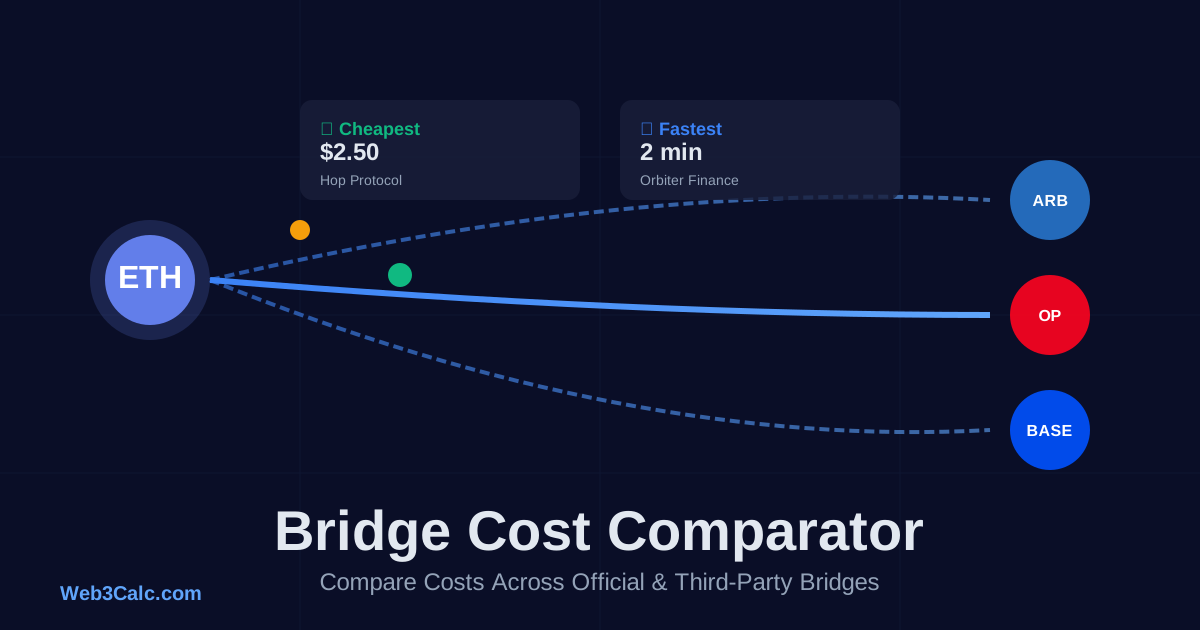
Complete Guide to Crypto Bridge Costs: Compare Fees & Find the Cheapest Route
Learn how to compare crypto bridge costs across official and third-party bridges. Compare Arbitrum, Optimism, Hop, Across, and more. Save money on your cross-chain transfers.

Uniswap V3 Liquidity Mining Guide: Advanced ROI Simulator & Strategy Calculator
# Uniswap V3 Liquidity Mining Guide: Advanced ROI Simulator & Strategy Calculator Uniswap V3 revolutionized DeFi liquidity provision by introducing concentrated liquidity, allowing LPs to earn 4,000...
Portfolio Rebalancing Calculator Guide: Optimize Your Crypto Asset Allocation
# Portfolio Rebalancing Calculator Guide: Optimize Your Crypto Asset Allocation Portfolio rebalancing is one of the most important yet often overlooked aspects of crypto investing. As market prices...